

Key takeaways
- Best all-around concrete demolition: Hilti TE 3000-AVR for demanding commercial work and thick concrete.
- Best high-impact corded option: Makita HM1812 for serious slab, foundation, and roadwork.
- Best portable professional breaker: Bosch GSH 11 VC for walls, floors, tile beds, and moderate concrete removal.
- Best cordless choice: Milwaukee MX FUEL Breaker, model 2718-20, where cords and generators are impractical.
- Best heavy-duty value category: A 60-joule, 15-amp electric breaker with vibration reduction and a 1-1/8-inch hex holder.
The best jackhammers depend on the material, daily workload, lifting tolerance, and available power: choose a 60–70-joule floor breaker for thick reinforced concrete, a 20–30-joule demolition hammer for controlled wall and slab work, or a cordless breaker when mobility matters more than continuous runtime.
Our top picks
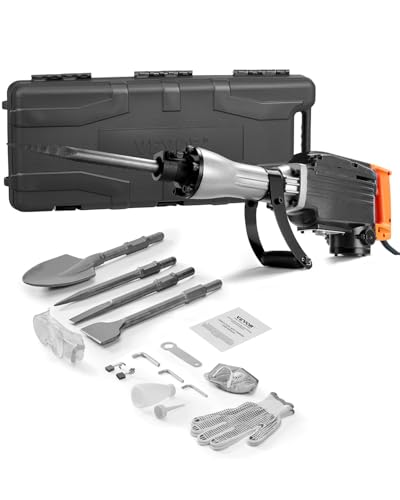


As an Amazon Associate we earn from qualifying purchases at no extra cost to you. Ratings are shown as listed on Amazon.
Best jackhammers by job
- Best all-around concrete demolition: Hilti TE 3000-AVR for demanding commercial work and thick concrete.
- Best high-impact corded option: Makita HM1812 for serious slab, foundation, and roadwork.
- Best portable professional breaker: Bosch GSH 11 VC for walls, floors, tile beds, and moderate concrete removal.
- Best cordless choice: Milwaukee MX FUEL Breaker, model 2718-20, where cords and generators are impractical.
- Best heavy-duty value category: A 60-joule, 15-amp electric breaker with vibration reduction and a 1-1/8-inch hex holder.
A demolition hammer is not automatically better because it has the highest impact-energy figure. Large breakers remove concrete quickly but are difficult to reposition and tiring to control. Smaller tools make cleaner openings and are more useful for overhead, vertical, and indoor work.
Head-to-head comparison
| Model | Impact energy | Stroke rate | Approx. tool weight | Bit system | Power requirement | Best use |
|---|---|---|---|---|---|---|
| Bosch GSH 11 VC | 23 J | 1,025–2,100 bpm | 11.4 kg / 25.1 lb | SDS-max | 1,700 W corded electric | Indoor demolition, floors, masonry, controlled chipping |
| Milwaukee MX FUEL Breaker 2718-20 | About 26.5 J | Up to about 1,300 bpm | About 28.6 kg / 63 lb with operating setup varying by battery | 1-1/8-inch hex | MX FUEL battery platform | Remote sites, utility work, cord-free concrete breaking |
| Makita HM1812 | About 72.8 J | About 1,070 bpm | About 14.2 kg / 31.3 lb | 28 mm hex | 15-amp corded electric | Heavy slab and foundation demolition |
| Hilti TE 3000-AVR | About 68 J | About 1,000 bpm | About 29.9 kg / 66 lb | TE-H hex | Heavy-duty corded electric | Continuous professional concrete removal |
| DeWalt D25980K | About 61 J | About 1,000 bpm | About 30 kg / 66 lb | 1-1/8-inch hex | 15-amp corded electric | Large-scale slab and road demolition |
Published specifications can vary by region and configuration. Impact energy is also measured under different standards, so use the table for selecting a size class rather than treating every joule rating as a laboratory head-to-head result.
How to choose the right size
For tile, mortar, and small concrete repairs
A 10–25-joule SDS-max demolition hammer is usually the more practical choice. Its lower weight makes it easier to hold at an angle, and variable speed helps prevent accidental damage to surrounding masonry. Bosch’s GSH 11 VC represents this category. Fit it with a narrow chisel for a starting groove, then change to a wider clay spade or scaling tool for removal.
For slabs and reinforced concrete
Choose approximately 50–75 joules with a large hex bit system. These breakers transfer substantially more energy per blow and are suited to thick floors, foundations, asphalt, and heavily bonded concrete. The trade-off is fatigue: a 60-pound-plus machine can be difficult to steer, transport, or use on stairs.
For work without reliable electricity
The Milwaukee MX FUEL Breaker eliminates extension cords and can be valuable around roads, unfinished structures, and utility trenches. Battery operation does not mean unlimited runtime. Plan spare charged batteries, a charging location, and a rotation schedule. For uninterrupted production over many hours, a corded breaker or hydraulic/pneumatic equipment may still be more economical.
Impact energy, stroke rate, and real productivity
Impact energy describes how much energy each blow delivers. Higher energy generally breaks thicker concrete faster, but it also increases recoil, noise, bit stress, and the consequences of poor positioning.
Stroke rate is the number of blows per minute. A faster rate can improve work on brittle material and shallow chipping, while a slower, harder blow may be more effective in thick, dense concrete. Do not select a tool from bpm alone; compare energy, bit geometry, and the operator’s ability to keep the tool square.
A simple productivity estimate shows why tool size matters. Suppose a large breaker removes 0.20 cubic meters of concrete per hour and a smaller breaker removes 0.10 cubic meters per hour. For a 1-cubic-meter job, the large machine requires roughly five active hours, while the smaller one requires roughly ten. If the larger tool costs $50 more per rental day but saves five labor hours at a $35 hourly labor rate, the potential labor saving is $175 before transport and fatigue are considered. Actual production varies greatly with reinforcement, access, concrete strength, and operator technique.
Vibration control is a working feature, not a luxury
Anti-vibration systems use isolated handles, spring elements, counterbalance mechanisms, or combinations of these designs. They reduce the vibration reaching the hands and arms, but they do not make a jackhammer harmless or permit unlimited operation.
For frequent use, prioritize a model with a published vibration value, an effective suspended handle, and a service network. Schedule pauses, keep both hands on the tool, and avoid forcing the bit sideways. If the tool begins behaving differently, produces unusual vibration, or the handle feels loose, stop and inspect it. Workplace exposure limits and required controls depend on local regulations and the total time spent operating vibrating equipment.
Bit compatibility and consumable costs
Bit standards are not interchangeable. SDS-max tools accept smaller demolition bits than large 1-1/8-inch, 28 mm, or proprietary heavy hex systems. Confirm the holder before buying a chisel, moil point, asphalt cutter, clay spade, or bushing tool.
- Pointed moil: starts cracks and penetrates dense concrete.
- Flat chisel: splits concrete along a line and removes edges.
- Wide scaling chisel: removes tile adhesive, mortar, and surface material.
- Clay spade: moves loose soil and breaks bonded clay, but is not a substitute for a soil compactor.
- Asphalt cutter: creates narrower, more controlled cuts in paving material.
Bits are consumables. The tip can mushroom, become blunt, or bend when used as a pry bar. Sharpening policies vary by bit type, and some heavy-duty bits are designed for replacement rather than repeated sharpening. Budget for several bits on a large demolition project rather than assuming one chisel will last through the job.
Decision matrix for common buyers
| Situation | Recommended class | Why | What to avoid |
|---|---|---|---|
| Occasional homeowner work | 10–25 J SDS-max hammer | Lower purchase cost, easier handling, useful for floors and masonry | Oversized 60–70 J breakers |
| Weekly contractor use | 20–35 J professional hammer with vibration control | Good balance of portability, productivity, and serviceability | Unbranded tools with unavailable seals and bits |
| Thick slab or foundation | 50–75 J heavy breaker | High energy reduces active breaking time | Low-power tools used as pry bars |
| Remote or cord-sensitive site | Cordless heavy breaker with multiple batteries | No extension cord or generator required | Starting without a runtime and charging plan |
| Frequent daily use | Professional model with AVR and local service | Better control, support, and replacement-part access | Choosing only by lowest purchase price |
Durability and ownership realities
The first parts to wear are commonly the bit, retaining mechanism, brushes on applicable corded designs, seals, power cord, and vibration-isolation components. Dust is especially destructive: it can enter through damaged boots, dirty vents, or neglected couplings. Before each use, inspect the bit shank, retaining collar, housing, cord or battery contacts, and handles.
Clean dust from vents with the method recommended by the manufacturer, keep the tool dry, and lubricate the bit shank only with the specified grease. Do not immerse the tool or use compressed air in a way that drives concrete dust deeper into the housing. Store bits dry and remove them after use so corrosion does not seize the holder.
Common mistakes include leaning heavily on the tool, twisting the barrel to widen a hole, operating with a damaged bit, using an extension cord that is too long or too light, and running a 15-amp breaker from an overloaded circuit. Let the impact mechanism do the work, keep the bit aligned with the intended break, and use a generator or circuit with adequate continuous capacity when mains power is unavailable.
Bottom line
For most indoor demolition and repair work, a 20–25-joule SDS-max hammer is the most versatile choice. For thick concrete and production demolition, step up to a 60–70-joule heavy breaker such as the Hilti TE 3000-AVR, Makita HM1812, or DeWalt D25980K. Choose the Milwaukee MX FUEL Breaker when mobility outweighs unlimited runtime. Whichever class you select, match the bit system, plan for consumables, and treat vibration control and serviceability as core specifications rather than extras.

Write Your Review
No reviews yet. Be the first to share your experience!