

Key takeaways
- The folded height, including the monitor and handle.
- The depth of the base and transport wheels.
- The turning space needed to move it from the exercise area to storage.
The best magnetic rowing machines for home workouts are the NordicTrack RW900 for coached training, the Hydrow Wave for a polished connected experience, the Echelon Row-s for compact interactive workouts, and the Sunny Health & Fitness SF-RW5515 for a lower-cost, quieter basic rower.
Magnetic rowers are usually the best fit for apartments and shared rooms because resistance comes from a magnet moving near a flywheel rather than from a water tank or fan. The trade-off is that inexpensive machines can have shorter rails, lighter frames, simpler monitors, and less convincing resistance at high stroke rates.
Our top picks

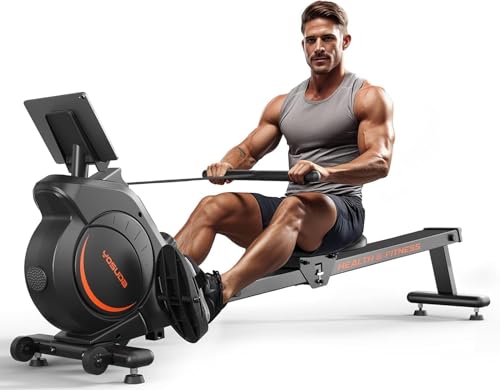


As an Amazon Associate we earn from qualifying purchases at no extra cost to you. Ratings are shown as listed on Amazon.
Best magnetic rowing machines compared
| Model | Resistance range | Rail and machine size | Folded or stored size | User limit | Monitor and noise |
|---|---|---|---|---|---|
| Sunny Health & Fitness SF-RW5515 | 8 magnetic levels | Approximately 48-inch rail; about 77 × 23 × 22.5 inches | Approximately 36.5 × 23 × 53.5 inches | 250 lb | Basic LCD; quiet flywheel with noticeable seat and chain noise |
| Echelon Row-s | 32 electronically controlled levels | Approximately 49-inch rail; about 84 × 21 × 46 inches | Approximately 37 × 21 × 55 inches when stored upright | 300 lb | Large connected display; low flywheel noise, with app subscription normally required for full content |
| NordicTrack RW900 | 26 digitally controlled levels | About 50-inch stroke; approximately 86.5 × 22.4 × 50.4 inches | Folds upward to approximately 36 × 22 × 50 inches | Approx. 250 lb | 22-inch touchscreen on current versions; quiet magnetic system, but screen and motor add complexity |
| Hydrow Wave | Digitally controlled magnetic resistance, with multiple on-screen settings | Approximately 80 × 25 × 45 inches | Designed for upright storage with a separate storage kit or wall solution depending on configuration | 375 lb | 22-inch touchscreen; particularly quiet, with fan and seat movement still audible |
Dimensions and specifications can vary by production year and regional version, so check the manufacturer’s current specification sheet before ordering. The table is most useful for comparing the machines’ relative size and capability rather than treating every measurement as interchangeable.
Best picks by situation
| Your priority | Best match | Why | What to accept |
|---|---|---|---|
| Lowest practical budget | Sunny SF-RW5515 | Simple magnetic resistance and a compact footprint without a large subscription ecosystem | Only eight levels, a basic display, and less frame rigidity for heavy or frequent users |
| Daily coached workouts | NordicTrack RW900 | Many resistance settings, automatic changes during classes, and a large touchscreen | Greater cost, more electronics, and likely ongoing membership expense |
| Quiet premium training | Hydrow Wave | Strong user-capacity rating, quiet magnetic action, and structured on-screen instruction | It is expensive for a machine whose full value depends on connected content and storage planning |
| Interactive training in a smaller room | Echelon Row-s | 32 resistance levels and an upright storage approach with a relatively narrow frame | Confirm tablet or display configuration and subscription requirements before buying |
| Long legs or a long torso | A machine with a 49- to 50-inch stroke | More room to reach forward without bending the knees excessively or shortening the catch | A longer rail needs more clearance, even if the machine folds |
Resistance: eight levels versus 26 or more
Resistance-number comparisons are not perfectly standardized. Level 8 on one rower does not necessarily feel like level 8 on another because flywheel mass, magnet spacing, software, and gearing differ.
An eight-level rower is sufficient for steady aerobic work, technique practice, and moderate intervals. It is less flexible when two people with different fitness levels share the machine. Digitally controlled models with 26 or 32 levels offer smaller adjustments and can change resistance automatically during guided workouts.
Do not confuse a higher resistance setting with better rowing. Rowing power comes primarily from how hard and how quickly you drive through the legs, followed by the torso and arms. A machine that lets you maintain smooth movement at low settings may be more useful than one that feels artificially heavy at its maximum.
Rail length and user fit
Rail length matters more than the folded footprint. A short rail can force a taller user to stop the seat before completing a comfortable stroke. Before buying, measure from the front of the seat at its rearmost position to the handle’s forward position, and compare that with your leg length and preferred technique.
As a practical screening rule, users under about 6 feet will usually have more options. Taller users should prioritize a stated 49- or 50-inch stroke and verify the manufacturer’s height guidance. Also check the footplates: adjustable heel cups and a wide range of strap positions matter if more than one person will row.
Leave at least 24 inches of clearance on each side where possible and enough space behind the machine to move safely. A rower measuring 86 inches long may need a clear area closer to 10 feet long once you account for access and the handle path.
Folding dimensions can be misleading
“Folds for storage” does not mean the machine becomes easy to carry. Most magnetic rowers fold by raising the rail, so the stored unit remains tall and may be difficult to maneuver through a narrow doorway. Check three measurements:
- The folded height, including the monitor and handle.
- The depth of the base and transport wheels.
- The turning space needed to move it from the exercise area to storage.
For an apartment, upright storage is useful only if the ceiling height, wall clearance, and floor surface can support it. Do not lean a heavy machine against an unstable shelf or block an exit. Some premium rowers require an optional wall-mounted storage solution rather than simply standing unattended.
Monitor features that are worth paying for
A basic LCD should show at least elapsed time, strokes per minute, distance, and calories. Bluetooth or ANT+ connectivity is useful if you want to record workouts on a compatible phone, watch, or training app.
A touchscreen becomes valuable when it provides clear pace targets, interval prompts, resistance control, and a reliable way to review progress. It is less valuable if you intend to row without classes. Connected machines can also become less useful if the subscription ends, so confirm whether manual rowing and basic metrics remain available without membership.
For serious training, look for a visible split or pace metric and an interval mode. Calories are estimates and should not be treated as a precise measure of exercise expenditure.
Noise and neighbor-friendliness
Magnetic resistance is quiet, but the entire machine is not silent. The main sounds usually come from the seat rollers, handle return, chain or strap, footplates, and the user’s contact with the floor.
- Use a dense exercise mat to reduce vibration and protect hard flooring.
- Keep the rail clean so dust does not roughen the seat-roller path.
- Return the handle gently instead of allowing it to slam forward.
- Check that the frame and footplates are tight; rattles are often assembly issues rather than motor noise.
For a bedroom or shared-wall apartment, a belt-driven magnetic model generally has a quieter return than a chain-driven budget model. Headphones can conceal flywheel noise, but they will not prevent vibration transmitted through the floor.
Assembly and ownership demands
Expect roughly 45 to 90 minutes for a basic rower and 90 minutes or more for a touchscreen model, depending on the number of frame sections and whether a second person helps hold the rail. The difficult steps are usually attaching the front stabilizer, connecting monitor wiring, routing the strap or chain, and tightening the seat-rail hardware evenly.
Before the first workout, confirm that:
- Every frame bolt is tight without being forced past its specification.
- The seat rolls smoothly from end to end without side-to-side wobble.
- The handle returns under control and does not scrape the housing.
- The foot straps hold the feet while still allowing quick release.
- The monitor reads a stroke only when the handle completes a full movement.
For routine care, wipe sweat from the rail and handle after each session, vacuum around the flywheel and rollers, and inspect bolts monthly if the machine is used several times a week. Seat rollers and straps are common wear items. On chain models, follow the manual’s lubrication schedule; do not spray lubricant into the flywheel or electronics. A squeak that persists after cleaning should be investigated rather than masked, because misaligned rollers can wear the rail.
How to choose based on use frequency
If you row once or twice per week, spending more on a large display may not improve the exercise itself. Prioritize a comfortable seat, a suitable rail, a stable frame, and a monitor that records basic intervals. If you expect five or more sessions per week, pay more attention to the user-weight limit, seat-roller quality, warranty, replacement-part availability, and the rigidity of the rail connection.
As a simple ownership calculation, a $600 rower used three times weekly for three years provides about 468 sessions. That is approximately $1.28 per session before electricity or membership costs. A $1,500 connected rower used five times weekly for three years provides about 780 sessions, or approximately $1.92 per session before subscription fees. The more expensive machine becomes harder to justify if the display or coaching service is rarely used.
Bottom line
Choose the Sunny SF-RW5515 when price and basic quiet cardio matter most. Choose the Echelon Row-s when you want many resistance steps in a relatively compact connected rower. Choose the NordicTrack RW900 for coached workouts with automatic resistance changes. Choose the Hydrow Wave when premium instruction, a high user-capacity rating, and low operating noise outweigh the higher total cost.
Whichever machine you choose, verify the current rail length, folded height, user limit, subscription terms, warranty, and replacement-part policy. Those details have more effect on long-term satisfaction than the number printed on the resistance dial.

Write Your Review
No reviews yet. Be the first to share your experience!