

Key takeaways
- 500–1,000 lumens: steps, small porches, and sheds.
- 1,000–2,000 lumens: entrances, patios, and short walkways.
- 2,000–4,000 lumens: driveways, garage fronts, and broad side yards.
- Over 4,000 lumens: large properties, commercial-style areas, or locations where the light can be carefully aimed to avoid glare.
The best motion sensor flood lights depend on whether you need a bright wired security light, a simple solar fixture for a remote area, or a connected camera light: for most homes, choose a wired LED model with at least 2,000 lumens, a 120–180-degree sensing angle, adjustable detection range, and an outdoor rating of IP65 or better.
Our top picks


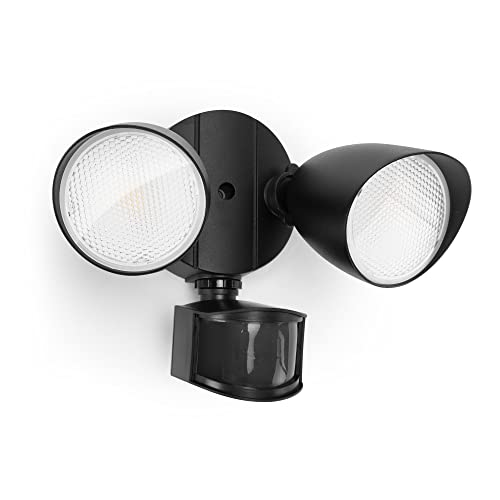
As an Amazon Associate we earn from qualifying purchases at no extra cost to you. Ratings are shown as listed on Amazon.
Quick Picks by Home-Security Situation
| Situation | Best choice | Target specifications | Main trade-off |
|---|---|---|---|
| Driveway or large side yard | Hardwired dual-head LED flood light | 2,000–4,000 lumens; 180-degree sensor; 50–70 ft range | Requires electrical installation |
| Front entry or porch | Compact wired or plug-in LED light | 800–2,000 lumens; 120–180-degree sensor; 20–40 ft range | Less coverage than a large two-head fixture |
| Fence, shed, or remote garden | Solar motion flood light | 400–1,500 lumens; separate solar panel; 20–40 ft range | Brightness and runtime depend on sunlight |
| Security monitoring as well as lighting | Floodlight camera | 1,500–3,000 lumens; adjustable motion zones; app alerts | Higher price and possible subscription costs |
| Budget replacement for an old halogen light | Basic motion-activated LED fixture | 1,500–3,000 lumens; 120-degree sensor; IP65 | Usually fewer controls and no camera |
Best Motion Sensor Flood Lights Compared
Best overall: Hardwired dual-head LED flood light
A hardwired, two-head LED fixture is the strongest all-purpose choice for a driveway, garage approach, or side yard. Look for two independently adjustable heads, a separate motion sensor, and controls for sensitivity, timer duration, and operating mode. A 2,000- to 3,000-lumen output is normally enough for a residential driveway without producing excessive glare.
Hardwired lights provide consistent brightness in winter, during cloudy weather, and after repeated activations. They also avoid the gradual dimming that occurs when a solar light’s battery is partly discharged. The disadvantages are electrical-box compatibility and installation difficulty. If the location does not already have an outdoor-rated junction box and wiring, an electrician may be needed.
Best for wide coverage: Adjustable-head flood light with a 180-degree sensor
A wide-angle sensor is valuable when people can approach from several directions. A 180-degree sensor can cover the path across a driveway or the corner of a house more effectively than a narrow 90-degree sensor. However, sensing angle is not the same as useful detection distance. A sensor may see across a broad arc but detect a person at only 30 or 40 feet.
For a large area, prioritize a model with adjustable range and aimable light heads. Point the heads toward the ground and entry routes rather than directly toward neighboring windows or the street. A 2,500-lumen fixture mounted 8 to 10 feet high can often illuminate a typical driveway, but trees, walls, parked vehicles, and heavy rain can reduce practical coverage.
Best solar option: Solar light with a separate panel and replaceable battery
Solar flood lights are most useful where running cable is expensive or impossible. Choose a unit with a separate panel connected by a weather-resistant cable, rather than a small panel built directly above the lamp. The separate-panel design lets you place the light near the area needing protection and the panel where it receives several hours of direct sun.
Solar output figures can be misleading because some manufacturers quote theoretical LED output rather than sustained brightness. For a useful security light, look for a published battery capacity of roughly 2,000–5,000 mAh, a claimed runtime of at least 6 hours at the selected setting, and a replaceable lithium battery if possible. In practice, repeated winter activations, shade, snow, and short daylight hours can reduce runtime substantially.
A solar model rated at 800 lumens may be adequate above a shed or gate, but it is less likely to match a 2,500-lumen wired fixture over a driveway. Select a higher-output solar unit only when its panel and battery are proportionally larger; a small lamp with an oversized lumen claim may deliver bright flashes but poor sustained illumination.
Best connected option: Floodlight camera
A floodlight camera combines illumination with video, two-way audio, and phone notifications. Ring Floodlight Cam models are a well-known wired example, while Eufy offers floodlight camera models with local-storage options on some products. Check the exact version before buying because resolution, storage, Wi-Fi requirements, and subscription features differ between generations.
Choose a camera light when you need evidence of activity or remote verification, not merely a light that comes on. Camera detection can be affected by Wi-Fi signal strength, privacy-zone settings, moving branches, and reflected headlights. A connected model may also require a cloud subscription for recorded video, so include that recurring cost in the ownership calculation.
Brightness, Detection Range, and Sensing Angle
Lumens describe the amount of light produced, not how evenly the area is illuminated. A narrow, intense beam can create bright spots and deep shadows, while two lower-powered heads may distribute light more effectively. For typical residential use, these ranges are practical starting points:
- 500–1,000 lumens: steps, small porches, and sheds.
- 1,000–2,000 lumens: entrances, patios, and short walkways.
- 2,000–4,000 lumens: driveways, garage fronts, and broad side yards.
- Over 4,000 lumens: large properties, commercial-style areas, or locations where the light can be carefully aimed to avoid glare.
Detection range is usually specified in feet, but moving across the sensor’s field of view is easier to detect than walking directly toward it. For that reason, mount the sensor so approaching traffic crosses its view when possible. Start with a 30- to 50-foot range and reduce sensitivity if it triggers on sidewalks, roads, or neighboring yards.
Weather Resistance and Installation Requirements
For exposed locations, IP65 is a sensible minimum: the fixture is dust-tight and protected against water jets. IP66 provides stronger water-jet protection, while IP44 is better suited to sheltered areas than fully exposed walls. An IP rating does not guarantee resistance to freezing temperatures, ultraviolet exposure, insects, or condensation, so also check the stated operating temperature.
Hardwired flood lights generally require a suitable outdoor junction box, a weatherproof cover or gasket, grounding, and a circuit that can safely support the fixture. Turn off power at the breaker before any work. If you are replacing a fixture but find brittle wiring, an absent ground, water inside the box, or uncertain circuit identification, use a qualified electrician.
Plug-in models are easier to install but need a protected outdoor receptacle with ground-fault protection. Avoid routing an extension cord through a door or window, where it can be pinched and allow water inside. Solar fixtures have the simplest electrical installation, but the panel must be secured against wind and positioned for useful sunlight.
Worked Coverage Example
Suppose a driveway is 40 feet long and 20 feet wide. A light rated for a 50-foot detection range sounds sufficient, but the sensor may cover only a 120-degree sector and the light heads may illuminate unevenly. If the fixture is mounted at one corner, the far end is farther away and partly outside the strongest beam.
A better arrangement is to mount a 2,000- to 3,000-lumen dual-head light near the garage, aim one head toward the driveway and the other toward the side path, and set the sensor to approximately 40 feet. This uses the published range with a margin rather than depending on its maximum claim. If the driveway is approached from the side, orient the sensor so people cross its field of view instead of walking directly toward it.
Ownership Realities and Common Mistakes
- False triggers: Motion sensors can react to tree branches, small animals, hot exhaust, and passing cars. Lower sensitivity, narrow the detection area, or reposition the unit before assuming it is defective.
- Premature battery wear: Solar batteries commonly lose capacity before the LED itself fails. Frequent night-time activation accelerates this, so choose a replaceable battery where possible.
- Dirty panels and lenses: Dust, pollen, snow, and insect residue reduce solar charging and light output. Clean the panel and lens with a damp, soft cloth every few months.
- Water intrusion: Missing gaskets, loose cable glands, and poorly sealed junction boxes are frequent failure points. Inspect seals after severe weather and do not drill extra holes in the housing.
- Incorrect aiming: Pointing a bright light at eye level creates glare and can make nearby areas harder to see. Aim down toward paths and ground-level approach routes.
- Short timer settings: A 10-second setting may turn off before someone reaches the door. Start around 60 seconds, then adjust to balance convenience and energy use.
Final Buying Recommendation
For dependable home security, choose a hardwired LED flood light producing about 2,000–3,000 lumens, with adjustable heads, a 120- to 180-degree sensor, a 30- to 50-foot detection range, and an IP65 or better enclosure. Choose solar when wiring is impractical and the location receives reliable sunlight. Choose a floodlight camera when recorded evidence and remote alerts matter more than simple illumination. The best motion sensor flood lights are not necessarily the brightest models; they are the ones whose coverage, power source, weather protection, and controls match the exact approach route you need to watch.

Write Your Review
No reviews yet. Be the first to share your experience!