

Key takeaways
- Storage: Confirm the maximum supported drive size and whether the manufacturer restricts drive models. Larger drives are often the simplest future upgrade.
- Memory: Replaceable RAM extends useful life for containers and indexing, but compatibility matters more than maximum capacity.
- Networking: A built-in 2.5GbE port is convenient; an expansion slot is more flexible if you may later need 10GbE.
- Expansion: Some four-bay systems accept an expansion enclosure, but expansion hardware can cost as much as a second NAS. Buy enough bays initially if your data growth is predictable.
- Cache: NVMe cache can improve repeated metadata-heavy workloads, but it will not make a gigabit network transfer at multi-gigabit speeds. More RAM and faster networking are often better first upgrades.
The best NAS devices for most homes in 2026 are the Synology DS224+ for simple two-drive storage, the QNAP TS-264 for stronger hardware and media work, and the Synology DS923+ or QNAP TS-464 when four drive bays and future expansion matter more than the lowest price.
Our top picks


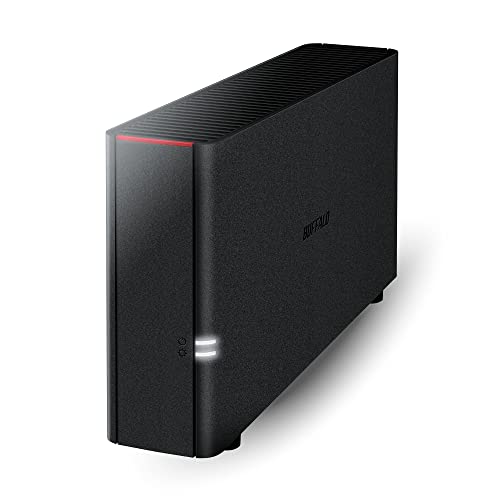
As an Amazon Associate we earn from qualifying purchases at no extra cost to you. Ratings are shown as listed on Amazon.
Choose by situation first
| Situation | Best fit | Why | Typical enclosure price |
|---|---|---|---|
| First NAS, documents and laptop backups | Synology DS224+ | Two bays, simple software, 2.5GbE, and an easy upgrade path to larger drives | About $250–$350 without drives |
| Home media server and several simultaneous users | QNAP TS-264 | Intel Celeron N5095, 8GB RAM, dual 2.5GbE, and hardware video-transcoding support | About $350–$500 without drives |
| Photos, computers, and a growing family archive | Synology DS923+ | Four bays, ECC memory, Btrfs snapshots, and optional 10GbE | About $550–$700 without drives |
| Four-drive performance at a moderate cost | QNAP TS-464 | Four bays, 8GB RAM, dual 2.5GbE, and two M.2 NVMe slots | About $500–$650 without drives |
| Maximum expansion in a compact home system | Five-bay or six-bay NAS | More usable capacity and better RAID flexibility than a two-bay enclosure | About $600–$1,000 without drives |
What matters more than the bay count
Drive bays and usable capacity
A two-bay NAS is inexpensive and compact, but RAID 1 uses half of the raw capacity for redundancy. Two 8TB drives therefore provide roughly 8TB of usable space before formatting and filesystem overhead. A four-bay NAS gives you more choices: RAID 5 uses the equivalent of one drive for parity, so four 8TB drives provide approximately 24TB raw usable capacity; RAID 6 uses two drives for parity and provides approximately 16TB.
RAID is not a backup. It helps keep data available when a drive fails, but it does not protect against accidental deletion, ransomware, theft, fire, or a corrupted file being synchronized everywhere. Choose two bays for ordinary backups and documents; choose four or more bays if you expect a large photo library, video collection, surveillance recordings, or several years of growth.
CPU and RAM
Entry-level NAS devices usually have ARM processors or modest Intel chips and 2GB to 4GB of memory. They are adequate for file sharing, automated computer backups, and photo storage. Intel-based models such as the QNAP TS-264 and TS-464 are more capable for indexing, containers, and media services.
Memory matters when several services run together. A practical minimum is 2GB to 4GB for a basic NAS, 8GB for a mixed-use home server, and 16GB or more for virtual machines, multiple containers, or heavy database applications. Check whether RAM is replaceable before buying: some compact models have soldered memory, while others accept a module. Do not assume that an advertised maximum is supported with every memory configuration; verify the manufacturer’s compatibility list.
Network speed
Gigabit Ethernet tops out at about 125MB/s in ideal conditions, which is enough for backups and ordinary document access. A 2.5GbE port can theoretically reach about 312MB/s, but the NAS, computer, switch, cables, and storage must all support the faster link. A 10GbE upgrade is useful for large video projects or multiple high-speed workstations, not merely because it sounds faster.
For a home with a gigabit router, a 2.5GbE NAS will still work normally. It becomes valuable when you later replace the router or add a multi-gigabit switch. Link aggregation is not a substitute for a faster single connection: it can benefit multiple clients, but one client may remain limited to one link.
Head-to-head: Synology DS224+ versus QNAP TS-264
The DS224+ is the easier recommendation for a first NAS. Synology DiskStation Manager has a polished backup workflow, clear storage-health alerts, and straightforward tools for file synchronization, photos, and remote access. Its two bays support Synology Hybrid RAID, RAID 1, and basic/JBOD configurations. The limitation is hardware: it has 2GB of memory, a dual-core Intel Celeron J4125, and one 1GbE port plus one 1GbE port rather than a built-in 2.5GbE interface.
The TS-264 is the better choice when performance and flexibility are priorities. It uses an Intel Celeron N5095, normally includes 8GB of memory, provides two 2.5GbE ports, and includes M.2 NVMe slots for cache or storage depending on the configuration. QNAP’s software exposes more advanced options, which can be useful but may require more learning. Its two-drive RAID 1 layout has the same capacity trade-off as the DS224+.
Choose Synology when you want the least complicated administration. Choose QNAP when you expect faster networking, containers, hardware-assisted media work, or more experimentation.
Four-bay choices: DS923+ versus TS-464
The Synology DS923+ is aimed at storage-first buyers. It has four drive bays, ECC memory, Btrfs support, snapshots, and an optional 10GbE network upgrade. Synology Hybrid RAID makes it convenient to combine drives of different sizes while retaining redundancy, although matched drives are easier to plan and replace. Its AMD Ryzen R1600 processor is strong for file services but lacks the integrated graphics found in some Intel models, so it is not the obvious choice for frequent hardware video transcoding.
The QNAP TS-464 is more attractive for media and applications. Its Intel Celeron N5095 includes integrated graphics for supported transcoding workloads, and the enclosure includes dual 2.5GbE networking and two M.2 slots. QNAP’s QuTS hero option may offer ZFS-based features on supported models, but it generally requires more memory and administration than a basic QTS setup.
For a quiet household archive, the DS923+ is a strong long-term platform. For a home lab or media-focused system, the TS-464 offers more hardware flexibility.
Backup tools and a safe setup
- Install two or more NAS-rated hard drives and update the NAS firmware before copying important data.
- Create a redundant storage pool. Use RAID 1 for two drives, or RAID 5/SHR for four drives when one-drive failure protection is sufficient.
- Create separate shared folders for documents, photos, media, and computer backups. This makes permissions and retention policies easier to manage.
- Enable scheduled computer backups. Synology Active Backup for Business and Hyper Backup cover common backup and replication tasks; QNAP offers HBS 3, Hybrid Backup Sync, for local, external, and cloud targets.
- Keep a second copy on an external USB drive or a reputable cloud-storage service. For important files, keep at least one copy disconnected or protected by immutable retention.
- Turn on two-factor authentication, automatic security updates where appropriate, and notifications for failed drives, unusual login attempts, and backup errors.
- Test restoration. A backup that has never been restored is only an assumption. Open several files and perform a full recovery test at least twice a year.
Noise, power, and ownership costs
The hard drives usually make more noise than the NAS enclosure. A two-bay system with two 3.5-inch drives commonly consumes about 15–30 watts while active and less while idle, while a four-bay system commonly uses about 25–50 watts depending on drives, expansion cards, and workload. Fan speed, room temperature, drive vibration, and standby settings can change those figures substantially.
At an average 30 watts, continuous operation uses 262.8 kilowatt-hours per year. At $0.20 per kWh, that is about $53 annually before adding drives, a UPS, or cloud services. Scheduled drive hibernation can reduce energy use, but frequent spin-up and spin-down may add wear and delay access. If the NAS is holding irreplaceable files, reliability is usually a better priority than chasing the smallest possible electricity bill.
Hard drives are the first major consumable. Monitor SMART warnings, temperature, bad-sector counts, and reallocated sectors, and replace a questionable drive before it fails completely. Keep ventilation clear, avoid placing the unit inside a closed cabinet, and use a small uninterruptible power supply if brief outages or brownouts are common. A UPS gives the NAS time to shut down cleanly; it does not replace a backup.
Upgrade paths to check before buying
- Storage: Confirm the maximum supported drive size and whether the manufacturer restricts drive models. Larger drives are often the simplest future upgrade.
- Memory: Replaceable RAM extends useful life for containers and indexing, but compatibility matters more than maximum capacity.
- Networking: A built-in 2.5GbE port is convenient; an expansion slot is more flexible if you may later need 10GbE.
- Expansion: Some four-bay systems accept an expansion enclosure, but expansion hardware can cost as much as a second NAS. Buy enough bays initially if your data growth is predictable.
- Cache: NVMe cache can improve repeated metadata-heavy workloads, but it will not make a gigabit network transfer at multi-gigabit speeds. More RAM and faster networking are often better first upgrades.
Bottom line
Buy a two-bay NAS if you need centralized files and automated backups at the lowest entry cost, choosing the DS224+ for simplicity or the TS-264 for faster networking and applications. Choose a four-bay NAS if replacing the entire enclosure in two years would be inconvenient; the DS923+ favors organized long-term storage, while the TS-464 favors media and home-lab flexibility. Whatever you choose, budget for hard drives, a UPS, and a second backup destination—the enclosure is only one part of a dependable storage system.


Write Your Review
No reviews yet. Be the first to share your experience!