

Key takeaways
- Compare the best inversion tables for degenerative disc disease, with gentle angle control, secure ankle systems, capacities and height ranges explained.
- Top Pick: Teeter FitSpine X1 Inversion Table
- Runner-up: Teeter EP-560 Ltd. Inversion Table
- Also consider: Innova ITX9700 Inversion Table
Degenerative disc disease describes the gradual loss of height and hydration in the spinal discs that comes with age and wear. As a disc thins, the space between the vertebrae narrows and pressure on the surrounding nerves and facet joints can build. Inversion therapy approaches that problem mechanically: by tilting the body head-down at a controlled angle, gravity gently stretches the spine, which can temporarily open the disc space and relieve pressure while you are on the table.
For this condition, the best inversion table is not the one that flips you the furthest. It is the one that lets you hold a mild, repeatable angle comfortably and safely, session after session. That means precise angle control, an ankle system that does not become the limiting factor, a backrest you can relax against for several minutes, and a frame rated comfortably above your body weight. The five tables below run from premium FDA-registered models to a budget pick.
As an Amazon Associate, we earn from qualifying purchases.
Table of Contents
- Why Angle Control Matters More Than Full Inversion
- How to Choose an Inversion Table for Degenerative Disc Disease
- Teeter FitSpine X1 Inversion Table
- Teeter EP-560 Ltd. Inversion Table
- IRONMAN Gravity 4000 Inversion Table
- Innova ITX9700 Inversion Table
- Innova ITX9688 Inversion Table
- Safety Notes Before You Invert
- Frequently Asked Questions
- Conclusion
- Product and ASIN Reference
Why Angle Control Matters More Than Full Inversion
Most of the decompression benefit of inversion happens well before you reach a fully vertical hang. At a shallow angle of roughly 20 to 30 degrees, the spine is already under meaningful traction, and many people with disc problems find a partial angle held for a few minutes more comfortable and easier to repeat daily than a short burst at full inversion. Going deeper increases pressure in the head and eyes and makes the ankle hold far more demanding, which is why gradual progression is the usual advice.
That is why this roundup favors tables with graduated control: preset pin positions, a tether strap, or precision balancing that responds to arm movement. The right tool is one that makes 20, 30, and 45 degrees feel secure and repeatable, because consistency over weeks is what a home traction routine is built on.
How to Choose an Inversion Table for Degenerative Disc Disease
Angle control system. Look for a way to limit and repeat your angle. Innova uses a six-position pin system with a protective cover, Teeter relies on precision balancing with an optional tether strap, and IRONMAN uses a tether strap with three starting pivot positions. All three approaches work; the pin system is the most foolproof for beginners because the maximum angle is set before you get on.
Ankle comfort. At partial angles your full weight is not hanging from your ankles, but the holders still carry the load. Wrap-around cups and reversible or extended-release systems matter if ankle pressure has stopped your sessions before, and an extended release handle helps if bending to reach your ankles is difficult because of your back.
Backrest design. You will spend several minutes lying still, so the bed matters. FlexTech beds flex with your body, memory foam pads cushion bony points, and adjustable lumbar pads or bridges let you support the exact segment that is degenerating.
Capacity and height range. Choose a table rated well above your body weight so the frame works in the middle of its range, not at its limit. Every table here fits users from about 4 feet 10 inches (4 feet 8 inches for Teeter) up to 6 feet 6 inches, and capacities run from 300 to 350 pounds.
Certification and frame quality. Teeter tables are UL safety certified and registered with the FDA as Class 1 medical devices, with degenerative disc disease among the indicated conditions in Teeter’s published listing. Other brands do not carry that registration, which does not make them unsafe, but it does mean you should weigh frame construction and warranty length more heavily.
Storage and weight. Inversion tables are large. Folded dimensions and item weight decide whether the table lives in a corner or becomes permanent furniture. The slimmest folders here fold to roughly 20 inches deep, but at 55 to 75 pounds, none of them is something you will want to move far every day.
Teeter FitSpine X1 Inversion Table

The FitSpine X1 is the entry point to Teeter’s current line and the strongest overall match for degenerative disc disease, mainly because of its certification and its backrest. Teeter lists its tables as FDA-registered Class 1 medical devices, and degenerative disc disease is one of the indicated conditions named in the listing, alongside herniated disc, sciatica, and spinal stenosis. The table is also UL safety certified, a third-party check none of the budget brands match.
The FlexTech bed is the other reason it leads this list. Instead of a rigid board, the backrest flexes on an eight-point suspension, so it moves with you as you stretch, and the surface encourages the body slide that deepens decompression. The included acupressure nodes can be placed in slots along the bed to press into tight spots, and the adjustable lumbar bridge adds support in the lower back, where most disc degeneration sits. Rotation is precision-balanced: shifting your arms controls the angle, so you can park at a mild tilt without fighting the table.
The trade-off is the ankle system: the X1 uses Teeter’s standard Ergo-Embrace supports, which are comfortable, but it lacks the extended reach handle of the higher FitSpine models, so you bend further to lock in.
Specs
- Weight capacity: 300 lb
- User height range: 4 ft 8 in to 6 ft 6 in
- Backrest: FlexTech flexible bed with acupressure nodes and adjustable lumbar bridge
- Ankle system: Ergo-Embrace supports
- Certification: UL safety certified, FDA-registered Class 1 medical device
- Folded dimensions: 20 x 28.8 x 66 in
- Warranty: 5 years
Teeter EP-560 Ltd. Inversion Table

The EP-560 Ltd. is Teeter’s earlier-generation design and remains a sensible premium alternative if you prefer a firm, track-style bed to the flexible FitSpine surface. It carries the same credentials that matter for this condition: UL safety certification and FDA registration as a Class 1 medical device, with degenerative disc disease again among the indicated conditions in Teeter’s published copy.
Its ComforTrak backrest is a rigid bed with a surface designed to maximize body slide during inversion, and it accepts the same family of accessories, including acupressure nodes and a lumbar bridge, through integrated slots. The Ergo-Embrace ankle supports wrap the ankle and distribute pressure over a wider area than basic foam rollers, and the frame is heat-treated steel. Height adjustment runs from 4 feet 8 inches to 6 feet 6 inches, and the 300-pound capacity matches the FitSpine X1.
Where it gives ground to the X1 is the bed feel: the ComforTrak surface does not flex, so longer low-angle sessions feel firmer. This is also an older model line, so check the listing carefully to confirm the current EP-560 Ltd. configuration rather than a leftover variant.
Specs
- Weight capacity: 300 lb
- User height range: 4 ft 8 in to 6 ft 6 in
- Backrest: ComforTrak rigid bed with accessory slots
- Ankle system: Ergo-Embrace supports
- Frame: heat-treated steel
- Certification: UL safety certified, FDA-registered Class 1 medical device
- Item weight: 60 lb
- Warranty: 5 years
IRONMAN Gravity 4000 Inversion Table
The Gravity 4000 is the pick for heavier users and for anyone who wants a thick, simple, heavily padded table. Its 350-pound capacity is the highest in this roundup, and the tubular steel frame is built around that rating. The memory foam backrest is covered in vinyl, and a removable lumbar pillow lets you add support under the lower back or take it away, which is a genuinely useful adjustment when the affected disc level changes how your back feels from day to day.
Angle control is by tether strap, with three pivot-arm starting positions that change how responsive the rotation feels. It is less precise than a pin system, but for mild angles, setting the strap short and staying shallow is easy to repeat. The ankle lock is a palm-activated ratchet, so you press to tighten rather than pulling a pin, and the extra-long handles give you something solid to pull on when returning upright.
At 75 pounds it is the heaviest table here, and the warranty is short: one year on the frame and 90 days on parts. It folds to a fairly slim profile for its size, but plan its home rather than expecting to move it daily.
Specs
- Weight capacity: 350 lb
- User height range: 4 ft 10 in to 6 ft 6 in
- Backrest: memory foam with removable lumbar pillow
- Ankle system: palm-activated ratchet lock, ergonomic molded cushions
- Angle control: tether strap, three pivot positions, inverts up to 180 degrees
- Assembled dimensions: 49 x 26 x 65 in
- Item weight: 75 lb
- Warranty: 1 year frame, 90 days parts
Innova ITX9700 Inversion Table
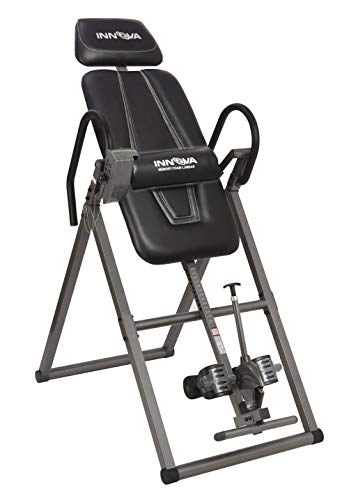
The ITX9700 is Innova’s comfort-focused model and the mid-range pick for readers who find firm beds aggravating. Its distinguishing feature is an adjustable memory foam lumbar pad built into a large padded backrest, so the support under the degenerating segment is shaped and cushioned rather than a loose pillow. An adjustable headrest completes the padding story, and together they make the ITX9700 the easiest table here to relax on for the longer, low-angle sessions that suit disc routines.
Underneath, it uses Innova’s familiar six-position adjustable pin system with a patented protective cover, which sets your maximum angle before you mount and removes guesswork from session to session. The ergonomic ankle holders use a larger front holder and a smaller rear holder to spread pressure, and the True Balance system combines height and headrest adjustments so the table rotates smoothly once dialed in.
Capacity is 300 pounds, the height range matches the other Innova, and the warranty is one year. If your main complaint with inversion has been comfort rather than control, this is the Innova to choose.
Specs
- Weight capacity: 300 lb
- User height range: 4 ft 10 in to 6 ft 6 in
- Backrest: large padded backrest with adjustable memory foam lumbar pad
- Ankle system: ergonomic holders, large front and smaller rear
- Angle control: six-position pin system with protective cover
- Assembled dimensions: 46 x 28 x 63 in
- Item weight: 55 lb
- Warranty: 1 year
Innova ITX9688 Inversion Table

The ITX9688 is the budget pick, and for degenerative disc disease its simplicity is a virtue. The six-position pin system with its patented protective cover gives you the same repeatable, pre-set angle control as the ITX9700, the single most important feature for a careful home routine, at the lowest cost in this roundup.
The reversible ankle holders can be swapped front to back to change the pressure distribution, and the extended ankle release knob on current versions is easier to reach than the short lever on earlier production, which matters when bending is the movement you are trying to avoid. The large padded backrest has an adjustable headrest, and the True Balance system ties the height setting to the headrest position so rotation stays predictable. There is no lumbar pad system here; if your degeneration is lumbar and you want targeted cushioning, the ITX9700 above is the better Innova.
It is rated for 300 pounds and users from 4 feet 10 inches to 6 feet 6 inches, weighs about 60 pounds assembled, and carries a one-year warranty. As a first table bought to find out whether regular inversion agrees with your back, it is the lowest-risk way in.
Specs
- Weight capacity: 300 lb
- User height range: 4 ft 10 in to 6 ft 6 in
- Backrest: large padded backrest with adjustable headrest
- Ankle system: reversible ergonomic holders, extended release knob
- Angle control: six-position pin system with protective cover
- Assembled dimensions: 46 x 28 x 62 in
- Item weight: 60 lb
- Warranty: 1 year
Safety Notes Before You Invert
Inversion is not appropriate for everyone, and degenerative disc disease often travels with other conditions. Published manufacturer guidance lists high blood pressure, glaucoma and other eye conditions, heart disease, pregnancy, recent spinal surgery or fracture, osteoporosis, hernia, and middle-ear infection among the reasons to avoid inversion or to clear it with a physician first. If you take blood pressure medication or have any history of stroke, treat medical clearance as a requirement, not a courtesy.
Start at a shallow angle, around 20 degrees, for one or two minutes, and increase angle and duration gradually over days. Stop if you feel sharp pain, dizziness, or pressure symptoms rather than mild stretching. Inversion temporarily relieves disc pressure while you are on the table; it does not repair a degenerated disc, and it works best alongside movement, strengthening, and your clinician’s advice.
Frequently Asked Questions
Can an inversion table cure degenerative disc disease?
No. Degenerative disc disease is a structural, age-related change in the discs, and no table reverses it. Inversion applies gentle traction that can temporarily increase the space between vertebrae and reduce pressure on nerves while you are inverted, which is why people use it for symptom relief. Think of it as management, not a cure, and keep your clinician involved in the plan.
What inversion angle is best for degenerative disc disease?
Most people with disc problems do best starting around 20 to 30 degrees. At that angle the spine is already under useful traction, but pressure in the head and eyes stays modest and the ankle load is light. Increase the angle gradually over sessions only if the shallow angles feel comfortable and helpful. Full inversion is not required for disc decompression and is not the goal for most degenerative disc routines.
How often should you use an inversion table for degenerative disc disease?
Short, regular sessions are the usual pattern: a few minutes once or twice a day is a common starting point in manufacturer guidance, building duration only as comfort allows. Consistency matters more than intensity. If a session leaves you sore for hours afterward, reduce the angle or duration rather than pushing through.
Who should not use an inversion table?
People with uncontrolled high blood pressure, glaucoma, retinal conditions, heart disease, a history of stroke, osteoporosis, a recent fracture or spinal surgery, a hernia, or who are pregnant should avoid inversion unless a physician specifically clears it. The same caution applies if you use blood thinners or blood pressure medication. When in doubt, ask first; the tables will still be there after the appointment.
Conclusion
For degenerative disc disease, buy control and comfort before anything else. The Teeter FitSpine X1 pairs FDA registration and UL certification with the most accommodating backrest here, making it the best overall choice. The Teeter EP-560 Ltd. offers the same credentials with a firmer bed. The IRONMAN Gravity 4000 serves heavier users with its 350-pound rating and thick memory foam, while the Innova ITX9700 builds its routine around a shaped memory foam lumbar pad, and the Innova ITX9688 delivers the essential pin-controlled angles at a budget tier. Clear the routine with your clinician before your first session.
More from Amazon
Programs that pair well with the guide above. Offers and eligibility are set by Amazon and may change.
Collect the home and kitchen items you want in one registry that guests can shop from.
Create a wedding registrySet up recurring deliveries of everyday items on eligible products. Terms and savings are set by Amazon.
Explore Subscribe & SaveFree shipping on eligible items, Prime Video and more. Eligible new members can start with a free trial.
Start a Prime free trialAudiobooks and podcasts to listen to on the go. Eligible new members can start with a free trial.
Try Audible freeAs an Amazon Associate we earn from qualifying purchases.




Write Your Review
No reviews yet. Be the first to share your experience!