

Key takeaways
- Compare the best neck stretchers from RESTCLOUD, ZAMAT, Fanlecy, Lumia Wellness and Cozyhealth by firmness, curve design, session time and heat.
- Top Pick: RESTCLOUD Neck and Shoulder Relaxer
- Runner-up: ZAMAT Neck and Shoulder Relaxer
- Also consider: Fanlecy Neck and Shoulder Relaxer
The best neck stretcher for most people is a simple lie-down foam cradle: you rest the back of your neck on its curve for about ten minutes and let the weight of your head create a gentle stretch that supports the natural C-shaped curve of the cervical spine. The RESTCLOUD Neck and Shoulder Relaxer is the default pick in this category thanks to its wave shape and two usable heights, while the Lumia Wellness block suits anyone who wants a firmer, more targeted orthotic, and the Cozyhealth model adds USB-powered heat. Below, five foam neck stretchers are compared on the published specs that matter: material, curve design, session time, and extras.
As an Amazon Associate, we earn from qualifying purchases.
Table of Contents
- How to Choose a Neck Stretcher
- 1. RESTCLOUD Neck and Shoulder Relaxer
- 2. ZAMAT Neck and Shoulder Relaxer
- 3. Fanlecy Neck and Shoulder Relaxer
- 4. Lumia Wellness Cervical Orthotic Traction Block
- 5. Cozyhealth Heated Neck Stretcher
- How to Use a Neck Stretcher Safely
- Frequently Asked Questions
- Conclusion
- Product and ASIN Reference
How to Choose a Neck Stretcher
Every pick in this guide is the same basic product type: a molded foam device you lie on, with no straps, pumps, weights, or door anchors. That separates neck stretchers from over-the-door traction kits, inflatable collars, and hanging neck hammocks, which apply force in different ways and are covered in other guides on this site. Within the foam category, four spec areas separate the models.
Foam density and firmness. Most relaxers use polyurethane or self-skinning foam with a medium-firm feel. A softer cradle is easier to tolerate as a beginner, while a firm block such as the Lumia presses a stronger curve into one section of the neck. Firmness is the single biggest comfort variable, and every maker notes an adjustment period of a week or two.
Curve shape and adjustability. Wave-shaped cradles support the whole cervical curve at once and often have two height sides, so flipping the device changes the intensity. Block designs concentrate the apex on one spot and let you move it between the upper neck, middle neck, and lower neck. Massage nodes and extended tails, as on the Fanlecy, add trigger-point pressure down into the upper back.
Session time. These are short-session tools, not pillows. Published guidance clusters around ten minutes per session, with daily caps ranging from twenty to thirty minutes depending on the model. None of the five is meant for overnight sleeping.
Extras. Covers, magnetic therapy cloth, and heat are the main add-ons. The ZAMAT ships with a magnetic therapy pillowcase, and the Cozyhealth pairs its foam cradle with a graphene heating pad powered over USB. Extras do not change the underlying stretch, so choose them only if you will actually use them.
1. RESTCLOUD Neck and Shoulder Relaxer

The RESTCLOUD is the reference design for this category and the safest first purchase for desk workers with postural neck stiffness. Its wave-shaped polyurethane foam cradle supports the cervical curve in three directions at once: vertical support under the neck, horizontal support across the shoulders, and a curvature stretch as the head settles back. Six raised massage nodes sit along the contact surface, and the wave profile gives you two height sides, so rotating the device end to end changes how deep the stretch feels.
RESTCLOUD publishes a clear protocol: ten minutes per session, no more than thirty minutes a day, on a hard flat surface such as a floor or yoga mat. The brand is equally clear that the relaxer is not an ordinary pillow and should never be used for a full night of sleep. Slight discomfort in the first sessions is normal, and the maker suggests most people settle into the fit within one to two weeks. As a budget-tier, one-piece foam tool with no cover to wash and nothing to assemble, it is the simplest routine to maintain.
Specs:
- Type: Wave-shaped foam neck cradle (lie-down)
- Material: Polyurethane memory foam, medium firmness
- Dimensions: 8.66 x 6.69 x 4.72 inches
- Weight: 10.01 ounces
- Design features: Two height sides, V-shaped curvature, 6 massage nodes
- Session guidance: 10 minutes per session, up to 30 minutes per day
- Surface: Hard flat surfaces and yoga mats; not for overnight sleep
- Color listed: Black
2. ZAMAT Neck and Shoulder Relaxer
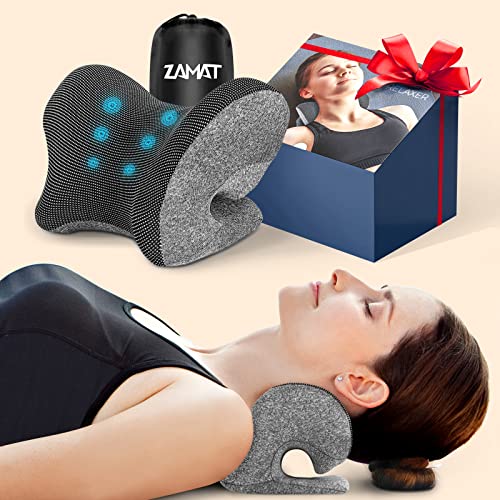
The ZAMAT follows the same lie-down cradle concept but wraps its self-skinning foam core in a magnetic therapy pillowcase, which is the main reason to choose it over plainer foam relaxers. The cover carries permanent magnetic particles that the brand positions for circulation support during sessions, and it gives the contact surface a softer, cloth finish rather than bare foam. The underlying curve is designed to conform to the cervical spine and ease tension across the neck and shoulders.
At 7.5 x 5.5 x 4 inches and about 0.7 pounds, the ZAMAT is one of the more compact options here, small enough to move between a bedroom floor and an office. ZAMAT caps use at twenty minutes a day and, like RESTCLOUD, warns against using the relaxer as a sleeping pillow. This is a mid-range pick for buyers who like the standard cradle shape but want a finished cover and a slightly gentler presentation.
Specs:
- Type: Foam neck cradle with fitted pillowcase (lie-down)
- Material: Self-skinning foam core; magnetic therapy cloth cover
- Dimensions: 7.5 x 5.5 x 4 inches (standard size)
- Weight: 0.7 pounds
- Design features: Magnetic therapy pillowcase, contoured cervical curve
- Session guidance: Up to 20 minutes per day
- Surface: Flat surfaces; not for overnight sleep
3. Fanlecy Neck and Shoulder Relaxer

The Fanlecy stretches the basic cradle shape in a literal way: an extended tail runs past the neck and down between the shoulder blades, carrying massage points into the upper back. If your tension pattern spans both the neck and the upper back, that longer contact area is the reason to pick this model. The C-shaped curve uses the weight of the head to produce the stretch, and the raised trigger points are meant to simulate fingertip pressure along the muscles at the base of the skull and between the shoulders.
The body is high-density self-skinning foam, a micro-elastic material the brand describes as odorless, durable, and resistant to deformation, so the curve should hold its shape across daily sessions. Fanlecy positions the relaxer for home, office, and travel use, and the one-piece build needs no setup beyond placing it on a flat surface. This blue version is a budget-tier option; a black version is sold as a separate listing.
Specs:
- Type: Extended foam neck and upper-back cradle (lie-down)
- Material: High-density self-skinning foam
- Design features: C-shaped curve, extended upper-back massage points, trigger-point nodes
- Stretch method: Gravity from head weight; vertical, horizontal, and curvature stretch
- Session guidance: Short daily sessions per brand guidance
- Color listed: Blue
4. Lumia Wellness Cervical Orthotic Traction Block

The Lumia block is the firmest and most targeted tool in this guide. Instead of cradling the whole curve, its closed-cell EVA foam block places an engineered apex under one section of the neck at a time, with three placements covering the upper neck, the middle neck, and the lower neck into the upper thoracic area. A three-height adjustable design lets you change how much lift the apex applies, which makes the Lumia the pick for users following a structured curve-restoration routine rather than a general relaxer session.
Lumia suggests ten minutes a day and notes the block is FSA and HSA eligible. Because the foam is firm and the pressure is concentrated, the brand frames it as an orthotic-style device of the kind used in chiropractic and physical therapy settings, and beginners should expect the strongest sensation of any pick here. Choose it if the softer cradles feel too mild; skip it if you already know firm pressure bothers your neck.
Specs:
- Type: Firm orthotic traction block (lie-down)
- Material: Closed-cell EVA foam, firm density
- Design features: Apex curve, 3-height adjustable design, 3 placements (upper, middle, lower neck)
- Session guidance: 10 minutes per day
- Eligibility: FSA and HSA eligible per brand
- Seller: Lumia Direct
5. Cozyhealth Heated Neck Stretcher
The Cozyhealth takes the standard self-skinning foam cradle and adds the one feature the other four lack: heat. A graphene heating pad sits over the cradle and runs from any USB power source, with three temperature settings on an inline controller and an automatic shutoff after three hours. Heat and stretch target the same problem from two sides, since warmth helps tight neck and jaw muscles let go while the curve holds the stretch.
The trade-offs are practical rather than structural. The pad is not rechargeable, so the USB cable has to stay plugged into a power bank, computer, or adapter during heated sessions, and no adapter is included in the box. Cozyhealth recommends keeping a single heating session to no more than thirty minutes and never using the heat function while sleeping. The foam base works unheated as a regular cradle, and the brand publishes the usual ten-minute daily stretching guidance. This is the premium pick for people whose stiffness responds well to warm compresses.
Specs:
- Type: Foam neck cradle with detachable heating pad (lie-down)
- Material: High-density self-skinning foam; graphene heating pad
- Heat: USB powered (5V, 1A input), 3 temperature settings, 3-hour automatic shutoff
- Session guidance: 10 minutes per day stretching; heating sessions up to 30 minutes
- Included: Traction pillow, heating pad, USB cable with controller, manual (no wall adapter)
- Color listed: Black
How to Use a Neck Stretcher Safely
Placement matters more than session length. Put the device on a firm, flat surface, lie down slowly, and settle the curve of your neck onto the cradle so the head can tip back gently. Bending your knees and resting your arms by your head, as several makers suggest, helps the neck muscles release instead of guarding. Start with five-minute sessions for the first several days, even if the brand allows ten, and build up only while sessions stay comfortable.
Stop rules are consistent across every listing in this guide. A neck stretcher should never cause sharp pain, and you should end the session at once if you feel pain, numbness, tingling down the arms, or dizziness, then get up slowly. These devices are sold for general neck and shoulder tension; they are not treatments for diagnosed cervical conditions. Anyone with a recent neck injury, cervical surgery, diagnosed disc problems, or persistent symptoms that have not been evaluated should talk to a healthcare professional before using one.
Frequently Asked Questions
How long should you use a neck stretcher each day?
Most makers in this guide publish guidance of about ten minutes per session. Daily caps vary by model: RESTCLOUD allows up to thirty minutes a day, ZAMAT caps use at twenty minutes a day, and Lumia suggests a single ten-minute session. Beginners should start with five-minute sessions and increase gradually over one to two weeks.
Can you sleep on a neck stretcher overnight?
No. Every brand covered here states that its device is not an ordinary pillow and must not be used for a full night of sleep. Neck stretchers hold the cervical spine in an extended position that is only appropriate for short, supervised-feeling sessions while you are awake and able to get up if something feels wrong.
Who should not use a neck stretcher?
Skip these devices, or get medical clearance first, if you have a recent neck injury, a history of cervical surgery or fusion, diagnosed disc herniation with arm symptoms, or unexplained numbness and weakness. The makers themselves advise consulting a healthcare provider for serious cervical conditions, and traction-style stretching is not a substitute for an evaluation.
What is the difference between a neck stretcher and a cervical traction device?
A foam neck stretcher is passive: the weight of your own head, roughly eight to ten pounds, creates a gentle extension stretch over a molded curve. Mechanical and pneumatic cervical traction devices apply a larger, measured pulling force along the spine using pumps, weights, or ratchets. Stretchers suit everyday muscle tension; stronger traction devices are a separate category with separate guidance.
Conclusion
For most buyers, the RESTCLOUD is the right place to start: it is the category reference design, with a two-height wave shape, clear session guidance, and nothing to assemble or maintain. The ZAMAT adds a magnetic therapy cover and a compact footprint, the Fanlecy reaches further into the upper back, and the Lumia block delivers the firmest, most targeted stretch for structured routines. If heat is part of what relaxes your neck, the Cozyhealth is the only pick here that combines a foam cradle with a USB-powered heating pad. Match the firmness to your tolerance, keep sessions short, and any of the five will do the simple job these devices are built for.
More from Amazon
Programs that pair well with the guide above. Offers and eligibility are set by Amazon and may change.
Collect the home and kitchen items you want in one registry that guests can shop from.
Create a wedding registrySet up recurring deliveries of everyday items on eligible products. Terms and savings are set by Amazon.
Explore Subscribe & SaveFree shipping on eligible items, Prime Video and more. Eligible new members can start with a free trial.
Start a Prime free trialAudiobooks and podcasts to listen to on the go. Eligible new members can start with a free trial.
Try Audible freeAs an Amazon Associate we earn from qualifying purchases.


Write Your Review
No reviews yet. Be the first to share your experience!