

Key takeaways
- For most new paddlers, choose a 10’6″–11’6″ inflatable all-around board that is 31″–33″ wide and rated comfortably above your fully loaded weight. Choose a 12’6″ inflatable touring board when you want longer, straighter trips without roof-rack storage. Select a 14′ hard touring board only when…
Best Paddle Boards for Beginners and Touring
The best paddle boards for most beginners are 10’6″–11’6″ inflatable all-around boards, while touring riders usually benefit from a 12’6″–14′ inflatable or hard board with a narrow, pointed nose and a higher weight capacity.
Quick picks by situation
| Rider situation | Best board type | Useful target specification | Why it fits |
|---|---|---|---|
| First-time rider, under 175 lb | Inflatable all-around | 10’6″–11′ × 31″–33″ wide; 250–300 lb capacity | Stable, manageable, easy to store and forgiving while learning |
| Tall or heavier beginner | Inflatable all-around or crossover | 11’6″–12′ × 32″–34″ wide; 300–400 lb capacity | Extra volume reduces flex and keeps the board balanced under load |
| Frequent day touring | Inflatable touring board | 12’6″–14′ × 28″–32″ wide; 300–400 lb capacity | Better glide and tracking without requiring a vehicle roof rack |
| Maximum speed and rigid handling | Hard touring board | 12’6″–14′ × 25″–29″ wide | Efficient waterline, precise edging and no inflation step |
| Small apartment or occasional use | Inflatable all-around | 10’6″–11’6″; packed length about 36″–40″ | Fits in a closet and usually weighs about 20–30 lb |
Inflatable or hard paddle board: which is better?
Inflatable boards
Inflatable stand-up paddle boards are the practical choice when storage, transport and durability against minor impacts matter most. A typical board uses drop-stitch construction: thousands of internal fibers connect the top and bottom layers so the inflated board becomes a rigid platform. Good models commonly require 12–18 PSI and take approximately 5–10 minutes to inflate with a manual dual-action pump, depending on board size and the user’s pace.
Our top picks


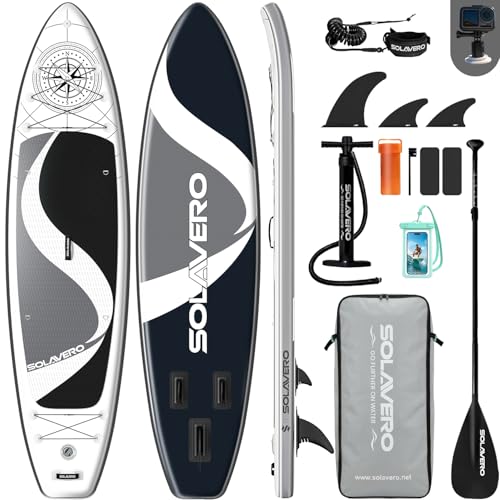
As an Amazon Associate we earn from qualifying purchases at no extra cost to you. Ratings are shown as listed on Amazon.
They are easier to carry to a launch, less likely to suffer cosmetic damage from contact with a dock, and usually fit in a backpack-sized bag. The compromises are slower setup, the need to dry the board before storage, and somewhat less crisp acceleration than a comparable hard board. A poorly inflated board can also feel soft and bend in the middle, particularly under a heavier rider.
Hard boards
Hard boards generally have a foam core with fiberglass, epoxy, or composite layers. They are ready immediately, glide efficiently, and respond more precisely when you shift your weight or paddle on one side for a long time. Their rigid shape is especially helpful for fitness paddling, longer tours and riders who value speed.
The drawbacks are storage and transport. A 12’6″ board requires a roof rack or a large vehicle, and it can be awkward to carry alone. Hard rails and pointed noses are also less tolerant of collisions with rocks, concrete edges and docks. Choose a hard board when you paddle often enough that eliminating inflation and maximizing glide outweigh the extra logistical work.
How length, width and shape affect beginners and touring
Length: Short boards turn more easily but lose speed and straight-line efficiency. Boards around 10’–11’6″ are versatile for beginners. A 12’6″ board is a strong compromise for touring, while a 14′ board is efficient on open, relatively calm water but less convenient in tight rivers or windy shorelines.
Width: Width is the quickest way to add stability. A 31″–33″ board is comfortable for many first-time riders. A 34″–36″ board offers more initial stability but creates more drag and can feel cumbersome for a shorter paddler. Touring boards are often 28″–32″ wide: narrower shapes move efficiently, but they demand more balance.
Thickness and volume: A 6-inch-thick inflatable board is common because it provides useful stiffness and buoyancy. Board capacity is not a recommendation for the rider alone; it includes the rider, clothing, water, cooler, dry bag and any passenger or pet. For predictable handling, select a board with a listed capacity at least 25% higher than your total loaded weight.
Shape: A rounded or blunt nose feels stable and turns easily. A pointed touring nose parts the water more cleanly and holds a straighter course. A square tail creates a broad standing area, while a narrower or rounded tail reduces drag. For a beginner who wants occasional distance, a crossover shape with a pointed nose and roughly 31″–33″ width is often more useful than an extremely wide recreational board.
Matching board capacity to rider weight
Use your complete launch-day weight rather than body weight alone. For example, a 185 lb rider carrying 12 lb of paddle, clothing, water and safety equipment has a loaded weight of 197 lb. Applying a 25% margin gives:
197 lb × 1.25 = 246 lb minimum recommended capacity.
A board advertised at 250 lb may work, but a 300 lb-capacity board will usually feel more composed and resist flex better. If the board will carry a child, dog or fishing gear, add that weight before making the calculation. Capacity ratings are not perfectly standardized, so the margin is useful rather than excessive.
Beginner versus touring priorities
Choose an all-around board if you want versatility
All-around boards suit calm lakes, protected bays and short outings. Look for a center carry handle, a comfortable deck pad, at least one secure leash attachment, and front cargo bungees. A removable center fin makes storage easier, while side fins or a two-plus-one fin setup can improve stability and tracking.
For a first board, avoid choosing solely by the largest stated weight capacity. An oversized board may float well but be difficult to control, particularly for a smaller rider. A board that is too narrow is equally frustrating because balance becomes the main task instead of paddling technique.
Choose a touring board if distance matters
Touring boards favor a long waterline, pointed nose, efficient fin and a narrower standing area. The extra length improves glide: each paddle stroke can carry farther before the board slows. A touring board also tracks better, meaning it remains pointed in one direction with fewer corrective strokes.
That efficiency comes with trade-offs. Turning takes more time, carrying the board is harder, and a narrow shape can feel unstable when you first stand up. Beginners who want to progress into touring should consider a 12’6″ board around 30″–32″ wide rather than immediately choosing a 14′ racing-style shape.
Setup and ownership details that affect real-world value
- Inspect before inflating. Check the valve, fin box, handles and seams for grit or damage. Sand in a valve can cause a slow leak.
- Inflate in stages. Attach the hose securely, inflate until the board takes shape, then continue to the manufacturer’s stated PSI. Do not guess based only on how firm it feels.
- Install the fin correctly. A loose or incorrectly seated fin can make the board wander and may damage the fin box.
- Rinse after use. Fresh water removes salt, sand and algae from valves, zippers and fin fittings. Let the board dry fully before rolling it.
- Store out of heat and sunlight. Prolonged heat can increase internal pressure and accelerate adhesive or material aging. Store it partially or fully deflated in a cool, dry place according to the manufacturer’s instructions.
- Check pressure and leaks periodically. If an inflated board becomes soft overnight, apply soapy water around the valve and seams; bubbles can help locate a leak. Use the correct repair material and allow adhesive to cure fully.
The components most likely to need attention are fin hardware, valve seals, handles, cargo bungees and the pump hose. A replacement fin or valve tool is inexpensive compared with replacing a board, so keeping basic spares in the gear bag is sensible. Avoid dragging any board across rough ground, even if an inflatable model is marketed as durable.
What should you budget?
In 2026, general market pricing is roughly $300–$700 for a basic inflatable all-around package, $700–$1,400 for a better-equipped inflatable touring board, and $900–$2,500 or more for a hard touring board. Package contents vary: paddle quality, leash, fin, pump and repair kit can change the real value substantially.
For occasional use, an inflatable board can be the better financial choice even if its purchase price is not the lowest. Suppose a $600 board is used 24 times over two seasons: the board cost is about $25 per outing before transport and maintenance. A $1,200 hard touring board used 100 times costs about $12 per outing, but only if you have suitable storage and actually paddle frequently. Usage frequency should therefore influence the decision as much as the sticker price.
Bottom line
For most new paddlers, choose a 10’6″–11’6″ inflatable all-around board that is 31″–33″ wide and rated comfortably above your fully loaded weight. Choose a 12’6″ inflatable touring board when you want longer, straighter trips without roof-rack storage. Select a 14′ hard touring board only when speed, rigid handling and frequent use justify its transport and storage demands. The best paddle boards are not simply the longest or highest-capacity models; they are the ones whose width, volume, construction and setup requirements match how—and how often—you will actually paddle.

Write Your Review
No reviews yet. Be the first to share your experience!