

Key takeaways
- Best for most home treadmills: a 3 mm to 6 mm PVC or dense rubber mat sized at least 3 inches wider than the treadmill on every side.
- Best for heavy treadmills or high-mileage use: a 6 mm to 10 mm dense rubber mat with a high compression rating and a textured underside.
- Best for carpet: a firm 3 mm to 6 mm mat that resists compression and includes ventilation channels or a moisture barrier.
- Best for hard floors: a non-staining rubber or PVC mat with a smooth, sealed underside and enough thickness to reduce vibration.
- Best for small rooms: a close-fitting mat that extends beyond the treadmill’s footprint without blocking doors, vents, or folding clearance.
- Best budget choice: a correctly sized 3 mm PVC mat for a lighter walking treadmill used several times per week.
Best Treadmill Mats for Floor Protection
The best treadmill mat is thick enough to distribute your machine’s weight, wide enough to catch every foot, and made from a material that suits your floor, room size, and training frequency—not simply the most expensive mat available.
Quick picks by situation
- Best for most home treadmills: a 3 mm to 6 mm PVC or dense rubber mat sized at least 3 inches wider than the treadmill on every side.
- Best for heavy treadmills or high-mileage use: a 6 mm to 10 mm dense rubber mat with a high compression rating and a textured underside.
- Best for carpet: a firm 3 mm to 6 mm mat that resists compression and includes ventilation channels or a moisture barrier.
- Best for hard floors: a non-staining rubber or PVC mat with a smooth, sealed underside and enough thickness to reduce vibration.
- Best for small rooms: a close-fitting mat that extends beyond the treadmill’s footprint without blocking doors, vents, or folding clearance.
- Best budget choice: a correctly sized 3 mm PVC mat for a lighter walking treadmill used several times per week.
What thickness should a treadmill mat be?
Thickness should match the treadmill’s total weight, the impact created by your workouts, and the floor beneath it. A thin mat mainly protects against scuffs and sweat; a thicker, denser mat also helps spread point loads and control vibration.
Our top picks

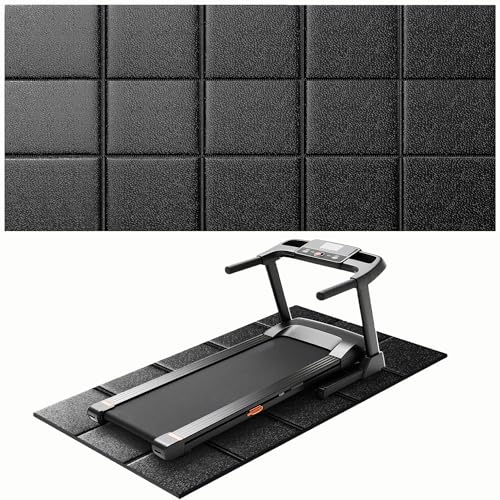


As an Amazon Associate we earn from qualifying purchases at no extra cost to you. Ratings are shown as listed on Amazon.
| Treadmill and floor situation | Recommended thickness | Useful dimensions | Best material type |
|---|---|---|---|
| Compact walking treadmill under 150 lb on hard flooring | 2 mm–3 mm | At least 3 in beyond each side | Sealed PVC or TPE |
| Folding treadmill, approximately 150–250 lb, moderate use | 3 mm–6 mm | Approximately 36 in × 78 in or larger | Dense PVC or rubber |
| Heavy treadmill over 250 lb or frequent running | 6 mm–10 mm | Approximately 40 in × 84 in or larger | High-density rubber |
| Carpeted floor with concern about indentation or moisture | 4 mm–8 mm | Machine footprint plus 4–6 in per side | Rigid, moisture-resistant PVC or firm rubber |
| Upper-floor room where vibration matters | 6 mm–10 mm | Full treadmill footprint plus walking clearance | Dense rubber, optionally over isolation pads |
Do not confuse thickness with density. A soft, spongy 10 mm foam sheet may compress more than a dense 4 mm rubber mat. For a treadmill, a firm material usually provides better long-term support than a very soft exercise mat.
How to choose the correct mat size
Start with the treadmill’s assembled dimensions, not only the belt size. Measure the length and width of the frame, including the motor housing and rear rollers. Then add a margin on all sides.
- Minimum margin: 3 inches on each side for a compact walking machine.
- Preferred margin: 4 to 6 inches on each side for a full-size treadmill.
- Front clearance: allow extra space under and around the motor cover, where dust and sweat often collect.
- Rear clearance: extend the mat beyond the rear feet and roller area, not just the end of the running belt.
For example, a treadmill measuring 32 inches wide by 72 inches long needs a minimum mat of approximately 38 inches by 78 inches when using a 3-inch margin. A 4-inch margin increases the target size to 40 inches by 80 inches. That extra coverage is useful if the treadmill shifts slightly during running or if sweat lands near the sides.
Check the folded dimensions as well. A mat can fit the treadmill perfectly when it is flat but interfere with a wall, cabinet, or doorway when the deck is raised. Leave room for the treadmill’s folding mechanism and for safe access to the power switch.
Rubber, PVC, TPE, or foam: which material is best?
Dense rubber
Rubber is usually the strongest choice for heavy machines, frequent running, and vibration control. It resists tearing and stays stable under treadmill feet. Its disadvantages are weight, rubber odor when new, and the possibility that an unsealed underside could discolor delicate flooring. Look for a sealed or non-marking surface when using it on finished wood or vinyl.
PVC
PVC mats are often lighter, less expensive, and easy to wipe clean. They work well for most home treadmills and offer good resistance to sweat and occasional spills. Thin PVC can curl at the edges or crease if stored folded, so roll it rather than sharply bending it.
TPE
Thermoplastic elastomer mats can provide a flexible, low-odor alternative to PVC. Quality varies considerably. Choose a firm, non-slip construction rather than a soft yoga-mat texture, which may compress beneath heavy treadmill feet.
Foam
Foam is comfortable underfoot but is generally a poor primary mat for a heavy treadmill. It can flatten, retain moisture, and allow the machine to rock. If used, it is better suited to a light walking platform with broad feet and low impact.
Decision matrix: match the mat to your room and routine
| Your situation | Recommended choice | Why | Avoid |
|---|---|---|---|
| Walking 3–5 days weekly in a small apartment | 3–6 mm PVC, close-fitting size | Protects the floor without consuming unnecessary room | Oversized roll mats that block doors |
| Running most days on an upper floor | 6–10 mm dense rubber | Better load distribution and vibration damping | Thin plastic sheets |
| Machine on carpet | Firm 4–8 mm PVC or rubber with moisture resistance | Reduces indentation and limits sweat reaching carpet | Soft foam that traps moisture |
| Hardwood or luxury vinyl flooring | Non-staining PVC or sealed rubber | Reduces scuffs while limiting contact transfer | Unsealed rubber with an unknown underside |
| Heavy treadmill used by several people | 6–10 mm high-density rubber, oversized by 4–6 in | Handles greater cumulative loading and movement | Thin mats with unsupported edges |
Vibration control: what a mat can and cannot do
A treadmill mat can reduce rattling, prevent direct contact between the frame and floor, and spread the load across a larger area. It cannot eliminate vibration caused by an uneven floor, loose frame bolts, worn rollers, or an unbalanced machine.
For the best result, place the treadmill on a level surface, adjust its leveling feet, and tighten accessible hardware according to the manufacturer’s instructions. If vibration travels through an upper-floor structure, dense rubber is usually more useful than soft foam. In severe cases, separate isolation pads under the treadmill’s feet may help, but they must be stable and compatible with the machine’s leveling system.
Moisture protection and floor safety
Sweat and cleaning liquid are common causes of floor damage. Choose a mat with a sealed, non-absorbent surface and wipe it after demanding sessions. On carpet, periodically lift the treadmill and mat so the floor can dry and be inspected. Do not assume a waterproof top surface prevents moisture from reaching the underside through the edges.
Wood floors require particular care. Keep the mat clean underneath, because trapped grit can act like sandpaper when the treadmill moves. For newly installed flooring, check the flooring manufacturer’s guidance about rubber contact, plasticizer transfer, and ventilation.
Setup steps that prevent premature wear
- Clean the floor. Remove grit, dust, and small stones before unrolling the mat.
- Let the mat flatten. Unroll it in a warm room and allow curled edges to relax before placing the treadmill on it.
- Center the machine. Confirm that every foot sits fully on the mat, with no foot near an edge or seam.
- Level the treadmill. A level frame reduces rocking and uneven pressure on the mat.
- Check after the first few sessions. Look for creeping, buckling, compressed spots, or moisture beneath the mat.
- Reposition if necessary. A mat that shifts is often too smooth underneath, too small, or installed on a dusty floor.
Durability and ownership realities
The first parts to wear are usually the edges, corners, and areas directly beneath narrow treadmill feet. Repeated movement can create permanent impressions, especially in softer materials. Replace a mat if it splits, develops raised ridges, becomes slippery, or no longer lies flat.
Vacuum or sweep beneath the treadmill regularly, then wipe the mat with mild soap and water. Avoid petroleum-based cleaners, harsh solvents, and excessive soaking. Do not fold a thick rubber mat tightly for storage; rolling it with the top surface facing outward generally reduces sharp creases.
A basic 3 mm mat may cost roughly $25–$60, a firmer 4 mm–6 mm option about $40–$100, and a heavy-duty rubber mat around $80–$180 or more depending on size. The most economical choice is the least expensive mat that still meets the required thickness, coverage, and moisture-resistance needs. Replacing a thin mat repeatedly is usually less economical than buying a correctly sized dense mat once.
Final buying checklist
- Measure the full treadmill footprint, including motor housing and rear feet.
- Add at least 3 inches per side; use 4–6 inches for heavy or high-impact use.
- Select 3–6 mm for most home treadmills and 6–10 mm for heavy machines or vibration concerns.
- Choose sealed PVC or non-staining rubber for hard floors.
- Choose a firm, moisture-resistant mat for carpet.
- Confirm the mat will not obstruct folding, doors, vents, or emergency access.
- Inspect the underside regularly for grit, moisture, discoloration, or compression damage.

Write Your Review
No reviews yet. Be the first to share your experience!