

Key takeaways
- Compare safety razors on head design, aggressiveness, handle grip and blade loading to get a close, smooth shave with far less skin irritation.
As an Amazon Associate we earn from qualifying purchases.
Disclosure: This article contains affiliate links. If you buy through these links, we may earn a commission at no extra cost to you.
Our top pick: Merkur 34C HD. Runner-up: Edwin Jagger DE89BL.
A safety razor holds a single thin double-edge blade at a fixed angle and lets the weight of the head do the work. There is no pivoting cartridge head dragging several edges across the same patch of skin in one stroke, and no tug from a dull multi-blade head used too long. For many people that difference shows up quickly as less redness, fewer ingrown hairs, and skin that feels calmer an hour after the shave.
The catch is that safety razors are not interchangeable. Head geometry, blade gap, handle length, and weight change how a razor behaves far more than the brand name does. A mild razor can feel too gentle on three days of coarse growth, while a heavier, more efficient razor can punish rushed technique. This guide compares five proven razors, from a compact German two-piece to an adjustable system and a heavy butterfly model, so you can match the tool to your skin and beard.
How to Choose a Safety Razor
Head design and comb type. Most razors here use a closed comb, meaning a solid safety bar runs in front of the blade and stretches the skin gently ahead of the edge. Closed-comb heads are the forgiving default for daily shaving and sensitive skin. Open-comb heads leave the bar toothed and feed longer growth to the blade more freely, suiting infrequent shavers but feeling less protective. Construction matters too: two-piece razors keep the base plate attached to the handle, three-piece razors come fully apart for cleaning, and butterfly models open the head doors with a twist of the knob.
Aggressiveness and blade gap. Aggressiveness describes how much blade the head exposes and how directly it meets the skin. A larger gap cuts longer growth in fewer passes but demands a lighter touch. Mild razors may need an extra pass yet forgive imperfect angles, suiting beginners and anyone prone to irritation. Adjustable designs sidestep the gamble with several settings or base plates, so one handle can shave gently on a weekday and more efficiently after a long weekend.
Handle length, weight, and grip. Weight is a feature, not a flaw: a heavier head lets gravity supply the pressure, so your hand only guides. Short handles feel nimble around the jaw, while longer handles help larger hands and anyone shaving legs. Grip matters most with wet, soapy fingers, so look for knurling or lined patterns that stay secure without squeezing. A smooth polished handle looks elegant but asks for dry hands.
Blade loading and blade choice. Loading should feel safe and repeatable. Three-piece heads align the blade on posts while you hold it by its short ends, butterfly heads accept the blade from above, and two-piece heads sit between the two for speed. Every razor here takes standard double-edge blades from any maker, and blade brand changes the feel as much as the razor does, so a small sampler is a sensible first purchase. Replace a blade as soon as it tugs.
Technique and skin preparation. No razor compensates for a dry, rushed pass. Soften whiskers with warm water, build a proper lather, and shave with the grain first using short strokes and almost no downward pressure. Keep the angle near thirty degrees, rinse the head often, and save any against-the-grain pass for the end. Finish with a cool rinse and a gentle moisturizer, and give irritated skin a rest day rather than chasing perfect smoothness daily.
1. Merkur 34C HD

The Merkur 34C HD has been the default recommendation for new wet shavers for decades. Made in Solingen, Germany, it is a two-piece razor with a short, thick handle and a closed-comb head that carries most of its weight up top. That top-heavy balance does the cutting for you: rest the head on the skin, keep your grip relaxed, and it glides through a day or two of growth with no need to push.
In use the 34C sits firmly in the mild-to-medium camp. The blade gap is modest, the safety bar keeps the edge controlled, and the shave rarely bites even when your angle drifts. Daily shavers will find two passes plenty, and the compact, knurled handle makes detail work around the nose simple while staying secure in wet hands. Loading is quick too: twist the knob at the base, lift the cap, drop the blade over the posts, and reassemble. For one dependable daily razor with no settings to manage, this is the benchmark.
Specs
- Construction: 2-piece design with closed comb head, made in Solingen, Germany
- Overall length: 83.3 mm (3.28 in); handle length 77.1 mm (3.04 in)
- Weight: 77 g (2.72 oz), concentrated toward the head for low-pressure cutting
- Handle: thick knurled grip, 11.6 mm diameter, chrome finish
- Blade loading: twist knob at handle base releases the top cap; accepts all standard double-edge blades
2. Edwin Jagger DE89BL

The Edwin Jagger DE89BL, made in Sheffield, England, pairs the well-regarded DE89 head with a polished chrome handle in a classic three-piece layout. The head holds the blade in a smooth, even curve that gives a mild-to-medium shave with very little blade feel, yet clears growth efficiently enough that most people finish in two passes. It is a particularly kind razor for sensitive skin and for anyone whose cartridge routine left redness on the neck.
The DE89BL feels balanced rather than head-heavy, pivoting easily at the jawline. The smooth chrome handle is its one compromise: beautiful and easy to clean, but with less purchase than a knurled handle when covered in lather, so dry fingertips help. It comes fully apart for deep cleaning, blade alignment on the posts is precise, and an included blade lets you shave the day it arrives.
Specs
- Construction: 3-piece design with closed comb head, made in Sheffield, England
- Blade gap: approximately 0.71 mm, mild-to-medium aggressiveness
- Weight: approximately 68 g with balanced, neutral handling
- Finish: triple-plated polished chrome on head and handle components
- Blade loading: head separates into cap, base plate, and handle; accepts all standard double-edge blades; one blade included
3. Rockwell 6C
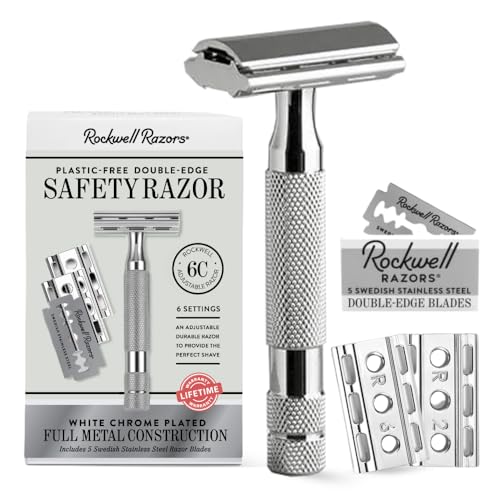
The Rockwell 6C solves the biggest uncertainty in buying a first safety razor: not knowing how much aggressiveness your skin wants. Instead of a dial, it ships with three reversible base plates providing six settings, from a very mild R1 to a much more efficient R6. You fit the plate that suits your face, and as your technique improves or your growth changes, you move up a setting rather than buying a second razor.
The mild plates suit daily shaving, the middle settings handle a normal beard in two passes, and the highest settings cut several days of growth with authority. Because the change comes from swapping a solid plate, there are no moving parts to loosen and the blade stays clamped rigidly, reducing chatter on coarse whiskers. A white chrome finish and knurled handle complete the most adaptable option in this group.
Specs
- Construction: 3-piece design with closed comb head and interchangeable base plates
- Settings: 6 shave settings (R1 to R6) across 3 reversible base plates
- Material: zinc alloy with white chrome finish; knurled handle for wet grip
- Model: RR-960408; designed by Rockwell Razors in Canada
- Included: 5 double-edge blades; accepts all standard double-edge blades
4. Parker 99R

The Parker 99R is the heavyweight of this group, a long-handled butterfly razor built around a solid brass frame with a chrome finish. Twist the knob at the bottom of the handle and the head doors open upward, so you drop a blade in and twist back — no disassembly, no loose parts on the counter, and no handling beyond holding the blade by its short edges. For anyone who finds three-piece loading fiddly, this is the friendliest mechanism here.
That convenience comes with real substance. The 99R is noticeably heavier than the others here, and the extra mass moves steadily through dense or multi-day growth with fewer repeat strokes. Its head is moderately assertive, more efficient than the Merkur or the Edwin Jagger, so it rewards a light touch. The long, textured handle suits larger hands, gives welcome reach for leg shaving, and stays planted in a wet grip.
Specs
- Construction: 1-piece butterfly (twist-to-open) design with closed comb head
- Frame: genuine brass frame with chrome plating
- Weight: approximately 4.0 oz, the heaviest razor in this comparison
- Handle: long handle, approximately 4 in, with textured grip pattern
- Included: 5 Parker Premium Platinum double-edge blades; accepts all standard double-edge blades
5. King C. Gillette Safety Razor

The King C. Gillette safety razor brings the double-edge format back under the name that launched it, in a mild three-piece design aimed squarely at people leaving cartridges behind. The closed-comb head uses a gentle blade angle that prioritizes comfort, and the safety bar carries fine grooves that help lather reach the skin and keep each stroke smooth. It is the most forgiving razor here on an imperfect angle, which makes the first two weeks of learning notably calmer.
The chrome-plated handle is longer than the Merkur’s, with a patterned section that grips better than it looks, and the balance sits slightly toward the head. The exposed blade corners make it easy to tidy a cheek line or clean up around a goatee with a precision a cartridge head cannot offer. Loading is standard three-piece work, and the box includes five platinum-coated blades matched to the head.
Specs
- Construction: 3-piece design with closed comb head and grooved safety bar
- Handle: chrome-plated handle with patterned grip section, longer format for control
- Character: mild aggressiveness tuned for comfort and for cartridge converts
- Included: 5 platinum-coated double-edge blade refills in the box
- Blade compatibility: accepts all standard double-edge blades from any maker
Comparison Summary
These five razors divide cleanly by how they solve the same problem. The Merkur 34C HD is the compact daily driver: short, heavy-headed, and mild. The Edwin Jagger DE89BL matches it for gentleness while adding a finer finish and a fully opening build that cleans easily. The Rockwell 6C is the pick when you do not want to guess, since its six settings cover several fixed razors in one handle. The Parker 99R commits to weight, reach, and the fastest blade changes, suiting coarse growth and larger hands best. The King C. Gillette is the gentlest fixed razor here, with edging precision as a bonus. Whichever you choose, allow patience for the first fortnight while technique settles.
Frequently Asked Questions
Are safety razors good for sensitive skin?
For many people, yes. A safety razor uses one sharp edge per pass instead of dragging several cartridge edges over the same skin, and you control the pressure yourself, so there is less scraping afterward. Pair a mild razor such as the DE89BL or the King C. Gillette with good lather, a fresh blade, and with-the-grain passes, and give your skin a few shaves to adjust.
How often should I change the blade?
Change it when it begins to tug or leave the skin feeling rough, which for most people is after three to seven shaves depending on beard density and blade brand. Stretching a dull blade further is a false economy, since a tired edge causes more irritation than any razor choice. Rinsing and shaking the razor dry helps the edge stay clean.
How long does it take to learn a safety razor?
Most people feel comfortable within one to two weeks. The habits are simple: prepare with warm water and lather, hold the razor near thirty degrees, use short strokes, and let the weight of the head supply the pressure. Expect a couple of minor nicks early on, usually from pressing or rushing, and treat them as technique feedback.
Can I use a safety razor for legs, head shaving, and travel?
Yes, with small adjustments. A longer handle such as the Parker 99R gives better reach for legs, while a mild setting on the Rockwell 6C suits head shaving. For travel, pack the razor in a case with blades stored separately in their wrappers, and note that double-edge blades belong in checked baggage on flights rather than in a cabin bag.
Conclusion
The best safety razor is the one whose head, weight, and handle match your skin and habits closely enough that good technique becomes easy. Begin with the Merkur 34C HD or the Edwin Jagger DE89BL for a proven mild shave, choose the Rockwell 6C if you want room to adjust, reach for the Parker 99R when weight and fast loading matter, or take the King C. Gillette for the gentlest introduction. Add a blade sampler, slow down, and any of these five will deliver a closer, calmer shave.
More from Amazon
Programs that pair well with the guide above. Offers and eligibility are set by Amazon and may change.
Collect the home and kitchen items you want in one registry that guests can shop from.
Create a wedding registrySet up recurring deliveries of everyday items on eligible products. Terms and savings are set by Amazon.
Explore Subscribe & SaveFree shipping on eligible items, Prime Video and more. Eligible new members can start with a free trial.
Start a Prime free trialAudiobooks and podcasts to listen to on the go. Eligible new members can start with a free trial.
Try Audible freeAs an Amazon Associate we earn from qualifying purchases.





Write Your Review
No reviews yet. Be the first to share your experience!