

Key takeaways
- Compare the best bread knives on blade length, serration pattern, steel and handle comfort to slice crusty loaves and soft sandwich bread without tearing.
As an Amazon Associate we earn from qualifying purchases.
Disclosure: This article contains affiliate links. If you buy through these links, we may earn a commission at no extra cost to you.
Our top pick: Mercer Culinary Millennia 10-Inch Wide Wavy Edge Bread Knife. Runner-up: Victorinox Fibrox Pro 10.25-Inch Bread Knife.
A bread knife solves a problem a straight edge cannot. A crusty loaf has two textures at once: a hard, brittle shell that resists pressure and a soft, airy interior that collapses under it. Press down with a smooth blade and the crust skids or the crumb compresses into a gummy wedge before the edge bites. A serrated blade works differently. Its teeth grip the crust at several small points, the blade moves in a long sawing stroke, and the slice separates with far less downward force. That is why the best bread knives move from a crackling sourdough boule to a tender sandwich loaf, brioche, or bagel without changing tools or mangling the food.
This guide compares five individual bread knives, not sets: a long wavy-edged workhorse, a Swiss pastry-style knife, a light Japanese slicer, a compact one-piece stainless design, and a stamped satin-finished knife with a traditional look. For a home recovery routine, a blade needing little downward pressure and a secure handle also reduce the effort each meal asks of your wrist and shoulder.
How to Choose a Bread Knife
Blade length comes first. An 8-inch blade suits sandwich loaves, bagels, small boules, and cakes, and it stores easily. A 9-inch blade adds stroke length for wider loaves. A 10-inch or 10.25-inch blade suits large rustic rounds, long baguettes cut on the diagonal, and splitting cake layers, because the slice can finish before the handle reaches the crust. If the blade is too short, you saw in choppy strokes, tear the bottom crust, and end with uneven slices.
Serration pattern comes second. Pointed teeth bite aggressively and help on thick, chewy rinds, but they can shred soft crumb if you press hard. Wavy or scalloped serrations have broader, smoother arcs: they glide with less tearing, leave fewer crumbs, and still grip crust with a long, light stroke. Match the pattern to the bread you cut most often.
High-carbon stainless steel resists staining and holds a serrated edge well. A stamped blade is lighter and thinner, helping it pass through soft crumb without wedging, while a heavier blade can feel steadier on hard crust. Serrated edges stay useful longer than plain edges but are harder to resharpen at home.
Handle comfort decides whether length helps or hurts. Look for a shape that fills the hand without a tight grip, texture that stays secure with damp or floury hands, and knuckle clearance to finish a slice at the board.
Care is simple. Hand wash and dry promptly, store on a strip, in a block slot, or with a guard, never loose in a drawer, and never use a bread knife on frozen food, bone, or a glass or stone board.
Mercer Culinary Millennia 10-Inch Wide Wavy Edge Bread Knife
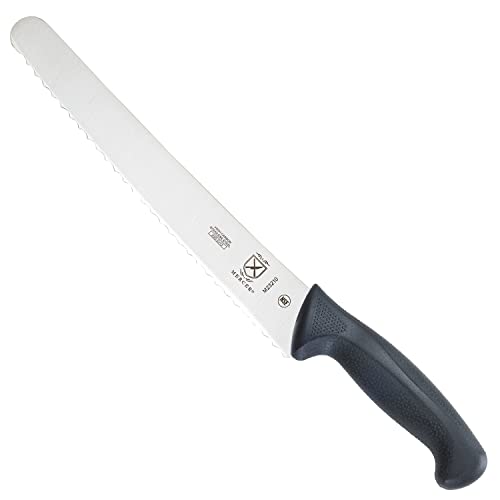
The Mercer Culinary Millennia 10-inch, model M23210, is the long, practical pick for bakers who cut wide loaves often. Its wide blade and wavy edge address the two-texture problem directly: the broad scallops grip the crust, the long stroke carries through the crumb, and the wide blade face helps keep the slice tracking straight. On a large sourdough round, that length means most slices finish without lifting and beginning again mid-loaf, which is where tearing usually happens.
The blade is one piece of high-carbon Japanese steel, stamped rather than forged, so it stays light for its size. The handle combines Santoprene for comfort with polypropylene for durability, and textured finger points add grip when hands are damp or dusted with flour. A protective finger guard separates hand from edge. This is a working knife in the plainest sense: no decorative finish to protect and no heavy bolster to clean around.
Choose this Mercer for large loaves, cake layers, tomatoes, melons, and squash skins. It is hand wash only, and the stamped blade can flex if twisted in a hard bottom crust, so let the teeth work with a level stroke.
Specs
- Blade length: 10 inches, wide profile
- Model: M23210, Millennia series
- Steel: One-piece high-carbon Japanese steel, stain-resistant
- Edge: Wide wavy serrated edge
- Construction: Stamped
- Handle: Santoprene and polypropylene, textured finger points, protective finger guard
- Weight: 4.8 ounces
- Care: Hand wash only
Victorinox Fibrox Pro 10.25-Inch Bread Knife

The Victorinox Fibrox Pro 10.25-inch, model 47547, is the longest knife here and the one with the most pastry-knife character. Its blade has a gentle curve that supports a smooth, rolling finish to each stroke, helping with cakes, pastries, and soft fruit as well as bread. The extra length over a standard 8-inch knife is not a luxury on a wide loaf; it is the difference between a clean single pass and a sawn, stepped edge on the far side of the slice.
Victorinox makes the blade from high-carbon stainless steel with a serrated wavy edge, stamped for light weight. At 4.8 ounces it feels easy to guide for a knife this long, and the balance suits cooks who slice several loaves in one session. The Fibrox handle is thermoplastic rubber with an ergonomic, textured shape designed to stay in the hand when wet. That grip, plus the low weight, makes this a sensible choice if hand fatigue is a concern and you still need full length.
The listing marks it as dishwasher safe, though hand washing treats the edge more kindly. Its curved profile needs a long storage slot or a strip, so measure your block first.
Specs
- Blade length: 10.25 inches, curved profile
- Model: 47547
- Steel: High-carbon stainless steel
- Edge: Serrated wavy edge
- Construction: Stamped
- Handle: Fibrox thermoplastic rubber, ergonomic and non-slip
- Weight: 4.8 ounces
- Origin and care: Made in Switzerland; listed as dishwasher safe, hand washing recommended for edge life
Tojiro Bread Slicer 235mm F-737

The Tojiro F-737 is the finesse option. Made in Japan, it pairs a 235mm stainless blade with a natural wood handle on a knife about 14.75 inches overall and only about 110 grams. That light, thin build changes how slicing feels. Instead of pushing through a loaf, you draw the blade back and forth with almost no downward load, and the wave edge separates thin, even slices with little crumbling. For delicate crumb, soft sandwich bread, and precise thin slices for toast, that lightness is a genuine advantage.
The F-737 suits cooks who value control over heft. Its smaller wood handle feels nimble and easy to angle for diagonal baguette cuts. A thin, light blade can bow if forced through a dense loaf, and the wood handle asks for hand washing and prompt drying. Treat it as a slicer, not a pry tool.
Specs
- Blade length: 235mm, about 9.25 inches
- Model: F-737
- Steel: Stainless steel
- Edge: Wave serrated edge, suitable for right- or left-handed use
- Handle: Natural wood, reinforced laminated material in the listing title
- Overall length: About 14.75 inches
- Weight: About 110 grams, about 3.9 ounces
- Origin and care: Made in Japan; hand wash and dry promptly
Orblue Serrated Bread Knife 8-Inch

The Orblue serrated bread knife, model ORB-BRD-KNF-BK-FBA, takes the opposite approach to the Tojiro: one piece of stainless steel, an 8-inch blade, and a 5-inch handle, for a compact knife with no joints, rivets, or handle scales to trap crumbs and moisture. That one-piece build makes rinsing and drying straightforward and removes any worry of a handle loosening over time. For a small kitchen or a second knife kept near the toaster, that simplicity has real appeal.
Its wavy edge suits the daily middle ground: sandwich loaves, bagels, muffins, small boules, and cake. The 8-inch length needs extra strokes on a wide rustic loaf, but for standard loaves it is easier to store and control. Grip comes from the ergonomic contour of the integrated handle.
Choose the Orblue if easy cleaning and compact storage rank ahead of maximum length, or if you want a dedicated everyday slicer everyone in the household can use without learning a particular grip. Keep it out of a loose drawer and wash it by hand to protect the teeth, even though the all-steel build tolerates water well.
Specs
- Blade length: 8 inches
- Model: ORB-BRD-KNF-BK-FBA
- Steel: Stainless steel, one-piece construction
- Edge: Wavy serrated edge
- Handle: Integrated stainless handle, 5 inches, ergonomic contour
- Overall length: About 13 inches
- Included detail: Tip guard described for the model line
- Care: Hand wash and dry for best edge life
HENCKELS Statement 8-Inch Bread Knife
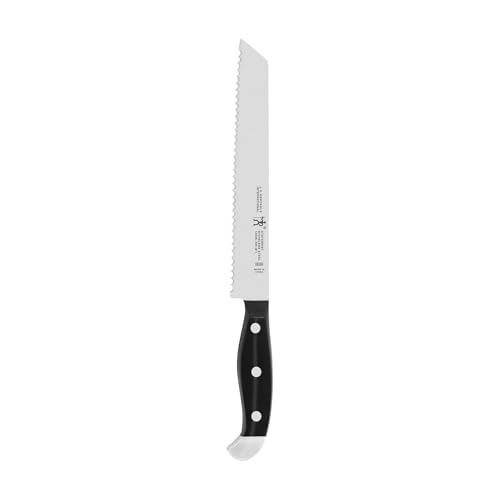
The HENCKELS Statement 8-inch, model 13546-203, is the familiar, polished option. Its single-piece, precision-stamped blade has a professional satin finish, and the design follows the traditional German-engineered look many cooks already know from other kitchen knives. If your hand expects a conventional handle shape and a bit more substance than the lightest stamped knives, this model feels immediately natural.
At 6.4 ounces, it is the heaviest 8-inch knife here, and that weight helps the teeth settle into a firm crust without extra arm pressure. The maker describes the edge as strong and suited to hard crusts, and the blade as finely honed for lasting sharpness. The listing marks it as dishwasher safe, though hand washing is gentler.
Pick the Henckels for standard loaves, baguettes, and cakes, a traditional look, and easy care. Skip it for very wide boules, where the longer Mercer or Victorinox finish slices more cleanly, or for the lightest thin work, where the Tojiro leads.
Specs
- Blade length: 8 inches
- Model: 13546-203
- Steel: High-quality stainless steel, satin finish
- Edge: Serrated edge with long prongs for hard crusts
- Construction: Single-piece, precision-stamped
- Handle: Stainless steel handle, traditional Statement styling
- Weight: 6.4 ounces, 0.4 pounds
- Care: Listed as dishwasher safe; hand washing recommended to retain the edge
Comparison Summary
All five knives cut both crusty and soft bread, but they divide cleanly by length, weight, and care. For large loaves and cake layers, the 10-inch Mercer M23210 and the 10.25-inch Victorinox 47547 give the longest strokes and the fewest fresh strokes. The Mercer offers a wide wavy edge and a textured Santoprene grip in a plain working design. The Victorinox adds a curved pastry-style profile, a Fibrox grip, and Swiss manufacture at the same light weight.
For finesse, the Tojiro F-737 is lightest and thinnest, best for thin slices and delicate crumb. For simplicity, the Orblue is a one-piece 8-inch knife best for daily loaves and easy rinsing. For a traditional feel, the Henckels Statement brings a satin-finished stamped blade and more weight at 8 inches.
Do not hone these edges on a standard steel or pull them through a plain-edge sharpener. When a serrated knife finally dulls, professional servicing or replacement is the realistic path.
FAQ
How long should a bread knife be for sourdough?
For most sourdough boules, 9 to 10.25 inches works best. A longer blade lets you finish a wide slice in one or two long strokes without the handle hitting the crust, keeping the bottom edge clean. An 8-inch knife still works on smaller loaves and sandwich bread, but it needs more strokes on a wide round and can tear the far side.
Are wavy serrations better than pointed teeth?
Wavy serrations are gentler. Their broad arcs glide through soft crumb with less tearing and fewer crumbs, and they still grip crust with a light sawing motion. Pointed teeth bite a very hard crust faster but can shred tender bread if you press down. Choose wavy edges for mixed daily use and pointed teeth only if thick, chewy crusts dominate your baking.
Can a bread knife be sharpened at home?
Not easily. Each tooth and gullet has its own shape, so a flat stone or plain-edge pull-through sharpener can damage the pattern. Cut only on wood or soft boards, store the knife protected, and wash it by hand. When it dulls, use a professional service for serrated blades.
What else can I slice with a bread knife?
Foods with a firm outside and soft inside suit a serrated blade: tomatoes, citrus, melons, pineapple, cakes, and pastries. Use a long, light stroke and let the teeth grip the skin first. Avoid frozen food, bone, and hard boards.
Conclusion
The best bread knife for you depends on the loaves on your counter. If you bake or buy large crusty rounds, begin with the Mercer Millennia 10-inch for its wide wavy edge and grippy working handle, or the Victorinox Fibrox Pro 10.25-inch for its curved profile and light professional grip. If you prize thin, delicate slices, the Tojiro F-737 offers the lightest touch. If you want compact, one-piece simplicity, choose the Orblue 8-inch. If you want a traditional look, a little more weight, and easy care, choose the Henckels Statement 8-inch. Any of the five will slice crusty and soft bread without tearing if you match length to your loaves, use long light strokes, and store the teeth protected.
More from Amazon
Programs that pair well with the guide above. Offers and eligibility are set by Amazon and may change.
Collect the home and kitchen items you want in one registry that guests can shop from.
Create a wedding registrySet up recurring deliveries of everyday items on eligible products. Terms and savings are set by Amazon.
Explore Subscribe & SaveFree shipping on eligible items, Prime Video and more. Eligible new members can start with a free trial.
Start a Prime free trialAudiobooks and podcasts to listen to on the go. Eligible new members can start with a free trial.
Try Audible freeAs an Amazon Associate we earn from qualifying purchases.

Write Your Review
No reviews yet. Be the first to share your experience!