

Key takeaways
- Strength: Welded steel body resists crushing, stacking, and impact. You can stack 3-4 loaded .50 cal cans without deformation.
- Seal: Compressible rubber gasket around the lid perimeter. When latched correctly, it creates an airtight and highly water-resistant seal.
- Security: Latch can be secured with a padlock through the hasp, and steel is far more difficult to pry or cut than plastic.
- Downsides: Heavy even when empty, will rust if paint is chipped or gasket traps moisture, and can dent.
The best ammo cans for secure storage are steel M2A1-style cans for maximum durability and long-term stacking, and polymer cans like the MTM ACR series, Plano Field Box, or MTM AC4C for lightweight portability and corrosion-proof waterproof storage.
Your choice comes down to what you are storing and where. Steel wins for fire resistance, security, and airtight seal longevity, while polymer wins for weight, rust-proof performance, and carrying comfort. Both can be waterproof if they have a quality gasket, but they achieve secure storage in very different ways.
Our top picks

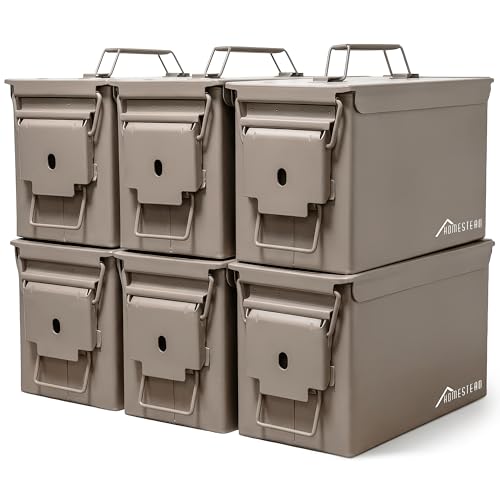
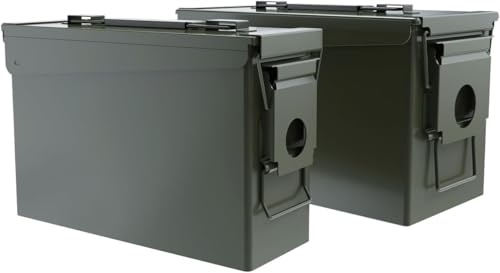
As an Amazon Associate we earn from qualifying purchases at no extra cost to you. Ratings are shown as listed on Amazon.
Steel vs. Polymer Ammo Cans: Core Differences
Traditional Steel Ammo Cans
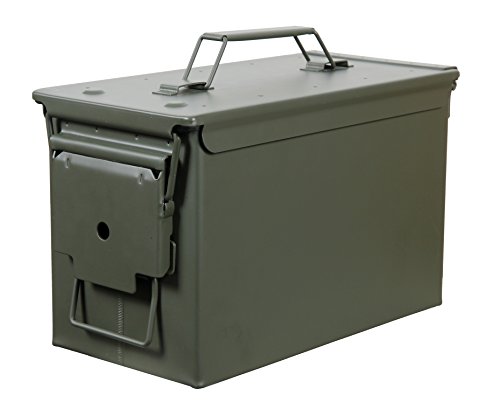
Based on U.S. military specifications M19A1 (.30 cal), M2A1 (.50 cal), and PA108 FAT 50, these are cold-rolled steel with a hinged lid, rubber gasket, and lever latch. New production cans from brands like Harbor Freight (Fortress), Sheffield, and surplus military cans all follow this pattern.
- Strength: Welded steel body resists crushing, stacking, and impact. You can stack 3-4 loaded .50 cal cans without deformation.
- Seal: Compressible rubber gasket around the lid perimeter. When latched correctly, it creates an airtight and highly water-resistant seal.
- Security: Latch can be secured with a padlock through the hasp, and steel is far more difficult to pry or cut than plastic.
- Downsides: Heavy even when empty, will rust if paint is chipped or gasket traps moisture, and can dent.
Polymer Ammo Cans
Modern polymer cans from MTM Case-Gard, Plano, and Flambeau use high-density polypropylene or polypropylene blends with O-ring or tongue-and-groove seals. Popular models include the MTM AC30C (.30 cal), AC50C (.50 cal), MTM ACR5-72 Ammo Crate, and Plano Field/Ammo Box 1312 and 1612.
- Strength: Molded one-piece body flexes rather than dents, will not rust, and handles humidity and salt air better.
- Seal: Continuous O-ring seal plus double-locking latches. Many are rated water-resistant and will float when sealed even when loaded.
- Security: Often include dual padlock points and molded-in hasps, but plastic can be cut with tools more easily than steel.
- Downsides: Less stack strength under extreme weight, can warp if stored in direct high heat (over 140°F), and plastic latches may loosen after years of UV exposure.
Spec Comparison Table: Common Ammo Can Sizes
Dimensions and weights vary slightly by manufacturer, but these are the standard figures for 2026 production models:
| Model / Type | Material | External Dimensions (L x W x H) | Empty Weight | Internal Capacity | Common Use |
|---|---|---|---|---|---|
| M19A1 (.30 Cal) Steel | Cold-rolled steel | 11.0 x 5.5 x 7.0 in | 3.9 lbs | ~200 rounds 7.62×51 / 500 rounds 5.56 | Small parts, handgun ammo, valuables |
| M2A1 (.50 Cal) Steel | Cold-rolled steel | 11.8 x 6.1 x 7.4 in | 5.2 lbs | ~400 rounds 7.62×51 / 1,000 rounds 9mm | General storage, heavy bulk ammo |
| PA108 / FAT 50 Steel | Cold-rolled steel | 12.0 x 6.0 x 8.5 in | 5.8 lbs | ~15% more volume than M2A1 | Bulky items, tools, larger supplies |
| MTM AC30C Polymer (.30 Cal) | Polypropylene | 11.3 x 5.2 x 6.9 in | 1.4 lbs | Similar to M19A1 | Portable field box, range trips |
| MTM AC50C Polymer (.50 Cal) | Polypropylene | 12.1 x 5.7 x 8.0 in | 1.8 lbs | Similar to M2A1 | Lightweight bulk storage |
| Plano 1312 / 1612 Field Box | Polypropylene | 13.0 x 6.5 x 9.5 in / 17.5 x 9.5 x 6.5 in | 2.5 – 4.1 lbs | Holds 4-6 ammo boxes + accessories | Range organization, mixed gear |
| MTM ACR5-72 Ammo Crate | Polypropylene | 18.5 x 12.5 x 10.0 in | 6.2 lbs | Holds in 4x .50 cal cans or bulk | Vehicle, garage bulk storage |
Key Buying Criteria for Secure Storage
1. Waterproof Seal and Humidity Control
A true ammo can needs a continuous, undamaged gasket. Steel cans use a flat rubber seal that compresses under the lever; polymer cans use a captured O-ring. Both are water-resistant when the gasket is clean and pliable, but neither is guaranteed submersible unless specified as water-resistant with a pressure-tested O-ring.
For secure storage beyond water, consider humidity. Steel seals tighter against vapor over decades, but any trapped moisture inside will cause rust on both the can and contents. Polymer will not rust but can trap humidity inside just as effectively. Add a rechargeable desiccant pack (30-50g per .50 cal size) and replace or recharge it every 3-6 months in humid climates. Check the gasket quarterly for cracks, flattening, or debris.
2. Locking Options and Actual Security
No standard ammo can is a safe. For secure storage, evaluate the lock interface:
- Padlock Hasp: Standard on steel M2A1/M19A1 and most MTM/Plano models. Fits a 1/4″ to 3/8″ shackle padlock. Prevents casual opening but not prying.
- Dual-Latch Lock Points: Found on MTM AC4C and Plano Field Boxes. Requires two padlocks, harder to twist open.
- Cable or Chain: Threading a cable through multiple cans and anchoring to a shelf prevents grab-and-go theft. More effective than the can’s own latch.
- Reinforced Options: Pelican-style cases and Hornady Security boxes offer steel-reinforced polymer and keyed locks for higher security, but cost significantly more than standard cans.
If you need theft deterrence for expensive contents, choose steel and store the locked can inside a locked cabinet or bolted steel locker. The can provides environmental protection; the locker provides security.
3. Size, Weight, and Portability
Weight adds up fast. A .50 cal steel can empty is 5.2 lbs; loaded with 1,000 rounds of 9mm it can exceed 38 lbs. The same volume in polymer is 1.8 lbs empty, saving over 3 lbs per can – a major difference if you carry cans to a vehicle or range.
Choose by intended location:
- .30 cal size: Best for portability, small parts, documents, first-aid, or splitting heavy ammo into manageable loads.
- .50 cal size: Best all-around for bulk storage and stacking. Fits standard shelving (12″ deep).
- FAT 50 / PA108 and Ammo Crates: Best for garage or closet bulk storage where you rarely move the container. Not ideal to carry fully loaded.
Decision Matrix: Which Can Fits Your Situation
| Your Situation | Best Choice | Why |
|---|---|---|
| Long-term storage in basement, garage, or bunker; want maximum durability and stackability | Steel M2A1 or PA108 FAT 50 | Highest crush strength, best airtight seal longevity, most pry-resistant |
| Humid, coastal, or boat/vehicle storage where rust is a concern | Polymer MTM AC50C or AC30C | Will not rust, O-ring tolerates humidity, lighter for transport |
| Frequent carrying to range, field, or between locations | Polymer .30 cal or Plano 1312 Field Box | 40-65% lighter, comfortable molded handle, no sharp edges |
| Storing documents, electronics, tools, or valuables needing moderate security | Steel .30 or .50 cal with padlock + desiccant | Steel is harder to breach, better fire resistance than polymer |
| Budget bulk organization on open shelving | Polymer MTM ACR5-72 or similar crate | Holds multiple smaller cans/boxes, one-time organization |
| Small apartment / limited space; need to store in closet | Two .30 cal polymer instead of one .50 cal steel | Easier to fit on closet shelf, lighter to lift overhead, divides weight |
Worked Example: How Many Cans Do You Need and What Will They Weigh?
If you plan bulk storage, calculate before you buy to avoid overloading shelves or your back.
Example goal: Store 2,000 rounds of 5.56×45 (55gr) for contingency storage.
- One .50 cal can holds roughly 1,000 rounds of 5.56 in 20-round boxes, or about 900 rounds loose.
- You need 2x .50 cal cans for 2,000 rounds boxed.
- Weight per 1,000 rounds 5.56 is ~27 lbs plus boxes. Add 5.2 lbs for steel or 1.8 lbs for polymer.
- Total per loaded steel can: ~32.2 lbs. Total for two cans: ~64.4 lbs.
- Total per loaded polymer can: ~28.8 lbs. Total for two cans: ~57.6 lbs.
A standard 36″ wide particleboard closet shelf is typically rated for 40-60 lbs total. Two loaded steel cans may exceed that rating. Splitting into three .30 cal cans (~21 lbs each when loaded with ~650 rounds) distributes weight better and keeps each can liftable with one hand. Always check your shelving load rating and distribute weight across studs.
Durability and Ownership Realities
Information sellers rarely mention:
- What wears first: The gasket. Steel can rubber gaskets dry out, flatten, and crack after 5-10 years, especially in heat. Polymer O-rings last longer but can pull out of the groove if pinched. Replacement gaskets for M2A1/M19A1 cost a few dollars and restore the seal completely.
- Rust starts at the seam: On steel cans, the bottom folded seam and the latch hinge are the first places to rust, not the flat sides. Touch up any paint chip with rust-inhibiting enamel immediately.
- Polymer weakness is UV and heat warping: Prolonged sun exposure makes polymer brittle and can cause lid warping that breaks the seal. Store out of direct sunlight and never leave in a car trunk in summer for months.
- Cleaning: Wipe steel cans with a dry cloth and light oil on the outside; never soak. Wash polymer cans with warm soapy water, dry completely before sealing. Do not use petroleum solvents on polymer.
- Common mistakes: Overfilling so the lid does not compress the gasket evenly, storing ammo loose with no desiccant in humid areas, and locking a damp can. Always leave 1/4″ of clearance at the top and ensure contents are dry before sealing.
- Consumables: Budget for desiccant packs and replacement gaskets/latches. A 6-pack of desiccant and two spare gaskets costs less than one replacement can and doubles seal life.
Final Picks by Use Case
Best Overall for Secure Home Storage: M2A1 (.50 Cal) Steel Can. Widely available in new production and surplus, strongest latch and stack, accepts a padlock, and replacement parts exist everywhere. Use for home storage where weight is not an issue.
Best Lightweight / Rust-Proof Alternative: MTM AC50C or AC30C. About one-third the empty weight of steel, truly rust-proof, excellent O-ring seal, and dual padlock tabs. Ideal for humid environments and transport.
Best for Organization and Portability: Plano Field Box 1312 or MTM ACR5-72 Ammo Crate. Not traditional ammo cans but better for mixing ammo, magazines, and tools with removable trays and better handles. Choose for range days and vehicle kits.
For most owners, a mix works best: steel .50 cal cans for static, long-term storage on shelving, and one or two polymer .30 cal cans for the kit you actually carry.
Frequently Asked Questions
Are ammo cans actually waterproof?
Quality cans with an intact gasket are highly water-resistant and will survive rain, splashes, and brief immersion. Most military-spec steel and O-ring polymer cans will keep contents dry if correctly latched and the seal is clean. They are not certified dive cases. For extended submersion or flooding concerns, place the sealed can inside a dry bag.
Can I use ammo cans for important documents and electronics?
Yes, with preparation. Line the bottom with a dry cloth, add desiccant to control humidity, and ensure nothing presses against the gasket. For paper, use a sealed zip bag inside the can as a second barrier against any trapped moisture.
Do I need to oil steel ammo cans?
Lightly oil the exterior latch and hinge once a year to prevent rust, but keep oil away from the rubber gasket and interior. Oil degrades rubber over time and can contaminate contents. If the interior shows surface rust, lightly sand, clean, and repaint with rust-inhibiting paint before storing anything inside.

Write Your Review
No reviews yet. Be the first to share your experience!