

Key takeaways
- Compare the best inversion tables for herniated discs on angle control, lumbar support and ankle comfort, with published specs for five leading models.
For readers comparing inversion tables for herniated discs, the Teeter FitSpine X2 is the strongest all-round pick: it pairs precise, gradual angle control with an included lumbar bridge, acupressure nodes and a 300 lb capacity, so the angle can be increased in small steps rather than all at once. The Innova ITX9600A is the leading mid-range alternative, with a six-position pin system that locks in partial angles. Below, five inversion tables are compared on published specs only — angle control, height range, weight capacity, lumbar accessories and ankle systems — so you can match a table to the setup your physician has cleared you to use.
As an Amazon Associate, we earn from qualifying purchases.
Table of Contents
- What Matters When a Disc Is Herniated
- The 5 Inversion Tables Compared
- 1. Teeter FitSpine X2
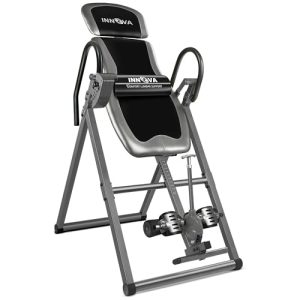
- 2. Innova ITX9600A
- 3. IRONMAN Gravity 4000
- 4. Health Gear ITM5500
- 5. Innova ITM5900
- How to Choose the Right Table
- Frequently Asked Questions
- Conclusion
- Product and ASIN Reference
What Matters When a Disc Is Herniated
Inversion therapy hangs the body at an angle so that gravity, rather than muscle effort, creates the stretch. No table in this roundup is presented as a treatment or cure for a herniated disc, and manufacturers themselves direct users with back conditions to consult a physician before inverting. What a well-chosen table can offer is control: the ability to start at a shallow angle, hold it securely, and return upright without jerking movements. Four published features decide how much control a table gives you.
Angle control. Tables limit the inversion angle in different ways. Pin systems offer fixed stops, tether straps allow any angle up to a set maximum, and balance-based designs move with your arm position. For a sensitive back, a system with several shallow stops or a strap you can shorten is easier to manage than an all-or-nothing design.
Height adjustment. The height setting positions your body weight correctly on the pivot. Every table below adjusts in small increments across a published range; the right setting is the one where raising your arms moves the table slowly and predictably.
Lumbar support options. Some tables include a lumbar bridge, cushion or massage pad in the box. These accessories change how the lower back is supported on the bed; they are comfort features, described here as the manufacturers describe them.
Ankle system. Because your full weight hangs from the ankle holders at steeper angles, padding, roller design and the reach of the locking handle all matter. Systems you can operate without bending far forward are easier for readers with limited flexibility.
Frame and capacity. A higher published weight capacity usually comes with a heavier, sturdier frame that flexes less. Match the capacity to the user with headroom to spare.
The 5 Inversion Tables Compared
1. Teeter FitSpine X2
Best for: Readers who want the most gradual, accessory-supported inversion of the group.
Teeter builds the FitSpine X2 around its FlexTech bed, which is designed to flex with the user during movement, and ships it with two lower-back accessories in the box: a detachable lumbar bridge that adds support behind the lower spine, and a set of acupressure nodes that can be placed along the bed. Angle is managed with an adjustable tether strap, so instead of fixed stops you set the maximum angle yourself and can shorten the strap to keep sessions shallow. The EZ-Reach ankle system uses a long handle and a spring-loaded lock, so securing your ankles takes less forward bending. Teeter also lists the FitSpine series as registered with the FDA as a class 1 medical device for a set of spinal conditions the company names in its own materials; your physician can advise whether that applies to your situation.
Specs
- Weight capacity: 300 lb
- Height range: 4 ft 8 in to 6 ft 6 in
- Angle control: adjustable tether strap, full inversion possible with strap removed
- Lumbar accessories included: detachable lumbar bridge and acupressure nodes
- Ankle system: EZ-Reach handle with spring-loaded ankle lock and foam rollers
- Frame: heavy-gauge steel, folds for storage
- Tier: premium
Standout points
- Lumbar bridge and acupressure nodes included rather than sold separately
- Strap-based angle control suits very gradual progression
- Ankle lock designed to reduce bending at the waist
2. Innova ITX9600A
Best for: Readers who prefer fixed, repeatable angle stops at a mid-range tier.
The ITX9600A controls angle with a six-position pin system: a locking pin sets the stop before you mount the table, covering shallow partial angles through to full inversion, and the same stop is there every session. Its True Balance system is designed to keep the pivot smooth for users of different builds, and the reversible ankle holding system combines padded holders with a pull-pin release. The backrest is padded, the handlebars are covered in soft foam for the return to upright, and the height scale adjusts in one-inch steps. No lumbar accessory is included, so readers who want extra lower-back support would add a cushion of their own.
Specs
- Weight capacity: 300 lb
- Height range: 4 ft 10 in to 6 ft 6 in
- Angle control: six-position adjustable pin system
- Lumbar accessories included: none; padded backrest as standard
- Ankle system: reversible ankle holders with pull-pin adjustment
- Frame: tubular steel, folds for storage
- Tier: mid-range
Standout points
- Six fixed stops make shallow angles repeatable session to session
- Height adjusts in small one-inch increments
- Simple mechanical design with few parts to manage
3. IRONMAN Gravity 4000
Best for: Heavier readers, or anyone who wants the highest capacity and a lumbar pillow included.
The Gravity 4000 carries the highest published capacity in this group at 350 lb, on a wide tubular steel frame with a scratch-resistant powder-coat finish. The backrest is memory foam with an adjustable lumbar pillow included, which can be positioned behind the lower back or removed. Its ankle system is palm-activated: a ratchet handle at ankle height locks the vinyl-covered foam rollers, so there is no long reach down to a foot-level lever. Angle is limited by a tether strap, and the table inverts up to 180 degrees with the strap removed. Non-skid floor stabilizers and tough rubber boots are fitted to keep the frame planted.
Specs
- Weight capacity: 350 lb
- Height range: up to 6 ft 6 in
- Angle control: adjustable tether strap, up to full inversion
- Lumbar accessories included: removable, adjustable lumbar pillow
- Ankle system: palm-activated ratchet lock with foam roller holders
- Backrest: memory foam
- Frame: extra-wide tubular steel, folds for storage
- Tier: mid-range
Standout points
- Highest capacity here, with headroom for larger users
- Ratchet ankle lock is operated by palm pressure rather than grip strength
- Lumbar pillow and memory foam backrest included
4. Health Gear ITM5500
Best for: Readers who want heat and vibration massage built into the backrest.
The ITM5500 is sold as an advanced-technology table, and its distinguishing feature is a removable heat and vibration massage pad that sits against the lumbar area of the backrest, operated by a wired remote. The frame uses a three-position adjustable center rotational bar to set how responsively the table moves, and the ankle system combines foam rollers with a locking bar. Sur-lock ankle holders and a padded backrest complete the setup. The published capacity is 300 lb, and the frame folds for storage. Readers who do not want the massage pad can remove it and use the table as a standard inversion table.
Specs
- Weight capacity: 300 lb
- Height range: 5 ft 1 in to 6 ft 5 in
- Angle control: adjustable rotational bar with tether-limited inversion
- Lumbar accessories included: removable heat and vibration massage pad with remote
- Ankle system: foam rollers with Sur-lock holders
- Frame: steel, folds for storage
- Tier: mid-range
Standout points
- Heat and massage pad included and removable
- Rotational bar adjusts how quickly the table responds
- Massage functions controlled from the backrest with a remote
5. Innova ITM5900
Best for: Readers who want a heat and massage pad plus fixed pin angle stops.
The ITM5900 combines the two control styles covered above: it uses a five-position pin system for repeatable angle stops, and adds an integrated vertical massage pad with heat that runs along the spine rather than only at the lumbar area. The pad’s settings are handled by a remote, and an adjustable headrest pad is included for support at steeper angles. Like the ITX9600A, it uses Innova’s True Balance pivot design and a reversible ankle holding system, with a 300 lb capacity and a height range that starts at the shorter end of this group.
Specs
- Weight capacity: 300 lb
- Height range: 4 ft 10 in to 6 ft 6 in
- Angle control: five-position adjustable pin system
- Lumbar accessories included: integrated heat and massage pad with remote, adjustable headrest pad
- Ankle system: reversible ankle holders with pull-pin adjustment
- Frame: tubular steel, folds for storage
- Tier: mid-range
Standout points
- Full-length heat and massage pad rather than a lumbar-only pad
- Pin stops plus massage in one table
- Headrest pad included for support while inverted
How to Choose the Right Table
Start with the angle system, because it shapes every session. If your physician has suggested beginning with very mild angles, a tether strap design such as the FitSpine X2 or the Gravity 4000 lets you set a shallow maximum and lengthen it gradually. If you would rather set a stop once and trust it, the pin systems on the two Innova tables give you the same angle every time without re-measuring a strap.
Next, check the fit numbers. Your height must sit inside the published range, and your weight should sit comfortably below the capacity; the Gravity 4000’s 350 lb rating gives the most headroom, while the other four tables are rated at 300 lb. Then consider the ankle system: at full inversion your body weight rests there, so padded rollers and a lock you can reach without folding forward — the Teeter’s long handle and the IRONMAN’s palm ratchet — are practical advantages for stiff or sore backs.
Finally, decide on accessories. A lumbar bridge (Teeter), a lumbar pillow (IRONMAN) and heat and massage pads (Health Gear and the Innova ITM5900) are different approaches to lower-back comfort; none of them changes what inversion itself does, and all five tables work without relying on the accessory. Whichever model you choose, follow the manufacturer’s guidance: begin at a shallow angle for short sessions, increase gradually only as your clinician advises, and stop if pain increases.
Frequently Asked Questions
Can an inversion table fix a herniated disc?
No table in this article is claimed to fix, cure or treat a herniated disc. Inversion tables are designed to let gravity stretch the body at a controlled angle, and some users choose inversion as one part of a routine their physician has approved. Only a clinician who knows your imaging and history can advise whether inversion is appropriate for your disc.
What angle should beginners with a disc problem start at?
Manufacturers generally advise starting with a shallow angle, around 20 to 30 degrees, for a few minutes at a time, and increasing only gradually. Tables with pin stops or an adjustable tether strap make it easier to hold a shallow angle consistently. Your physician’s guidance takes priority over any general advice in this article.
Is full inversion better than partial inversion?
Not necessarily, and for many readers partial inversion is the practical choice. The tables here can be limited to partial angles with their pin or strap systems, and full inversion places the most load on the ankle holders. Many users stay at moderate angles permanently; the right angle is the one your clinician has cleared and that you can return from smoothly.
Who should not use an inversion table?
Manufacturers list contraindications that commonly include high blood pressure, glaucoma and other eye conditions, heart conditions, pregnancy, recent surgery and certain spinal conditions. A herniated disc itself may rule inversion in or out depending on its location and severity, which is why every brand in this roundup directs buyers to consult a physician before use.
Conclusion
For most readers comparing inversion tables for herniated discs, the Teeter FitSpine X2 offers the most considered package: strap-based angle control for gradual progression, a lumbar bridge and acupressure nodes in the box, and an ankle system designed to limit bending. The IRONMAN Gravity 4000 is the pick for heavier users, with a 350 lb capacity and a ratchet ankle lock, while the Innova ITX9600A keeps things simple with six fixed angle stops. Readers who want heat and massage should look at the Health Gear ITM5500 or the Innova ITM5900. Whichever table you choose, treat the published specs as your shortlist filter, and treat your physician’s advice as the final word on whether and how far to invert.
More from Amazon
Programs that pair well with the guide above. Offers and eligibility are set by Amazon and may change.
Collect the home and kitchen items you want in one registry that guests can shop from.
Create a wedding registrySet up recurring deliveries of everyday items on eligible products. Terms and savings are set by Amazon.
Explore Subscribe & SaveFree shipping on eligible items, Prime Video and more. Eligible new members can start with a free trial.
Start a Prime free trialAudiobooks and podcasts to listen to on the go. Eligible new members can start with a free trial.
Try Audible freeAs an Amazon Associate we earn from qualifying purchases.

Write Your Review
No reviews yet. Be the first to share your experience!