

Key takeaways
- Choose the Normatec 3 Legs when pressure precision and five-zone coverage matter most. Choose the RecoveryAir JetBoots when cordless convenience will determine whether you use the device regularly. Choose a lower-priced pneumatic boot when you want basic sequential compression for occasional home sessions, but prioritize…
Best Leg Compression Massagers for Recovery
The best leg compression massagers for most post-workout users are the Hyperice Normatec 3 Legs for adjustable, structured recovery, the Therabody RecoveryAir JetBoots for cordless convenience, and a full-length pneumatic boot with heat if warmth matters more than portability.
These devices use inflatable chambers that fill and release air around the legs. They are not interchangeable with a vibrating massager: compression boots provide sequential pressure, while vibration products mainly create local movement. The right choice depends on pressure control, leg coverage, fit, noise, controls, and how consistently you will use the device.
Our top picks


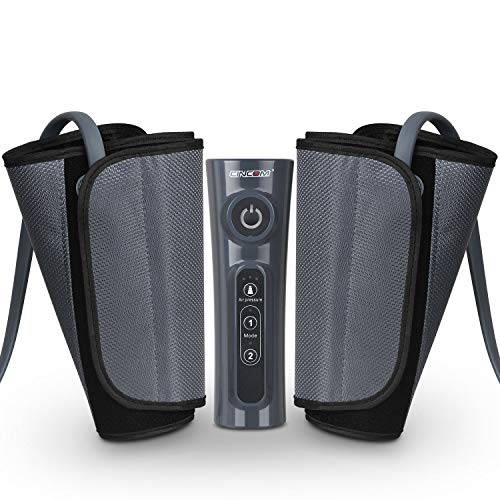

As an Amazon Associate we earn from qualifying purchases at no extra cost to you. Ratings are shown as listed on Amazon.
Quick comparison: leading compression boot types
| Product or type | Pressure and zones | Boot coverage and fit | Heat | Controls and power | Typical market range |
|---|---|---|---|---|---|
| Hyperice Normatec 3 Legs | 7 intensity levels; 5 overlapping zones | Full foot, calf, knee, thigh; adjustable wrap-style leg fit | No integrated heat | Wireless controller; rechargeable battery rated for about 2.5 hours | $700–$900 |
| Therabody RecoveryAir JetBoots | 4 pressure levels; sequential multi-zone compression | Full-leg, foot-to-thigh boot; cordless design | No integrated heat | Built-in controls; roughly 2–3 hours of use per charge, depending on setting | $700–$900 |
| Connected pneumatic boots with separate controller | Usually 4–6 zones; commonly 4–6 pressure levels | Often supplied in short, standard, and long sizes; check thigh circumference | Usually no; some accessories add warmth | AC controller, sometimes with a wired remote; commonly 45–60 minute timers | $250–$600 |
| Entry-level full-leg air massager | 2–4 zones; commonly 3–4 pressure levels | More generous wrap adjustment, but less precise chamber overlap | Occasionally included, usually at one fixed temperature | Wired hand control; AC power | $100–$250 |
Specifications vary by revision and size, so confirm the exact model before purchase. Pressure numbers are not always directly comparable: one company may list chamber pressure in mmHg while another emphasizes numbered intensity levels. A higher number does not automatically mean a better recovery session.
Best picks by situation
| Your priority | Best fit | Why | Trade-off |
|---|---|---|---|
| Most adjustable pressure | Normatec 3 Legs | Seven intensity settings and five zones make gradual progression easier | Premium price and no heat |
| Travel or minimal setup | RecoveryAir JetBoots | Integrated cordless design avoids hoses and a separate pump | Fewer manual pressure steps than the Normatec |
| Occasional home use on a budget | Entry-level pneumatic boots | Lower upfront cost and sufficient basic sequential compression | More noise, less refined fit, and shorter expected service life |
| Long legs or large thighs | Boots with explicit long and wide sizing | Better chamber placement prevents gaps and concentrated pressure | Dimensions matter more than brand; standard boots may not fit |
| Warmth is essential | Compression boots with a dedicated heat setting | Combines pneumatic pressure with adjustable warmth | Heat can add bulk, battery drain, and another component to clean |
What to evaluate before buying
Pressure levels and compression pattern
Look for at least three clearly separated intensity settings, a low setting for first use, and a timer that stops automatically. More advanced systems let you alter the sequence or hold pressure in selected zones. This is useful when one area feels more fatigued than another, but it also increases complexity.
For a first session, use the lowest setting for 15–20 minutes. The boot should feel snug and rhythmic, not painful, numb, or sharply constricting. Do not assume the maximum setting is the most effective one. A comfortable, repeatable session is more useful than an unpleasant setting you avoid.
Massage zones and coverage
Five overlapping zones generally offer a smoother progression from foot to thigh than two large chambers. Foot coverage is particularly important: some boots stop at the ankle, while others include a separate inflatable section under or around the foot. A foot chamber adds coverage but can feel tight in wide shoes or high arches.
Measure from the bottom of your heel to the top of your thigh, then measure calf and thigh circumference at their widest points. Compare those measurements with the manufacturer’s size chart rather than relying on height alone. A boot that is too short can place a chamber across the wrong joint; one that is too loose may inflate unevenly.
Heat options
Heat is a comfort feature, not a requirement for pneumatic compression. It may appeal after cold-weather training or when you prefer a warmer sensation, but it reduces simplicity and can shorten cordless runtime. If a model has heat, look for at least two temperature settings, a separate heat switch, and an automatic shutoff. Avoid sleeping in a heated device.
Controls, noise, and portability
A controller with physical buttons is easier to operate while seated than a phone-only interface. A display should show intensity, remaining time, battery status, and the active zone. Cordless boots are convenient in a hotel room, but an AC-powered pump can run longer sessions without charging.
Noise is usually produced by the pump rather than the fabric boots. Expect a quiet hum and periodic valve clicks from most systems; lower-cost pumps can be noticeably louder. If you plan to read or watch television, choose a model described as quiet and check whether the pump can sit beside the chair instead of directly on it.
Setup for a consistent post-workout session
- Inspect the boots and hoses. Check for twisted tubing, damaged seals, or a stuck zipper before connecting power.
- Put the boots on over thin, dry clothing. Smooth fabric reduces rubbing and keeps sweat away from the liners.
- Align the foot and knee sections. Fasten the boot evenly; do not force a zipper over a circumference it was not designed to accommodate.
- Start low for 15–20 minutes. Increase pressure only if the sensation remains comfortable and circulation feels normal.
- Stop for pain, numbness, tingling, unusual color change, or worsening swelling. Those symptoms are a reason to remove the boots and seek appropriate medical advice.
- Wipe and dry the interiors. Leave zippers open until the fabric is fully dry before storing the unit.
Ownership costs and durability
A $150 entry-level unit used once weekly for two years costs about $1.44 per session before electricity. A $800 premium unit used four times weekly for three years costs about $1.28 per session. The premium model can therefore make sense for frequent users, even though its purchase price is much higher.
The first parts likely to show wear are zippers, hook-and-loop fasteners, hose connectors, and the fabric around the foot. Sweat, body oils, and storing the boots while damp accelerate deterioration. Use a slightly damp cloth and mild soap unless the manual permits another cleaner; do not machine-wash inflatable chambers or immerse the controller.
Keep hoses loosely coiled, avoid placing weight on the pump, and store the boots away from heat and direct sunlight. For cordless models, follow the charging guidance and avoid leaving a depleted battery unused for many months. Replacement hoses and cuffs may be available for premium systems, while inexpensive units can be difficult to repair economically.
Who should ask a professional first?
Compression equipment is not appropriate for everyone. Ask a healthcare professional before use if you have diagnosed or suspected circulation problems, a history of blood clots, significant swelling with an unexplained cause, uncontrolled heart or vascular conditions, reduced sensation, or a recent operation or injury. This article provides general buying information, not a diagnosis or treatment recommendation.
Bottom line
Choose the Normatec 3 Legs when pressure precision and five-zone coverage matter most. Choose the RecoveryAir JetBoots when cordless convenience will determine whether you use the device regularly. Choose a lower-priced pneumatic boot when you want basic sequential compression for occasional home sessions, but prioritize documented sizing, washable surfaces, replacement parts, and a low starting pressure over the number of modes listed on the box.



Write Your Review
No reviews yet. Be the first to share your experience!