

Key takeaways
- Compare the best inversion tables for neck pain, with precise angle limiters, contoured headrests, secure ankle systems and height ranges explained.
- Top Pick: Conclusion
- Runner-up: Conclusion
- Also consider: Conclusion
The best inversion table for neck pain is the Teeter FitSpine X1, because cervical traction works at shallow, carefully limited angles, and the X1 combines a preset angle tether, precision-balanced rotation, an FDA-registered design and UL safety certification. The Teeter EP-960 Ltd. adds an extended ankle lock handle and traction handles for assisted stretching at those same shallow angles. The Innova ITX9700 pairs an adjustable headrest with a memory foam lumbar pad, the Innova ITX9688 is the budget pick with a multi-position headrest and extended ankle holders, and the YOLEO Gravity Heavy Duty covers the value tier with a memory foam bed and an adjustable headrest of its own. Every model below lets you cap the angle well short of full inversion, which is where neck routines should stay.
As an Amazon Associate, we earn from qualifying purchases.
Table of Contents
- How to Choose an Inversion Table for Neck Pain
- 1. Teeter FitSpine X1
- 2. Teeter EP-960 Ltd.
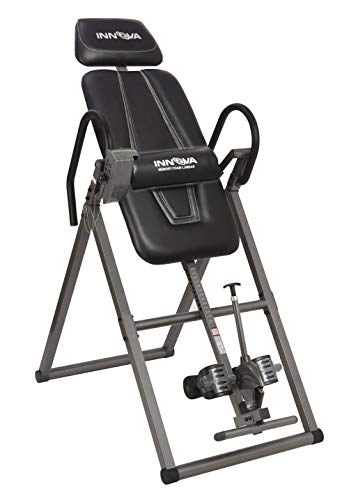
- 3. Innova ITX9700
- 4. Innova ITX9688
- 5. YOLEO Gravity Heavy Duty
- Frequently Asked Questions
- Conclusion
How to Choose an Inversion Table for Neck Pain
Start with angle control, because the neck needs less inversion, not more. Traction reaches the cervical spine at partial angles, and most neck routines work between 20 and 40 degrees. Pressure in the head and eyes climbs as the angle deepens, which is the opposite of what a sore neck needs, so the angle limiter is the feature that matters most: look for a preset tether strap or a multi-position pin that physically stops the bed at the angle you set. A table that can only be controlled by balance alone is a poor match for neck work.
Clear inversion with a physician first, and treat red flags seriously. Neck pain that comes with arm weakness, numbness or tingling in the hands, dizziness, or pain after a fall or accident needs a medical evaluation before any home traction. Inversion also raises pressure in the head, so people with uncontrolled high blood pressure, glaucoma or other eye conditions, a history of stroke, carotid artery disease, recent neck or spinal surgery, or who are pregnant should not invert unless a specialist approves it. An inversion table is a home traction tool, not a diagnosis or a treatment for the underlying cause of neck pain.
Check the headrest and the top of the bed. Your head stays on the bed for the whole session, and a neck that is pushed forward or left unsupported will complain quickly. Adjustable headrest pillows let you set the support under the curve of the neck, and contoured beds that flex with the spine keep the head and shoulders in a neutral line. If you plan longer sessions at shallow angles, headrest adjustability is worth more than extra padding lower down the bed.
Match the height range and capacity to your body. The height setting positions your center of gravity over the pivot, which is what makes rotation smooth and predictable instead of abrupt. Taller than the stated range and the table can rotate too fast; shorter than the minimum and the ankle holders may not close securely around you. Capacity works the same way: pick a rating comfortably above your weight so the frame, bearings and ankle system operate inside their design limits. The five tables here are all rated at 300 lb, with height ranges starting between 4 feet 8 inches and 4 feet 10 inches and topping out at 6 feet 6 inches.
Prioritize ankle comfort and an easy lock. At partial angles your ankles carry less load than at full inversion, but they still anchor your whole body while your neck is trying to relax. Contoured, padded holders that spread pressure across the front and back of the ankle help you stay in position for a useful session. Extended or ratchet-style locks also matter more than most buyers expect: bending deeply to fasten your ankles strains the neck and shoulders you are trying to unload, so a longer handle or an extended holder is a genuine neck-pain feature, not a luxury.
1. Teeter FitSpine X1
The FitSpine X1 is the premium pick and the strongest fit for neck routines, because its design centers on controlled, partial inversion. The EZ-Angle tether strap lets you preset your maximum angle in advance, marked at 20, 40 and 60 degrees, and the precision-balanced frame means small shifts of your arms move the bed smoothly instead of in sudden tips that jar a sore neck. Teeter lists the X1 as FDA-registered and UL safety-certified, and its FlexTech backrest flexes with your spine during the stretch rather than holding it flat and rigid, so the head and shoulders settle in a neutral line. Eight removable acupressure nodes and an adjustable lumbar bridge are included for the lower back, and the Ergo-Embrace ankle supports wrap the ankle with contoured foam, which helps when sessions run several minutes at a shallow angle.
Specs:
- Weight capacity: 300 lb
- User height range: 4 ft 8 in to 6 ft 6 in
- Angle control: EZ-Angle tether with preset markings at 20, 40 and 60 degrees, precision-balanced rotation
- Ankle system: EZ-Reach ankle lock with Ergo-Embrace supports
- Backrest: FlexTech bed with 8 acupressure nodes and adjustable lumbar bridge
- Certification: FDA-registered, UL safety-certified
2. Teeter EP-960 Ltd.
The EP-960 Ltd. is the pick for buyers who want Teeter’s certified platform with hardware aimed at easier, assisted sessions. It carries the same FDA registration as a 510(k) medical device and the same UL safety certification as the X1, and its EZ-Reach ankle system uses an extended handle, so securing your ankles takes noticeably less forward bending, a real benefit when bending is what aggravates your neck. The ComforTrak bed flexes for comfort and has built-in hand grips, and the included traction handles and Stretch Max handles let you add gentle manual stretch while resting at a shallow angle, which suits neck and shoulder tension well. The EZ-Angle tether presets at 20, 40 and 60 degrees keep the ceiling on your session mechanical rather than balance-based. Acupressure nodes and a lumbar bridge are included, and a five-year full warranty backs the frame.
Specs:
- Weight capacity: 300 lb
- User height range: 4 ft 8 in to 6 ft 6 in
- Angle control: EZ-Angle tether with preset markings at 20, 40 and 60 degrees
- Ankle system: EZ-Reach ankle system with extended lock handle and Ankle Comfort Dial
- Backrest: ComforTrak bed with traction handles, acupressure nodes and lumbar bridge
- Certification: FDA-registered 510(k) medical device, UL safety-certified
- Warranty: 5-year full warranty
3. Innova ITX9700
The ITX9700 is the mid-range pick built around head and lumbar comfort. Its adjustable headrest pillow can be repositioned to sit under the curve of the neck, which is the detail neck-pain shoppers should weigh first on this class of table, and the removable memory foam lumbar pad supports the lower back while traction is applied along the whole spine. Angle control comes from a six-position pin system with a protective cover, giving fixed, repeatable stops that suit a conservative routine you return to daily. Innova’s True Balance system is designed to make rotation respond to small weight shifts rather than sudden swings, and the reversible ankle holders use a large front holder with a smaller rear holder to spread pressure. It skips the Teeter certifications, which is where the mid-range positioning comes from, but the structure and 300 lb rating are squarely in line with the rest of this group.
Specs:
- Weight capacity: 300 lb
- User height range: 4 ft 10 in to 6 ft 6 in
- Angle control: six-position pin system with protective cover
- Ankle system: large front and small rear holders, reversible
- Backrest: padded bed with removable memory foam lumbar pad
- Extras: adjustable headrest pillow, True Balance system
4. Innova ITX9688
The ITX9688 is the budget pick in this roundup, and two of its features answer neck-pain problems directly. Its headrest adjusts to multiple positions, so support can be placed where your neck curve needs it rather than wherever a fixed pad happens to sit, and its extended ankle holding system lengthens the locking mechanism so the holders can be secured with less forward bending. The ankle holders are also reversible, letting you swap their positions to change where pressure falls across the ankle. The padded backrest rides on a heavy-duty steel frame, and the six-position pin adjustment shared across the Innova line gives repeatable angle stops for a shallow, conservative routine. It gives up the memory foam lumbar pad of the ITX9700 and the certifications of the Teeter models, which is where the savings come from, but the core structure and 300 lb rating match its siblings.
Specs:
- Weight capacity: 300 lb
- User height range: 4 ft 10 in to 6 ft 6 in
- Angle control: six-position pin system with protective cover
- Ankle system: extended ankle holding system, reversible holders
- Backrest: padded bed with multi-position adjustable headrest
- Frame: heavy-duty steel
5. YOLEO Gravity Heavy Duty
The Gravity Heavy Duty is the value pick, covering the essentials a neck routine needs at the lowest tier in this roundup. The backrest is high-density memory foam shaped to the curve of the back, and the headrest adjusts so the head stays supported instead of hanging off the top of the bed. An adjustable safety belt adds a second layer of security across the body, and the angle stops are set on the rear cross bar, giving fixed positions you can return to instead of free-swinging balance. The steel frame is rated to 300 lb and the height adjustment covers the same 4 feet 10 inches to 6 feet 6 inches range as the Innova models. It lacks a preset tether with marked angles and any third-party certification, so disciplined, shallow sessions matter more here, but for buyers who want a padded bed and an adjustable headrest on a budget, it covers the fundamentals.
Specs:
- Weight capacity: 300 lb
- User height range: 4 ft 10 in to 6 ft 6 in
- Angle control: fixed angle positions on the rear cross bar
- Ankle system: padded ankle holders with adjustable safety belt
- Backrest: memory foam bed with adjustable headrest
- Frame: heavy-duty steel, foldable for storage
Frequently Asked Questions
Can an inversion table really help neck pain?
Inversion applies gentle traction along the whole spine, and at shallow angles some of that stretch reaches the cervical spine, which is why some people with stiffness and muscle tension in the neck find short-term relief. It does not fix the underlying cause of neck pain, which can range from posture and muscle strain to disc or joint problems that need proper diagnosis. Treat the table as one tool inside a plan your physician or physical therapist agrees with, and stop if symptoms move into the arms or hands.
What inversion angle is best for neck pain?
Shallow angles are the rule for the neck. Most routines start around 20 degrees and stay between 20 and 40 degrees, because cervical traction does not require deep inversion and head and eye pressure rises quickly as the angle increases. Tables with a preset tether or a position pin, like the five above, hold that angle mechanically instead of relying on your balance. Build duration before you build angle, and come back up slowly to avoid lightheadedness.
Who should not use an inversion table for neck pain?
Do not invert without specialist clearance if you have uncontrolled high blood pressure, glaucoma or other eye disease, a history of stroke, carotid or vertebral artery problems, recent neck or spinal surgery, a cervical fracture or instability, or if you are pregnant. Neck pain with progressive arm weakness, loss of hand coordination, fever, or pain that follows a fall or accident is a reason to see a doctor promptly rather than a reason to buy equipment. When in doubt, get assessed first.
How long should a neck pain inversion session last?
Maker guidance for inversion generally suggests starting with one to three minutes once or twice a day at a shallow angle, then extending sessions gradually only if your neck feels the same or better afterward. How your neck responds in the hours after a session matters as much as how it feels on the table, so keep a conservative schedule and review it with your physician or therapist. Short, regular, gentle sessions are more useful than occasional long or deep ones.
Conclusion
For neck pain, the right inversion table is the one that makes shallow, repeatable traction easy to control and keeps your head properly supported. The Teeter FitSpine X1 leads this roundup with its preset angle tether, precision balance, FDA registration and UL certification, and the EP-960 Ltd. keeps that certified foundation while adding an extended ankle handle and traction handles for assisted stretching. The Innova ITX9700 stands out for its adjustable headrest and memory foam lumbar pad, the ITX9688 brings a multi-position headrest and an extended ankle lock to the budget tier, and the YOLEO Gravity Heavy Duty covers the value end with a memory foam bed and adjustable headrest. Whichever model fits, get medical clearance first, start at a shallow angle, and let the limiter, not momentum, decide how far you go.




More from Amazon
Programs that pair well with the guide above. Offers and eligibility are set by Amazon and may change.
Collect the home and kitchen items you want in one registry that guests can shop from.
Create a wedding registrySet up recurring deliveries of everyday items on eligible products. Terms and savings are set by Amazon.
Explore Subscribe & SaveFree shipping on eligible items, Prime Video and more. Eligible new members can start with a free trial.
Start a Prime free trialAudiobooks and podcasts to listen to on the go. Eligible new members can start with a free trial.
Try Audible freeAs an Amazon Associate we earn from qualifying purchases.




Write Your Review
No reviews yet. Be the first to share your experience!