

Key takeaways
- It is usually heavier and more expensive than entry-level tables.
- The larger frame is less convenient to move between rooms.
- More adjustment points mean more parts to inspect and tighten.
The best inversion tables for back relief are the Teeter FitSpine X3 for premium ankle comfort and construction, the Innova ITX9600 for adjustable features at a moderate price, and a compact folding table for occasional users with limited floor space.
Inversion tables differ less in their basic purpose than in how safely and comfortably they hold your body. The important buying questions are whether the ankle supports fit without painful pressure, whether the height and weight adjustments match you, how precisely you can control the angle, and whether you have enough clear space to rotate without striking a wall or piece of furniture.
Our top picks


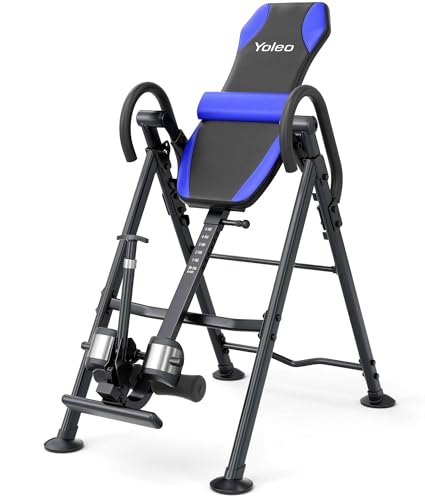

As an Amazon Associate we earn from qualifying purchases at no extra cost to you. Ratings are shown as listed on Amazon.
Quick comparison of the best inversion tables
| Choice | Best for | Typical user height | Weight capacity | Inversion control | Approximate floor space | General market range |
|---|---|---|---|---|---|---|
| Teeter FitSpine X3 | Frequent use and ankle comfort | About 4 ft 8 in to 6 ft 6 in | Up to about 300 lb | Adjustable tether, handle-assisted return, optional full rotation depending on configuration | About 60 in long by 28 in wide; allow 80 in or more of clear length | About $350–$550 |
| Innova ITX9600 | Feature value and adjustable positioning | About 4 ft 10 in to 6 ft 6 in | Up to about 300 lb | Adjustable safety tether and angle-control system | About 46 in long by 26 in wide; allow roughly 75 in of clear length | About $150–$250 |
| Body Champ IT8070 | Basic home use on a budget | About 4 ft 9 in to 6 ft 6 in | Up to about 250 lb | Safety tether and manual pivot control | About 47 in long by 26 in wide; allow roughly 75 in of clear length | About $120–$200 |
| Compact folding inversion table | Smaller rooms and infrequent use | Commonly about 4 ft 10 in to 6 ft 3 in | Usually 250–300 lb | Usually a tether with fixed angle settings | Often 50–65 in long by 25–30 in wide when open | About $130–$300 |
Dimensions and capacities can vary by production version, so check the specific manual before purchase. The clearance figures are more useful than the folded dimensions: an inversion table that stores in a small closet may still need most of a room when you are tilted backward.
Best overall for regular use: Teeter FitSpine X3
The Teeter FitSpine X3 is the strongest choice for people who expect to use an inversion table several times per week and are willing to pay for more refined contact points. Its ankle-lock design uses a height-adjustable support system and broad, contoured cuffs rather than relying only on a narrow bar pressing against the ankles. That matters because ankle pressure is often the first comfort problem during longer sessions.
The table has a relatively substantial frame, a padded back surface, adjustable traction-style handholds, and a tether that limits the maximum angle. Its balance is designed to make returning upright less abrupt than on a poorly balanced table. It is also one of the better options for taller users, although people near the upper height or weight limit should confirm the current specification.
Trade-offs
- It is usually heavier and more expensive than entry-level tables.
- The larger frame is less convenient to move between rooms.
- More adjustment points mean more parts to inspect and tighten.
Choose it when ankle comfort, frame solidity, and frequent use matter more than the lowest purchase price.
Best adjustable-value option: Innova ITX9600
The Innova ITX9600 is a practical middle ground. It commonly includes adjustable height settings, a padded backrest, a safety tether, and an adjustable headrest or lumbar-support arrangement depending on the version. Its angle-control system is useful for beginners because it can limit how far the table travels instead of leaving the user to manage the entire range immediately.
Its ankle holders are serviceable for many users, but they generally provide less cushioning and contouring than premium Teeter supports. Fit is especially important if you have a smaller ankle circumference, sensitive Achilles tendons, or difficulty reaching the release mechanism while inverted. Try the lowest angle first and verify that the locking and release levers can be operated without twisting awkwardly.
The ITX9600 suits a household that wants adjustable positioning and occasional-to-regular use without moving into premium pricing. It is also a sensible choice for a first table when you are unsure whether inversion will become part of your routine.
Best budget choice: Body Champ IT8070
The Body Champ IT8070 focuses on the essentials: a padded platform, height adjustment, ankle supports, a tether, and a steel frame. It can be adequate for short sessions when used within its limits and placed on a level, non-slip surface.
The compromise is refinement. Budget ankle holders may concentrate pressure in a smaller area, the pivot can feel less smooth, and the frame may transmit more movement when you mount or dismount. Check every fastener after assembly and before the first several uses. This is a better fit for someone who wants an affordable introduction than for a tall, heavy, or frequent user seeking maximum comfort.
How to choose by situation
| Your situation | What to prioritize | Most suitable direction |
|---|---|---|
| First-time user | Adjustable tether, easy return handles, clear instructions | Innova ITX9600 or a similarly adjustable mid-range table |
| Use four or more times weekly | Broad ankle supports, smooth pivots, durable padding, stable frame | Teeter FitSpine X3 |
| Budget below about $200 | Verified capacity, steel frame, replacement parts availability | Body Champ IT8070 or a basic Innova model |
| Small apartment | Folding frame, manageable folded weight, storage clearance | Compact folding model; measure the open position first |
| Tall or heavier user | At least 6 ft 4 in height range and capacity above your body weight | Teeter or a model specifically rated for your measurements |
Measure the room, not just the product
Manufacturers usually list the table’s footprint while upright, but safe use requires clearance for the rotating bed and your body. A practical planning method is:
- Measure the open table length and width.
- Add at least 12 inches to each side for mounting, dismounting, and hand movement.
- Add 12–18 inches beyond the head and foot ends.
- Check ceiling height if the table will be used near its maximum angle.
- Keep the unit away from doors, shelves, sharp corners, and low light fixtures.
For example, a table measuring 60 by 28 inches should not be treated as a 60-by-28-inch commitment. Adding 12 inches on both sides gives 52 inches of working width. Adding 18 inches at both ends produces a recommended clear length of about 96 inches. Your particular model may need less, but this calculation exposes why a spare bedroom or open exercise area is safer than a narrow hallway.
Ankle-lock comfort is a deciding factor
Look for height-adjustable ankle brackets, padded cuffs, a release mechanism that is reachable while upright, and a design that spreads pressure rather than pinching one tendon. Open-toe or flexible-cuff designs can make positioning easier, while rigid foam rollers may feel more secure but can create pressure points.
Do not assume that a higher weight capacity means greater comfort. Capacity describes structural loading; it does not guarantee that the ankle supports will fit your lower-leg shape. If two people will share the table, confirm that the adjustment can be changed quickly and repeatably.
Setup, use, and maintenance
Assemble the frame on a level surface and tighten hardware in the sequence specified by the manual. Before climbing on, test the table with your hands, confirm that the tether is attached, and make sure the frame does not rock. Set the height adjustment close to your own height; an incorrect balance point can make the table rotate too quickly or require excessive effort to return upright.
For an initial session, use a shallow angle for a short period and return upright slowly. Increase only one variable at a time. Stop if you experience sharp pain, dizziness, numbness, unusual weakness, or other concerning symptoms.
Wipe the handles and ankle supports with a manufacturer-compatible mild cleaner, keep sweat from soaking into padding, and inspect pivot hardware, straps, tether stitching, and foam every few weeks. The parts most likely to show wear are ankle padding, fabric straps, plastic adjustment knobs, and pivot bushings. Replace damaged components rather than bypassing a safety tether or continuing with loose hardware.
Safety and medical considerations
Inversion is not appropriate for everyone. People with uncontrolled high blood pressure, certain heart or eye conditions, balance problems, pregnancy, recent surgery, or other medical concerns should ask a qualified healthcare professional before using an inversion table. An inversion table is not a diagnosis or treatment for back pain. Seek prompt medical advice for severe or persistent pain, weakness, numbness, loss of bladder or bowel control, or pain following an injury.
For most buyers, the final decision is simple: choose the Teeter FitSpine X3 when comfort and repeated use justify the cost, the Innova ITX9600 when adjustable features offer the best balance, and a compact or Body Champ table when price and occasional use are the main priorities. In every case, correct fit, a controllable angle, a stable frame, and sufficient room matter more than the maximum inversion angle advertised.





Write Your Review
No reviews yet. Be the first to share your experience!