

Our Top Picks
- Top Pick: ONETWOFIT Inversion Table
- Runner-up: Conclusion
- Also consider: Teeter FitSpine X3 Inversion Table
If you are shorter than about five feet four inches, the specification that decides whether an inversion table works for you is not the maximum height. It is the minimum. Most tables are designed around average and tall frames, so a shorter user can end up with a backrest that sits too high on the spine, a balance point that feels abrupt, and an ankle lock positioned beyond a comfortable reach. The five tables below address that problem in different ways. One model adjusts down to four feet three inches, the two Teeter tables start at four feet eight inches, and the two Innova tables start at four feet ten inches while adding fine height increments and adjustable headrests. Every pick is a full-size inversion table for home use, and each one suits a different priority, from the easiest ankle lock to reach, to the lowest starting height, to the softest backrest padding.
As an Amazon Associate, we earn from qualifying purchases.
Table of Contents
- What to Look for in an Inversion Table for a Shorter Frame
- Teeter FitSpine LX9
- ONETWOFIT Inversion Table
- Teeter FitSpine X3
- Innova ITX9600
- Innova ITX9700
- Setup Tips for Shorter Users
- Frequently Asked Questions
- Conclusion
- Product and ASIN Reference
What to Look for in an Inversion Table for a Shorter Frame
Start with the published minimum user height, and treat it as a hard limit rather than a suggestion. An inversion table rotates around a pivot point that is calibrated against your height setting, and that setting positions your center of mass relative to the frame. When the height setting is taller than your body, the table tends to tip too quickly, resist returning upright, or hold your weight in a way that makes small arm movements feel exaggerated. When the setting matches your height, the table responds smoothly to arm position, which is how you control the angle and return to upright. A table whose range starts below your height gives you room to fine-tune that balance point one notch at a time.
Height increments matter almost as much as the range itself. Tables with many closely spaced settings let a shorter user dial in the exact point where the bed feels neutral. An adjustable headrest also helps, because torso length varies independently of leg length, and moving the headrest changes where your weight sits on the backrest.
Next, look at the ankle lock. Securing your ankles means reaching down toward your feet while standing on the frame, and shorter arms and a shorter torso make that reach longer in practical terms. Extended lock handles, palm-activated levers, and ratchet systems all reduce how far you need to bend. Angle control matters too: a marked tether or a multi-position pin lets a beginner stop at a shallow, partial angle instead of drifting toward full inversion.
Finally, a safety note that applies to every table in this guide. Inversion is not appropriate for everyone. People with high blood pressure, glaucoma, a hernia, osteoporosis, or a recent surgery or injury should speak with a doctor before inverting, and anyone who feels dizzy or uncomfortable should return upright and stop.
Teeter FitSpine LX9
The FitSpine LX9 is the premium pick here, and it earns that spot for shorter users through two design choices. The first is the boarding base, a widened frame opening at the front of the table. Mounting an inversion table involves stepping in close and settling your ankles into the lock, and the wider opening makes that step-in noticeably less awkward when your stride is short. The second is the Deluxe EZ-Reach ankle lock, which uses an extended handle so you can secure and release your ankles without folding yourself in half to reach the mechanism.
The height range starts at four feet eight inches, the lowest floor in the Teeter line alongside the X3 below. The FlexTech backrest flexes slightly as you invert, which supports a fuller stretch along the spine, and the EZ-Angle tether clips in at marked presets of 20, 40, and 60 degrees so beginners can cap the angle before getting on. Teeter registers its tables with the FDA and certifies them to UL safety standards, and the five-year full warranty is the longest coverage in this roundup. Choose the LX9 if you want the easiest mounting experience and the strongest warranty, and you are comfortable at the premium tier.
Specs
- User height range: 4 ft 8 in to 6 ft 6 in
- Weight capacity: 300 lb
- Ankle lock: Deluxe EZ-Reach with extended handle
- Backrest: FlexTech flexible bed
- Angle control: EZ-Angle tether with 20, 40, and 60 degree presets
- Frame: Boarding base for easier mounting
- Certifications: FDA-registered, UL safety certified
- Item weight: About 74 lb
- Warranty: 5-year full warranty
ONETWOFIT Inversion Table

The ONETWOFIT table holds a distinction none of the other picks can match: its published user height range starts at 51 inches, roughly four feet three inches. That makes it the only table in this group sized for genuinely petite users, including shorter teens under adult supervision and adults who fall below the four-foot-ten floor of most mainstream tables. Its twelve height settings are spaced closely together, which gives shorter users unusually fine control over the balance point described earlier. Small adjustments matter at this end of the range, because a single notch represents a larger share of total body height.
The U-shaped ankle supports cradle the front of the ankle rather than pressing a flat pad across it, a shape that tends to sit more securely on smaller ankles. The weight capacity of 330 lb is generous for this class of table and leaves headroom for a wide range of body types at shorter heights. The trade-off sits at the top of the range: the maximum height of about six feet three inches means a much taller partner or family member may not be able to share it. If you are the shortest person in your household and every other table starts too tall, this is the one built around your measurements, at a budget-friendly tier.
Specs
- User height range: 51 in to 74.8 in (about 4 ft 3 in to 6 ft 3 in)
- Weight capacity: 330 lb
- Height settings: 12 positions
- Ankle supports: U-shaped holders
Teeter FitSpine X3
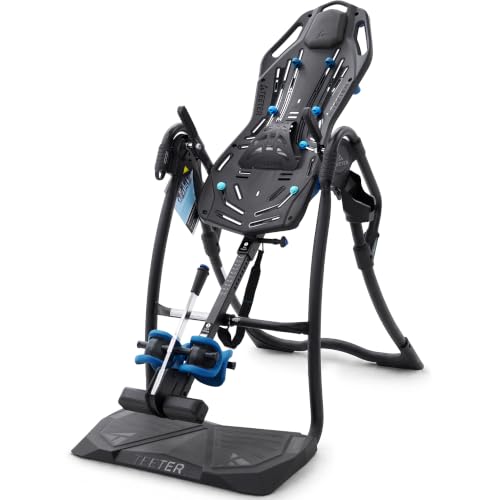
The FitSpine X3 shares the four-foot-eight minimum height and the core engineering of the LX9, and it is the better choice if you like Teeter’s approach but do not need the boarding base. Its Deluxe EZ-Reach ankle lock system uses an extra-long handle, the single most useful feature on any table for a shorter user, because it brings the release point up toward your hands instead of asking you to reach all the way to your ankles while inverted or while stepping in.
The EZ-Angle tether again provides marked presets at 20, 40, and 60 degrees, so your maximum angle is decided on the ground, not mid-session. The FlexTech backrest is the same flexible bed used on the LX9, and the X3 adds a set of acupressure nodes and a lumbar bridge in the box, which clip onto the backrest for targeted pressure during a session. Like the LX9, it is FDA-registered and carries the five-year full warranty. Pick the X3 if you want the premium build, the long-reach ankle lock, and the accessory kit, while staying one step below the flagship tier. It sits in the premium tier, though it is the more restrained of the two Teeter options here.
Specs
- User height range: 4 ft 8 in to 6 ft 6 in
- Weight capacity: 300 lb
- Ankle lock: Deluxe EZ-Reach with extra-long handle
- Backrest: FlexTech flexible bed
- Angle control: EZ-Angle tether with 20, 40, and 60 degree presets
- Included accessories: Acupressure nodes and lumbar bridge
- Certifications: FDA-registered
- Warranty: 5-year full warranty
Innova ITX9600
The ITX9600 is the budget pick in this group, and for shorter users its appeal is adjustment density at a modest tier. Its minimum height of four feet ten inches covers a large share of shorter adults, and the True Balance system lets you adjust the headrest position, the height setting, and the ankle holding arrangement together so the table balances around your own center of gravity rather than a factory average. The reversible ankle holders flip to suit different ankle shapes, which helps when your ankles are narrower than the design default.
Angle control comes from a six-position side pin with a protective cover, replacing the older strap style. Pins give you repeatable, positive stops, which many beginners prefer over a tether because the same setting produces the same angle every session. At 52 lb, this is also the lightest table in the roundup, and it folds for storage, so it suits smaller rooms and users who cannot wrestle a heavy frame around. The one-year limited warranty is shorter than the Teeter coverage, which is the main compromise at this tier. Choose the ITX9600 if you are at or above four feet ten inches and want a first table that is light, compact, and easy to fine-tune.
Specs
- User height range: 4 ft 10 in to 6 ft 6 in
- Weight capacity: 300 lb
- Angle control: Six-position pin with protective cover
- Balance system: True Balance triple adjustment
- Ankle holders: Reversible
- Headrest: Adjustable
- Assembled size: 46 x 28 x 63 in
- Item weight: 52 lb
- Warranty: 1-year limited warranty
Innova ITX9700
The ITX9700 builds on the same Innova frame as the ITX9600 and redirects the spending toward comfort, which is a sensible trade for shorter users who plan longer, gentler sessions. The defining feature is a memory foam lumbar pad that fills the curve of the lower back. On a standard flat backrest, a shorter torso can leave the lumbar region unsupported, because the pad placement assumes a longer spine. The shaped foam insert compensates for that mismatch, and the adjustable headrest plus a removable head pillow let you shift your position on the bed until the support lands where your back actually curves.
The six-position pin system with its protective cover carries over, giving the same repeatable angle stops, and the ankle holders are shaped to surround the ankle on multiple sides rather than clamp down from one direction, which distributes pressure more evenly on smaller ankles. The table folds for storage when floor space is tight. Like its sibling, it carries a one-year limited warranty and starts at four feet ten inches. Choose the ITX9700 if you are within its height range and your priority is backrest comfort during decompression sessions rather than the lightest frame or the longest warranty. It sits at the mid-range tier.
Specs
- User height range: 4 ft 10 in to 6 ft 6 in
- Weight capacity: 300 lb
- Lumbar support: Memory foam pad
- Headrest: Adjustable, with removable head pillow
- Angle control: Six-position pin with protective cover
- Ankle holders: Surround-style cups
- Storage: Folds for storage
- Warranty: 1-year limited warranty
Setup Tips for Shorter Users
Set the height adjustment to your measured height before your first session, then change it one notch at a time. With your ankles locked and your arms resting at your sides, the table should stay near level. If it tips toward inversion too eagerly, shorten the setting by one notch. If it will not move when you raise your arms, lengthen it by one notch. That neutral balance is the foundation of safe inversion, and shorter users feel small errors more because each notch is a bigger fraction of their height.
Begin at the shallowest angle your table allows, around 20 degrees, and stay there for short sessions while your body adapts. Keep your movements slow, rest at horizontal before standing up, and give yourself a moment before walking away, since blood pressure shifts can cause brief lightheadedness. Having another person nearby for the first few sessions is a sensible precaution at any height.
Frequently Asked Questions
What minimum height should a shorter user look for on an inversion table?
Look for a minimum rating at or below your own height. A floor of four feet eight inches, as on the two Teeter tables here, covers most shorter adults, while the ONETWOFIT range starting near four feet three inches suits petite users below that. If a table’s minimum is above your height, keep looking rather than trying to make it work.
Can I use an inversion table if I am shorter than its stated minimum height?
It is not recommended. The height range reflects where the pivot, backrest, and ankle lock geometry work as designed. Below the minimum, the ankle holders may not grip securely and the balance point shifts, so the table can tip unpredictably or refuse to return upright. Choose a table whose published range includes your height.
Why does the height setting change how an inversion table balances?
The bed rotates around a fixed pivot, and the height setting slides your body relative to that pivot. When the setting matches your height, your center of mass sits close to the pivot, so small arm movements control the angle smoothly. A setting that is too tall moves your center of mass away from the pivot, which makes the table tip faster and return harder.
How long should a beginner stay inverted?
Start conservatively: brief sessions of about thirty seconds to a minute at a shallow angle, then return to horizontal and rest. Many clinicians suggest building duration gradually over days and weeks only if you feel no dizziness, pressure in the head, or increased pain. Inversion is a form of traction, not a contest, and anyone with a medical condition should clear it with a doctor first.
Conclusion
For shorter users, the right inversion table is the one whose height range starts at or below your own height and whose ankle lock you can reach without strain. The ONETWOFIT is the only pick here that reaches down to about four feet three inches, making it the natural choice for the most petite frames. The Teeter FitSpine LX9 and FitSpine X3 start at four feet eight inches and add the easiest ankle locks and the longest warranties. The Innova ITX9600 keeps things light and budget-friendly, while the ITX9700 trades a little of that lightness for memory foam comfort. Match the table to your height first and your priorities second, and the fit will take care of itself.


More from Amazon
Programs that pair well with the guide above. Offers and eligibility are set by Amazon and may change.
Collect the home and kitchen items you want in one registry that guests can shop from.
Create a wedding registrySet up recurring deliveries of everyday items on eligible products. Terms and savings are set by Amazon.
Explore Subscribe & SaveFree shipping on eligible items, Prime Video and more. Eligible new members can start with a free trial.
Start a Prime free trialAudiobooks and podcasts to listen to on the go. Eligible new members can start with a free trial.
Try Audible freeAs an Amazon Associate we earn from qualifying purchases.



Write Your Review
No reviews yet. Be the first to share your experience!