

Key takeaways
- Compare the best inversion tables for beginners: five easy-start models with pin-locked angles, secure ankle holders, capacities and height ranges.
The best inversion table for beginners is the Innova ITX9600A, because its six-position pin system locks the backrest at preset angles, so a first-time user can start at a shallow tilt and step up gradually instead of balancing freehand. If budget matters most, the YOLEO Gravity Heavy Duty adds a ratchet ankle lock, a safety lock pin and an adjustable protective belt at the entry end of the market. Every model in this roundup is a standard inversion table with no powered heat or massage pad, chosen for predictable angle control, secure ankle systems and clearly published capacity and height limits, which are the things that matter most in the first weeks of use.
As an Amazon Associate, we earn from qualifying purchases.
Table of Contents
- How Beginner-Friendly Inversion Tables Differ
- What to Check Before You Buy
-
- Innova ITX9600A Inversion Table With Standard Ankle Holding System
-
- Teeter FitSpine X1 Inversion Table
-
- IRONMAN Gravity 4000 Inversion Table
-
- Innova ITX9700 Inversion Table With Memory Foam Lumbar Pad
-
- YOLEO Gravity Heavy Duty Inversion Table
- Frequently Asked Questions
- Conclusion
- Product and ASIN Reference
How Beginner-Friendly Inversion Tables Differ
A beginner-friendly inversion table is defined less by padding or brand than by how it controls the angle. Beginners are advised to start at a shallow tilt, often around 20 to 30 degrees, and increase only as the body adapts. Tables that lock the angle mechanically, with a pin that drops into a numbered position, make that progression repeatable: the setting chosen on Monday is the same setting available on Friday. Tables that rely on a tether strap or on balance alone give finer control, but the angle is harder to reproduce exactly, which is why most of the picks here use pins or a fixed-position adjustment bar.
The second difference is the ankle system. Every session starts and ends with the ankle holders, and a design that can be opened and closed without deep bending, such as an extended handle, a ratchet or a palm-activated release, reduces the awkward part of the routine. The third difference is sizing honesty: each table here publishes both a weight capacity and a height range, and a beginner should be comfortably inside both, not at the edge of either.
What to Check Before You Buy
Angle control. Look for preset positions you can verify before each session. Six pin positions, as on the ITX9600A, give smaller steps between angles; four fixed positions, as on the IRONMAN Gravity 4000, cover the angles most beginners actually use.
Ankle system reach. If bending to floor level is difficult, prioritize an extended release handle or a ratchet lock over a basic pull pin, and check whether the holders are padded or use foam rollers.
Weight capacity. Ratings here run from 300 lb to 350 lb. Compare the rating with the heaviest intended user and leave a margin rather than buying exactly at the limit.
Height range. Most models here fit users from about 4 ft 10 in to 6 ft 6 in. The balance point of an inversion table depends on setting the height correctly, so a model whose range centers on your height will rotate more predictably.
Footprint and folding. Inversion tables are large. Several models here fold for storage, but folded depth varies, so measure the intended corner or closet before ordering.
Safety basics. Inversion is not suitable for everyone. The manufacturers of these tables direct users to consult a licensed physician before use, and that guidance appears in the documentation for every model here. Start shallow, keep early sessions short, and have another person nearby for the first sessions.
1. Innova ITX9600A Inversion Table With Standard Ankle Holding System
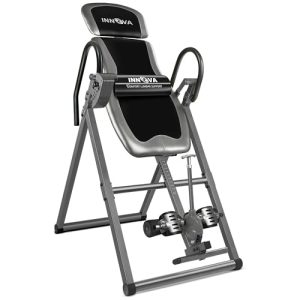
The ITX9600A takes the top spot for beginners because its angle control is the most graduated in this group. The six-position adjustable pin system, protected by a patented cover, locks the backrest at preset angles, so a new user can begin at the shallowest setting and move one pin at a time over the following weeks. There is no strap to measure and no free balancing to manage while confidence builds.
The rest of the specification suits first-time users well. The height setting adjusts for users from 4 ft 10 in to 6 ft 6 in, the capacity is 300 lb, and the headrest adjusts so the pivot point can be fine-tuned to the individual body. The ankle holders are reversible, letting the wider padded surface sit in front of or behind the ankle, and the backrest is a large padded board on a heavy-duty steel frame. The table folds for storage, although like most full-size tables it does not fold completely flat.
Specs
- Angle settings: six-position adjustable pin system with protective cover
- Weight capacity: 300 lb
- Height range: 4 ft 10 in to 6 ft 6 in
- Ankle system: standard ankle holding system with reversible ankle holders
- Backrest: large padded backrest with adjustable headrest
- Frame: heavy-duty steel frame, folds for storage
- Part number: ITX9600A
- Tier: budget
Choose the ITX9600A if you want the most step-by-step angle progression available at the entry end of the market, on a frame sized for most adults.
2. Teeter FitSpine X1 Inversion Table
The FitSpine X1 is the premium pick, and its beginner case rests on certification and ankle design. Teeter lists the FitSpine line as UL safety certified and registered with the FDA as a Class 1 medical device, the only such registration in this group. The Ergo-Embrace ankle supports wrap the ankle with shaped cups rather than flat pads, and the backrest surface is designed to flex and elongate during inversion.
Angle control on the X1 works through the adjustable tether and the balance of the table, with a preset angle guide marked at 20, 40 and 60 degrees, so beginners can set a maximum tilt before lying back. The included accessories are also relevant for new users: the table ships with eight acupressure nodes that clip into the backrest slots and an adjustable lumbar bridge, both removable while you learn the basic routine. Capacity is 300 lb and the height range runs from 4 ft 8 in to 6 ft 6 in, the widest at the short end of any model here.
Specs
- Angle control: adjustable tether with preset angle guide at 20, 40 and 60 degrees
- Weight capacity: 300 lb
- Height range: 4 ft 8 in to 6 ft 6 in
- Ankle system: Ergo-Embrace ankle supports
- Included accessories: eight acupressure nodes and adjustable lumbar bridge
- Certification: UL safety certified; FDA-registered Class 1 medical device, per the manufacturer
- Part number: X14
- Tier: premium
Choose the FitSpine X1 if third-party safety certification and the most supportive ankle cups matter more to you than a locking pin system.
3. IRONMAN Gravity 4000 Inversion Table
The Gravity 4000 suits beginners who are heavier or who struggle to operate a small ankle pin. Its capacity is 350 lb, the highest in this roundup, and the ankle lock is palm-activated: pressing a lever with the palm closes the ratchet-style holder, which many users find easier than pulling a spring pin at floor level. Extra-long safety handles give a clear handhold for controlling the return to upright.
Comfort features are simple but complete. The backrest is memory foam covered in vinyl, and a lumbar pillow is included and removable, so support can be added or taken away as you learn which setup suits your back. Rubber non-skid stabilizers keep the frame planted on hard floors, and the tubular steel frame folds to about 17 inches deep, one of the slimmer folded profiles in this group. Height adjustment covers users up to 6 ft 6 in.
Specs
- Weight capacity: 350 lb
- Height range: up to 6 ft 6 in
- Ankle system: palm-activated ratchet ankle lock with ergonomically molded ankle cushions
- Backrest: memory foam vinyl-covered backrest with removable lumbar pillow
- Handles: extra-long safety handles
- Frame: extra-wide tubular steel frame with rubber non-skid stabilizers; folds to about 17 in deep
- Model number: 5402
- Tier: mid-range
Choose the Gravity 4000 if you are near the 300 lb limit of the other tables here, or if a palm-activated ankle lock sounds easier to manage than a pull pin.
4. Innova ITX9700 Inversion Table With Memory Foam Lumbar Pad
The ITX9700 is the comfort-first option among the Innova models. It replaces the standard backrest padding with a large memory foam backrest and adds an adjustable memory foam lumbar pad, which gives new users a softer surface during the longer, slower sessions that early inversion involves. The lumbar pad also has a pocket designed to hold a hot or cold compress, although the compress itself is not included and no powered heat or massage is built in.
Underneath, the specification matches the ITX9600 family: a heavy-duty steel tube frame, a 300 lb capacity and a height range from 4 ft 10 in to 6 ft 6 in, with angle selection by locking pin. The ankle holders use molded foam for a closer fit, and foam-covered handlebars help with the return to upright. Assembled, the table measures 46 x 28 x 63 in and weighs 55 lb, so it is a two-person job to move despite the folding frame. A one-year warranty is published for the model.
Specs
- Backrest: large memory foam backrest with removable head pillow
- Lumbar support: adjustable memory foam lumbar pad with pocket for a hot or cold compress (compress not included)
- Weight capacity: 300 lb
- Height range: 4 ft 10 in to 6 ft 6 in
- Angle settings: locking pin system with preset positions
- Assembled dimensions: 46 x 28 x 63 in
- Item weight: 55 lb
- Warranty: one-year warranty, per published listing information
- Tier: mid-range
Choose the ITX9700 if backrest comfort is your main concern and you want memory foam cushioning without stepping up to a heated or motorized model.
5. YOLEO Gravity Heavy Duty Inversion Table
The YOLEO Gravity Heavy Duty is the budget alternative for beginners who want more than one safety mechanism. It combines a ratchet ankle locking system with a separate safety lock pin, and adds an adjustable protective belt that limits how far the table can rotate, so the maximum angle is set by hardware before the session starts rather than judged mid-session. For a nervous first-time user, that belt is a meaningful feature at this tier.
The table includes a headrest, which many entry-level models leave out, and the integrated steel frame is rated to 300 lb. The manufacturer recommends the table most strongly for users at or under 265 lb within that limit, which is worth noting when comparing capacities across this roundup. The frame folds for storage, the base uses non-slip feet, and the Amazon listing publishes a two-year warranty for the model. Height is adjusted on the main shaft in the usual way; check the listing against your height before ordering, as with every table here.
Specs
- Weight capacity: 300 lb (manufacturer recommends users at or under 265 lb)
- Ankle system: adjustable ratchet ankle locking system with safety lock pin
- Angle limiting: adjustable protective belt plus safety lock pin
- Backrest: padded backrest with included headrest
- Frame: integrated steel frame with non-slip feet, folds for storage
- Part number: RW0803221A
- Warranty: two-year warranty, per the published Amazon listing
- Tier: budget
Choose the YOLEO Gravity Heavy Duty if you want a belt-limited maximum angle and a ratchet ankle lock at the lowest tier in this group.
Frequently Asked Questions
What angle should a beginner start at on an inversion table?
Manufacturers and the manuals for these tables consistently advise starting at a shallow angle, around 20 to 30 degrees, rather than full inversion. A pin system or a preset tether setting makes that starting angle repeatable. Increase the angle gradually over days or weeks, only as sessions at the current angle feel comfortable, and return to a shallower setting if dizziness or pressure appears.
How long should a beginner invert for each session?
The guidance in the product documentation is to begin with short sessions of one to two minutes and build up slowly as the body adapts. Short, regular sessions at a shallow angle are the standard beginner pattern. End the session immediately if you feel pain, strong dizziness or unusual pressure, and follow the manual for your specific model.
Is a pin system or a tether strap better for beginners?
A pin system locks the backrest at numbered, preset angles, which makes each session reproducible and easy to verify before lying back; the Innova tables here work this way. A tether strap, used by the Teeter X1, sets a maximum angle but allows movement up to that limit, which some users prefer once they are confident. Neither is unsafe when used as directed, but pins are simpler to manage in the first weeks.
Who should not use an inversion table?
The manufacturers direct anyone with conditions such as high blood pressure, glaucoma or other eye conditions, heart disease, recent surgery or spinal injury, or who is pregnant, to avoid inversion unless a licensed physician advises otherwise. Every brand in this roundup instructs users to consult a physician before first use, and that step matters more for beginners than any single product feature.
Conclusion
For most beginners, the Innova ITX9600A is the best starting point: six locking pin positions make angle progression gradual and repeatable, and the 300 lb capacity with a 4 ft 10 in to 6 ft 6 in height range fits most adults. The Teeter FitSpine X1 is the premium step up, adding UL certification, FDA registration and the most supportive ankle cups. The IRONMAN Gravity 4000 covers heavier users at 350 lb with a palm-activated ankle lock, the Innova ITX9700 prioritizes memory foam comfort, and the YOLEO Gravity Heavy Duty keeps the budget tier honest with a ratchet lock, a safety pin and an angle-limiting belt. Whichever model you choose, confirm your height and weight against the published limits, start at a shallow angle, and talk to a physician before your first session, just as the manufacturers direct.
More from Amazon
Programs that pair well with the guide above. Offers and eligibility are set by Amazon and may change.
Collect the home and kitchen items you want in one registry that guests can shop from.
Create a wedding registrySet up recurring deliveries of everyday items on eligible products. Terms and savings are set by Amazon.
Explore Subscribe & SaveFree shipping on eligible items, Prime Video and more. Eligible new members can start with a free trial.
Start a Prime free trialAudiobooks and podcasts to listen to on the go. Eligible new members can start with a free trial.
Try Audible freeAs an Amazon Associate we earn from qualifying purchases.
Write Your Review
No reviews yet. Be the first to share your experience!