

Key takeaways
- Compare the best pizza pans on material, crust browning, nonstick release and oven limits to bake crisp, evenly browned homemade pizzas every time.
As an Amazon Associate we earn from qualifying purchases.
Disclosure: This article contains affiliate links. If you buy through these links, we may earn a commission at no extra cost to you.

A great homemade pizza is mostly a heat problem. Toppings cook from the top down while the crust must set, dry out, and brown from the bottom up, and a pan that traps moisture or heats unevenly leaves a pale, soft base under melted cheese. The right pan fixes that balance. Perforated pans let steam escape and hot air reach the underside of the dough. Heavy solid pans store heat and push it steadily into the crust. Deep rectangular pans protect a thick Detroit-style pie while its edges fry against the walls.
This guide compares five pizza pans that cover those approaches: a perforated nonstick pan for thin crusts, a solid steel pan for everyday pies, a seasoned cast iron pan for deep browning, a larger textured nonstick pan for family-size pizzas, and a deep Detroit-style pan for thick squares with crisp, caramelized edges. None is a baking stone and none needs a peel, so all suit ordinary home ovens. Read the buying criteria first, because the best pan for a cracker-thin crust is rarely the best pan for a loaded deep dish.
How to Choose a Pizza Pan
Material decides how fast a pan heats and how evenly it browns. Aluminized and heavy-gauge steel heat quickly, resist warping, and give a balanced bake for most doughs. Cast iron heats more slowly but holds heat far longer, so it keeps browning the base after cold dough lands on it, and it tolerates broilers, grills, and stovetops that would damage a coated pan. Aluminum is light and responsive, which is why deep professional-style pans often use it with a hard anodized finish. Nonstick coatings release cheese and sauce with almost no effort but should be kept away from metal utensils and very high heat.
Surface design is the second decision. Perforations let moisture escape from under the dough, the single most effective trick for a crisp thin crust, though sauce can drip through if the dough is very wet. A solid surface suits saucy pies, frozen pizzas, and reheating slices, and a slightly textured solid surface lifts the crust just enough to reduce steaming. A raised rim keeps toppings contained and gives you something to grip.
Size and oven fit come next. A 14-inch pan is the home standard: large enough for a family pizza, small enough for most ovens and cabinets. A 15- or 16-inch pan feeds a crowd but needs a wider oven, so measure before you buy. Depth matters for style, not size alone. Shallow pans bake flat pizzas; walls around two and a half inches deep are built for thick Detroit and Sicilian styles, where dough rises against the sides and cheese crisps where it touches the hot metal.
Finally, think about care. Nonstick pans want gentle sponges and moderate temperatures. Cast iron wants drying and a thin coat of oil after washing, and rewards that effort with a surface that improves over years. Match the routine to your habits, because the pan you enjoy cleaning is the pan you will actually use.
Cuisinart Chef’s Classic Pizza Pan — Perforated Crisping for Thin Crusts

Specs
- Diameter: 14 inches
- Material: Heavy-gauge aluminized steel
- Surface: Perforated base with nonstick interior and exterior
- Model: AMB-14PPP1 (AMB-14PP)
- Edges: Thick rolled edges to resist warping
- Care: Dishwasher friendly, hand washing recommended for the coating
The Cuisinart Chef’s Classic is the pan for thin crusts that keep coming out soft in the middle. Its base is pierced with holes across the whole surface, and those perforations do two jobs: they let steam escape instead of condensing under the crust, and they let hot air touch the underside directly. The result is a base that sets firmly, browns evenly, and keeps a pleasant snap even under wet toppings like fresh mozzarella and tomato.
The heavy-gauge aluminized steel body heats evenly, so edge and center finish together rather than leaving a ring of pale dough. The nonstick finish inside and out means baked-on cheese wipes away instead of needing a soak, and the rolled edges help the pan stay flat through repeated heating and cooling. Load it with a well-floured, moderately stretched dough rather than a very wet one, since sauce can find its way through the holes. For thin home pies and reheated slices that need their crunch back, this perforated design is the most direct route to a crisp finish.
Wilton Perfect Results Premium Pizza Pan — Simple Solid Pan for Everyday Pies
Specs
- Diameter: 14 inches
- Material: Steel with a premium nonstick coating
- Surface: Solid, smooth baking surface
- Construction: Warp-resistant build for repeated oven use
- Care: Dishwasher safe; hand wash in warm soapy water for best results
- Coverage: Backed by a 10-year limited warranty
The Wilton Perfect Results Premium is the straightforward solid pan most households will use most. Its unbroken steel surface supports the whole crust, so it handles saucy pies, frozen pizzas, and generously topped doughs without drips onto the oven floor. The solid base also reheats leftover slices evenly, restoring the bottom without drying the top.
Steel heats faster than cast iron, so there is no long preheat, and the pan is sturdy enough to resist warping that would bake lopsided crusts. The nonstick coating releases a finished pizza with a gentle shake, and cleanup is a quick wash. Pair it with a hot oven and, for fresh dough, a light dusting of flour or semolina underneath to encourage browning. If pizza night rotates between frozen pies on busy evenings and fresh dough on weekends, this dependable, no-fuss option covers both.
Lodge Seasoned Cast Iron Pizza Pan — Deep Browning and Serious Heat

Specs
- Diameter: 14 inches (about 18.4 x 14.75 x 1.25 inches overall with handles)
- Material: Seasoned cast iron, model P14P3
- Surface: Pre-seasoned with vegetable oil for a natural easy-release finish
- Weight: About 9.5 pounds
- Handles: Dual loop handles on both sides
- Care: Hand wash only, dry promptly and oil lightly
The Lodge cast iron pan plays a different game from every coated pan here. Cast iron stores a large amount of heat, so when you preheat it and lay cold dough across it, the surface temperature barely dips. The base begins frying on contact, building deep, even browning and a sturdy crunch thin pans struggle to reach. Its raised lip keeps the pizza contained, and its handles make a heavy, hot pan manageable with good mitts.
The seasoning is the other half of its appeal. The pan arrives pre-seasoned, and each bake adds to that layer, so release improves with use. It also moves beyond the oven: use it on a grill for a smoky, blistered pie, on the stovetop as a wide griddle for flatbreads, or under the broiler to finish toppings. The trade-offs are honest ones. It is heavy, needs hand washing and prompt drying, and asks for a real preheat to show its best work. Weekly pizza bakers who want one pan to outlast everything else in the kitchen will find those habits easy to accept.
OXO Good Grips Non-Stick Pro Pizza Pan — Larger Pan With a Textured Surface
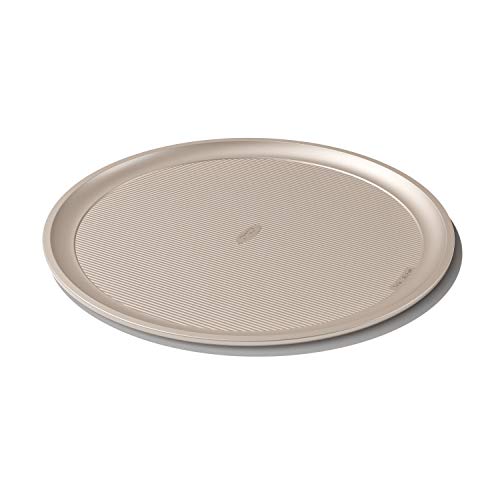
Specs
- Diameter: 15 inches
- Material: Commercial-grade aluminized steel, model 11159900
- Surface: Ceramic-reinforced two-layer nonstick coating
- Texture: Micro-textured pattern across the baking surface
- Finish: Scratch, stain, corrosion and abrasion resistant coating
- Rim: Wide rim for a secure grip with oven mitts
The OXO Non-Stick Pro is built for bakers who want more room. At 15 inches it takes a generous family pizza or wide flatbread without crowding, and its aluminized steel body spreads heat evenly so the larger surface does not develop a pale center. The micro-textured pattern is functional, not decorative: it increases airflow under the crust and promotes more even browning than a smooth sheet, while helping the dough grip instead of shrinking back as it bakes.
The two-layer, ceramic-reinforced coating is designed for release and durability together, standing up to sticky cheese edges while letting the finished pizza slide off cleanly. A wide, squared rim gives mitts something solid to hold when the pan is loaded and hot. Keep metal spatulas off the coating and slice on a board instead, and it will keep its easy release for years. It suits households that bake big pizzas often and want solid-pan convenience with better browning than a basic smooth pan delivers.
LloydPans Detroit Style Pizza Pan — Deep Walls for Crispy Cheese Edges

Specs
- Dimensions: 10 x 14 x 2.5 inches (inside top about 9.63 x 13.63 inches)
- Material: 14-gauge hard coat anodized aluminum
- Finish: Pre-Seasoned Tuff-Kote (PSTK) stick-resistant coating, made without PTFE
- Model: RCT-14926-PSTK
- Weight: About 1.4 pounds
- Care: Hand wash; metal utensil safe surface
Detroit-style pizza is defined by its pan. Dough proofs and bakes in a deep rectangular pan, cheese is pushed to the edges, and where cheese meets the hot walls it fries into a dark, lacy, crispy border. The LloydPans Detroit pan is the home version built for that job: heavy 14-gauge aluminum that heats fast and evenly, a hard anodized body that will not rust, and walls two and a half inches deep that shape the thick, airy crumb and support the cheese edge while it caramelizes.
The PSTK finish is baked on as a permanent, stick-resistant layer, so there is no seasoning routine and no delicate coating to protect; the surface is metal utensil safe, and finished pizzas release with a thin spatula run around the walls. Being aluminum, it stays light even when loaded with thick dough and toppings. Beyond Detroit pies, the depth suits Sicilian squares and focaccia with crisped edges. If your ambitions run thick rather than thin, this pan delivers a style the round pans here cannot reproduce.
Comparison Summary
Each pan here solves a specific crust problem. The Cuisinart perforated pan is the thin-crust specialist, venting steam for the crispest base. The Wilton solid steel pan is the everyday all-rounder, comfortable with frozen pizzas, saucy fresh pies, and reheated slices, with the easiest care of the group. The Lodge cast iron pan is the heat bank: preheat it and it browns deeper than any lightweight pan, works on grills and stovetops, and lasts for decades in exchange for hand washing and real weight. The OXO Non-Stick Pro adds size and texture, giving big pizzas better browning and release. The LloydPans Detroit pan trades round versatility for the thick crumb and fried cheese edges of a true Detroit-style bake. Choose first the pan matching the style you make most often, then add a second design later for the opposite end of the crust spectrum.
FAQ
Should I choose a perforated or solid pizza pan?
Choose a perforated pan when a crisp base is your priority, especially for thin crusts and wet toppings, because the holes vent steam and let hot air reach the dough. Choose a solid pan for saucy pies, frozen pizzas, and reheating, since the surface supports the crust and catches drips. Many bakers keep one of each.
Do I need to preheat a pizza pan?
Preheating helps heavy pans most. A preheated cast iron pan begins browning the crust on contact and produces the firmest base. Lightweight steel and aluminum pans heat quickly during the bake, so they work well without preheating, which also makes loading raw dough easier. If you do preheat, use sturdy mitts and load the dough carefully.
How do I keep pizza from sticking to the pan?
Begin with a surface that suits the dough: nonstick and seasoned finishes release most pizzas with no help at all. For uncoated or perforated pans, dust the pan or the dough with flour or semolina, and avoid excess sauce near the base. Let the baked pizza rest for a minute before sliding a spatula underneath, since the crust firms as steam escapes and releases more cleanly.
What size pizza pan fits a home oven?
A 14-inch pan fits comfortably in nearly every standard home oven and feeds a typical family, which is why most designs center on that size. A 15- or 16-inch pan needs a wider oven cavity and more storage space, so measure the oven interior and your cabinet before choosing one. Deep rectangular pans should also be checked against rack width, since their corners need clearance on all sides.
Conclusion
Crisp crusts and even browning come from matching the pan to the pizza. Vent steam with the perforated Cuisinart for thin pies, lean on the Wilton for everyday ease, bank serious heat in the Lodge cast iron for deep color, use the textured OXO when size and release matter, or go deep with the LloydPans for Detroit-style edges. Pick the design that fits the pizzas you actually bake, and your oven will turn out pies with firm, golden bases week after week.
More from Amazon
Programs that pair well with the guide above. Offers and eligibility are set by Amazon and may change.
Collect the home and kitchen items you want in one registry that guests can shop from.
Create a wedding registrySet up recurring deliveries of everyday items on eligible products. Terms and savings are set by Amazon.
Explore Subscribe & SaveFree shipping on eligible items, Prime Video and more. Eligible new members can start with a free trial.
Start a Prime free trialAudiobooks and podcasts to listen to on the go. Eligible new members can start with a free trial.
Try Audible freeAs an Amazon Associate we earn from qualifying purchases.


Write Your Review
No reviews yet. Be the first to share your experience!