

Our Short List of 3

- Magnification: 3x main lens
- Lens width: 4.35 inches
- Lens material: Acrylic with anti-glare treatment
- Lighting: SMD LEDs with 3 colour modes and stepless dimming

- Magnification: 5x page lens
- Lens size: 4.5 x 7 inches rectangular
- Lens material: Optical-grade acrylic
- Lighting: 24 SMD LEDs with cool white, warm white, and combo modes

- Magnification: High-power main lens for close work
- Lens diameter: 3.15 inches
- Lens material: Double-layer glass
- Lighting: 12 built-in LEDs with a single-button switch
All 5 Picks at a Glance
| Product | Specs | Action |
|---|---|---|
| 1. MagniPros 3X Large Magnifying Glass with Light (ED11) |
| Check price on Amazon |
| 2. MagniPros 5X Large LED Page Magnifier |
| Check price on Amazon |
| 3. Nazano Magnifying Glass with Light and 12 LEDs |
| Check price on Amazon |
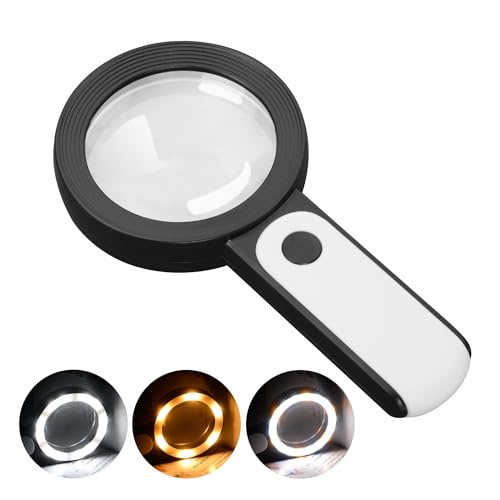 4. JMH Magnifying Glass with Light and 18 LEDs (JMH-030) |
| Check price on Amazon |
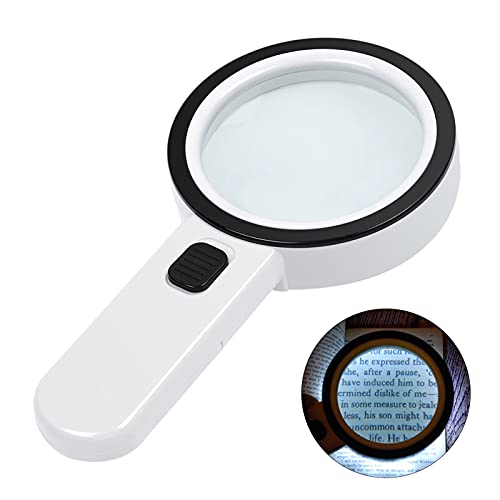 5. AIXPI Magnifying Glass with Light and Double-Layer Glass Lens |
| Check price on Amazon |
Key takeaways
- Compare handheld magnifiers on lens strength, lens size, lighting and handle comfort to read fine print, labels and hobbies without eye strain.
As an Amazon Associate we earn from qualifying purchases.
Disclosure: This article contains affiliate links. If you buy through these links, we may earn a commission at no extra cost to you.
Reading fine print should not feel like hard work. Whether you are working through a novel at the kitchen table, checking a medicine label in a dim hallway, reading a menu, or sorting coins and stamps for a hobby, a good handheld magnifier brings the page closer without forcing you to squint or hunt for a brighter room. Small print on bottles, appointment cards, and packaging does not get larger on its own, and tired eyes make it harder still.
The handheld format has a particular advantage. You pick it up, hold it at the angle that works for your eyes, and set it down again. There is no band around your head, no clamp on a desk, and no lamp to position. You control the distance, tilt, and light as you move between a paragraph, a bill, a serial number, and a closer look at a stitch or tiny screw.
This guide compares five handheld magnifiers, including lighted LED models, on lens strength, size, material, lighting, power, weight, and handle comfort. Two picks come from MagniPros, alongside models from Nazano, JMH, and AIXPI.
How to Choose a Handheld Magnifier
Magnification strength
For general reading, moderate magnification is usually the most comfortable. A lens around 3x makes body text clearly larger while still showing several words at once, so your hand moves steadily. Stronger lenses show less of the page and need a closer, steadier hold. Very high numbers on packaging deserve caution: some sellers headline an inflated figure that does not match the usable power of the main lens.
Lens size and shape
Lens size decides how much you see before you move your hand. A round lens around three inches across covers a short paragraph or a large label comfortably. A wide rectangular lens covers full lines of text, which reduces side-to-side movement and helps you keep your place, so page-style magnifiers feel calmer for long reading. Smaller lenses are lighter and easier to carry, but they demand more repositioning.
Lens material: glass versus acrylic
Glass lenses tend to feel crisp and resist scratching, and double-layer glass designs are prized for clarity. They add weight, though, which matters if your grip tires quickly. Acrylic lenses are lighter and less fragile if dropped, and optical-grade acrylic keeps a large page lens light enough to hold for a chapter at a time. Acrylic needs gentler cleaning, since grit can mark it, so use a soft cloth for either material.
Lighting
Built-in LEDs change a magnifier from a fair-weather tool into an all-day one. Light aimed at the page lifts contrast, which often helps as much as magnification itself, especially on glossy packaging and dull newsprint. Useful differences include the number of LEDs, whether the light can be dimmed, and whether you can switch between cool white, warm white, and a mixed mode. Dimming helps on shiny paper where full brightness creates glare.
Handle comfort, weight, and power
You will hold this tool for minutes at a time, so weight and grip shape matter as much as optics. A magnifier that weighs only a few ounces, with weight spread evenly between lens and handle, is easier to keep steady. Look for a handle that fills the palm and a switch you can find by touch. Models on common AAA or AA batteries are simple to keep going at home, with no cables.
The 5 Handheld Magnifiers Compared
1. MagniPros 3X Large Magnifying Glass with Light (ED11)
- Magnification: 3x main lens
- Lens width: 4.35 inches
- Lens material: Acrylic with anti-glare treatment
- Lighting: SMD LEDs with 3 colour modes and stepless dimming
The MagniPros ED11 is the classic round-lens reading magnifier in this group, built around adjustable light. Its main lens gives moderate magnification suited to books, newspapers, mail, and medicine labels, with a wide viewing area for a round design. Three colour light modes shift between cool white, warm white, and a combined setting, and brightness adjusts smoothly, so you can dial glare down on glossy paper and turn it up for dull newsprint.
It is light for its size, the grip sits naturally in the palm, and power comes from three AAA batteries, so there is no cord. For a reader whose main frustration is dim, uneven room light rather than extremely small print, this balance is hard to beat.
2. MagniPros 5X Large LED Page Magnifier
- Magnification: 5x page lens
- Lens size: 4.5 x 7 inches rectangular
- Lens material: Optical-grade acrylic
- Lighting: 24 SMD LEDs with cool white, warm white, and combo modes
Where the ED11 is round, this MagniPros page magnifier is wide and rectangular, shaped the way a line of text is shaped. The large lens covers a broad block of a book or newspaper page at once, so you move the magnifier down the page in calm steps instead of sweeping it across every line. That makes it a strong choice for longer sessions with novels, magazines, and documents. A single button cycles through cool white, warm white, and combo light modes.
Despite the big lens, the tool stays light, with weight spread across a broad frame. The optical-grade acrylic lens resists shattering if dropped, and power comes from three AAA batteries. If your reading is mostly seated and page-based, this is the format designed for you.
3. Nazano Magnifying Glass with Light and 12 LEDs
- Magnification: High-power main lens for close work
- Lens diameter: 3.15 inches
- Lens material: Double-layer glass
- Lighting: 12 built-in LEDs with a single-button switch
The Nazano takes the opposite approach to the page magnifier: a compact round glass lens with high stated power for short, demanding tasks. Its double glass lens is aimed at the smallest print in the house: prescription bottles, vitamin jars, statement footnotes, coupons, and the tiny instructions folded inside packaging. Twelve LEDs throw even light onto the spot you are reading, which helps when a label curves around a bottle. A simple switch keeps operation uncomplicated.
Glass gives a crisp feel and good scratch resistance, and the lens covers a whole label or coin face. It runs on two AA batteries. The trade-off is field of view: at high magnification you see a small area at a time and need a steady hand. Used for brief close checks, it is a practical drawer and bedside companion.
4. JMH Magnifying Glass with Light and 18 LEDs (JMH-030)
- Magnification: Main lens for reading and inspection, double glass design
- Lens diameter: 3.15 inches (80 mm)
- Lens material: Double-layer glass
- Lighting: 18 LEDs with cold, warm, and mixed modes
The JMH-030 is the lighting specialist among the round-lens models. Eighteen LEDs are arranged around its lens, working in three modes: a cold white mode, a warm mode, and a mixed mode that uses the full set. Cold light sharpens print in the morning, warm light feels easier in the evening, and the mixed mode suits hobbies such as coin sorting, stamps, and model work. The lens is a double glass design sized for a paragraph, a label, or a small object.
The body is large enough to grip securely and arrives fully assembled: fit three AAA batteries and it is ready. Weight is noticeable beside the lightest acrylic models, but balance is even. For readers who find light matters as much as magnification, the JMH offers the most lighting control here.
5. AIXPI Magnifying Glass with Light and Double-Layer Glass Lens
- Magnification: True 3x main lens
- Lens material: Double-layer real glass
- Lighting: 12 ultra-bright LEDs
- Power source: 2 AA batteries, not included
The AIXPI makes an honest case that will appeal to careful buyers: a double-layer glass lens that provides true 3x magnification. In a category full of inflated numbers, a clear 3x claim matched to a real glass lens is refreshing, and 3x is the level most people find comfortable for everyday reading. Twelve LEDs provide even light for books, newspapers, coins, and close work, and the lens covers a useful block of text.
The magnifier arrives fully assembled, runs on two AA batteries, and has no modes to learn. At 255 grams without batteries it feels solid yet light enough for regular use. The maker advises standard rather than rechargeable AA cells for the LED circuit.
Comparison Summary
All five models are handheld, and four of the five add built-in LED light. The differences that matter are format and light control. For long, seated reading, the MagniPros page magnifier stands apart with its wide rectangular lens that covers full lines at once. For adjustable light over a round lens, the MagniPros ED11 offers three colour modes with smooth dimming and an anti-glare lens. For the most lighting modes around a glass lens, the JMH-030 combines eighteen LEDs with cold, warm, and mixed settings.
For very small print, the Nazano concentrates on a compact glass lens with twelve LEDs. For a clearly stated, true 3x glass lens with no settings to learn, the AIXPI is the everyday pick. Glass models weigh more; acrylic models feel lighter for long holds. Batteries are AAA for the MagniPros models and the JMH, and AA for the Nazano and AIXPI.
Frequently Asked Questions
What magnification is best for reading books and newspapers?
Moderate magnification around 3x suits most book and newspaper reading. It makes text clearly larger while still showing a full line at once. Stronger lenses are better saved for short tasks such as labels and footnotes.
Is a glass or acrylic lens better for a handheld magnifier?
Glass lenses feel crisp and resist scratching, but they add weight. Acrylic lenses are lighter and less fragile if dropped, though they need gentler cleaning. Choose glass for a compact lens, and acrylic for low weight in a large lens.
Do I need LEDs in a handheld magnifier?
LEDs help more than many buyers expect. Light aimed at the page lifts contrast on dull newsprint and glossy packaging. Cool and warm modes and dimming reduce glare and feel gentler in the evening, so a lighted model is worth choosing if you read in bed or at a counter.
How can I reduce hand and eye tiredness when using a magnifier?
Pick the lightest model that covers your task, rest your forearm on a table, and hold the lens at a steady distance. Take short breaks, blink often, and use the built-in light to raise contrast instead of leaning closer.
Conclusion
The right handheld magnifier is the one that matches the reading you actually do. Choose the MagniPros page magnifier for long, seated sessions over books and documents, the MagniPros ED11 for tunable light over everyday print, the JMH-030 for the widest choice of light modes around a glass lens, the Nazano for compact, high-power checks of the smallest labels, and the AIXPI for an honest 3x glass lens with simple, even light. Keep the lens clean and spare batteries nearby, and small print no longer has to be a barrier to reading and daily life at home.
More from Amazon
Programs that pair well with the guide above. Offers and eligibility are set by Amazon and may change.
Collect the home and kitchen items you want in one registry that guests can shop from.
Create a wedding registrySet up recurring deliveries of everyday items on eligible products. Terms and savings are set by Amazon.
Explore Subscribe & SaveFree shipping on eligible items, Prime Video and more. Eligible new members can start with a free trial.
Start a Prime free trialAudiobooks and podcasts to listen to on the go. Eligible new members can start with a free trial.
Try Audible freeAs an Amazon Associate we earn from qualifying purchases.
Write Your Review
No reviews yet. Be the first to share your experience!