

Key takeaways
- At least 6–12 inches on each side for access and ventilation.
- About 24 inches of open space behind the deck where possible.
- A desk position that lets you step off without turning into a wall or chair.
- Enough ceiling height for your standing posture, particularly if the desk is on a platform or thick mat.
The best walking pad treadmills for small spaces are the WalkingPad C2 for most apartment users, the Egofit Walker Pro M1 for the tightest rooms, the UREVO Strol 2S for a lower-cost everyday option, and the WalkingPad R2 if you need occasional jogging speed as well as walking.
Our top picks


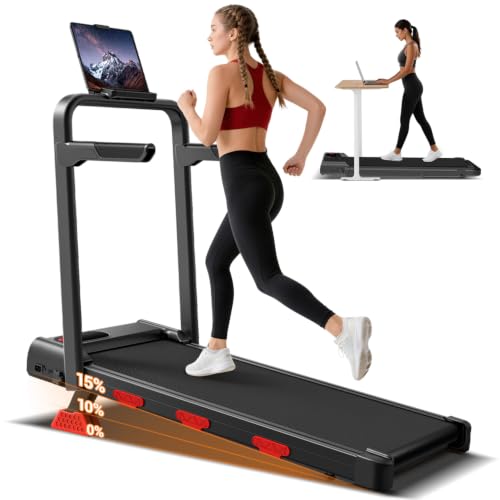

As an Amazon Associate we earn from qualifying purchases at no extra cost to you. Ratings are shown as listed on Amazon.
Quick comparison: walking pads for apartments and home offices
The measurements below are useful buying figures, but exact dimensions, noise figures, and controls can vary by production revision and regional model. Check the current specification sheet before ordering, especially if your desk clearance is tight.
| Model | Walking surface | Maximum speed | Approx. noise claim or range | Storage approach | Best fit |
|---|---|---|---|---|---|
| Egofit Walker Pro M1 | About 38.8 × 16.5 in | About 3.7 mph | Roughly 50–60 dB in typical listings | Very short deck; can slide under many sofas or beds | Smallest rooms and light walking |
| WalkingPad C2 | About 47.2 × 16.5 in | About 3.7 mph | Often listed around 55 dB | Folding deck; stores under suitable furniture | Most apartment walkers |
| UREVO Strol 2S | About 48.4 × 17.5 in | About 4.0 mph | Commonly listed around 55 dB or below | Flat deck; usually needs a bed, sofa, or wall-side parking space | Budget-conscious daily use |
| WalkingPad R2 | About 47.2 × 17.4 in | About 6.2 mph | Typically louder at running speeds | Folds and has an upright handrail/storage profile | Users who want walking and occasional jogging |
A walking surface around 16.5 inches wide is adequate for deliberate walking, but it leaves less room for sideways foot movement than a conventional treadmill. A surface closer to 17.5 inches feels more forgiving, particularly for taller users or anyone who walks while reading. Length matters too: a 39-inch deck saves floor space but gives you less stride margin than a 47- or 48-inch deck.
Our picks by situation
Best overall for an apartment: WalkingPad C2
The C2 is a sensible middle ground. Its folding deck is substantially easier to store than a conventional treadmill, while its roughly 47-inch walking surface is more usable for normal walking than ultra-short compact models. Its approximately 3.7-mph ceiling is enough for desk walking and purposeful indoor walking, but not for running.
Choose it when you want to use a walking pad several times a week and can reserve roughly 5 feet by 2.5 feet of clear operating space. The important measurement is not only the deck: allow room behind and beside the machine so you can step off safely and move around your desk.
Best for the smallest home office: Egofit Walker Pro M1
The M1’s short deck is its defining advantage. It is easier to park under furniture and less visually intrusive in a studio apartment or narrow office. The trade-off is a shorter, narrower walking surface and a lower speed ceiling. It suits shorter users, compact strides, and slow-to-moderate desk walking better than long-stride exercise.
Before buying, measure your normal stride. A simple test is to mark the distance between the heel positions of several comfortable steps, then add safety margin. If your normal step length is around 24 inches, a 39-inch deck can work for controlled walking, but it leaves less room for distraction or changes in pace.
Best value-oriented option: UREVO Strol 2S
The Strol 2S offers a comparatively wide walking surface and a walking-focused speed range without the bulk of a full treadmill. It is a good choice when you want a flat machine for regular walking and are willing to store it under a bed or sofa rather than fold it into a smaller footprint.
Confirm the actual folded or standing dimensions before purchase. “Under-desk” describes how the machine is used; it does not guarantee that the machine will fit beneath your particular furniture.
Best for walking plus jogging: WalkingPad R2
The R2 is the clear choice among these models if you want more than desk walking. Its higher maximum speed and handrail make it more suitable for faster sessions, but those features also create compromises: it is heavier, more expensive, harder to hide, and usually noisier when the belt moves quickly.
Do not choose the R2 merely because its speed number is higher. If you will only walk at 2–3 mph, the C2 or Strol 2S is generally easier to live with in a compact room.
Decision matrix for a small-space purchase
| Your priority | Choose | Why | Accept this compromise |
|---|---|---|---|
| Lowest storage footprint | Egofit Walker Pro M1 | Short deck and compact overall profile | Less stride room and slower top speed |
| Frequent walking in an apartment | WalkingPad C2 | Good balance of deck length, folding, and speed | Not designed for running |
| Wider surface at a moderate price | UREVO Strol 2S | More lateral room for ordinary walking | Flat storage can be less convenient |
| Walking and occasional jogging | WalkingPad R2 | Higher speed ceiling and supportive rail | More noise, weight, and storage demand |
| Quiet office use | C2 or Strol 2S | Walking speeds produce less motor and foot noise | Sound still travels through hard floors |
How much room do you really need?
Start with the machine’s operating footprint, then add clearance. A practical apartment setup needs approximately:
- At least 6–12 inches on each side for access and ventilation.
- About 24 inches of open space behind the deck where possible.
- A desk position that lets you step off without turning into a wall or chair.
- Enough ceiling height for your standing posture, particularly if the desk is on a platform or thick mat.
For example, a 48.4-inch-long walking pad is 4.03 feet long. Adding 2 feet of exit space behind it gives about 6 feet of functional depth. A product that technically fits in a 5-foot gap may still be awkward or unsafe to use there.
Noise: the specification is only part of the answer
Walking-pad noise comes from the motor, belt rollers, footsteps, and vibration transmitted into the floor. A manufacturer’s decibel figure is normally measured under particular conditions and may not represent a wood floor, an uneven surface, or a user walking heavily.
For apartment use, place the machine on a dense treadmill mat that covers the contact area without blocking ventilation. Keep your steps light, avoid running during quiet hours, and use lower speeds while on calls. A 3.7-mph walking pad may be tolerable in a shared room, whereas the same machine can become noticeably louder at its maximum speed.
Storage and desk compatibility
Measure the clearance under your furniture at its lowest point, not at the center. Include the power cord, remote control, and any protruding wheels. Many walking pads are roughly 5–7 inches tall when flat, but a folded or rail-equipped model may require substantially more vertical space.
Never store a heavy treadmill where you must lift it over fragile furniture. A model that is slightly larger but has reliable transport wheels can be more practical than a smaller machine that requires awkward carrying. Leave the belt area unobstructed while the motor is cooling.
Ownership realities: what wears first
The walking belt, front and rear rollers, and motor are the parts most affected by frequent use. Dust and hair increase friction; a belt that is dry, off-center, or over-tightened can make the motor work harder. Check the manual before applying lubricant because some belts use different maintenance requirements.
- Vacuum around the deck and motor openings regularly, especially with pets or carpet.
- Inspect belt alignment after moving the machine.
- Use the recommended lubricant and interval rather than applying oil indiscriminately.
- Keep the machine level; an uneven floor can encourage belt drift and vibration.
- Do not exceed the stated user-weight limit or leave the pad running unattended.
If two people use the pad for 30 minutes each on five days per week, that is 5 hours weekly, or about 260 hours annually. At that usage, maintenance and warranty support matter more than a small difference in purchase price. For occasional use, a compact walking-focused model is usually the more sensible choice; for daily use, prioritize belt quality, service availability, and a walking surface that does not force a cramped stride.
Bottom line
Choose the Egofit Walker Pro M1 when every inch matters, the WalkingPad C2 when you want the best balance for apartment walking, the UREVO Strol 2S when surface width and value are priorities, and the WalkingPad R2 only when you will use its higher speed and handrail. Whichever model you select, measure the complete operating and storage space, not just the treadmill deck.

Write Your Review
No reviews yet. Be the first to share your experience!