

Key takeaways
- Inspect belt alignment every few weeks. A belt drifting to one side can wear its edge.
- Keep shoes clean and dry. Small stones can damage the belt surface.
- Use a level, firm surface and a suitable treadmill mat.
- Do not exceed the stated user-weight limit, especially during long sessions.
- Allow the motor to cool if the manual specifies a duty-cycle limit.
- Replace a remote battery promptly if speed commands become intermittent.
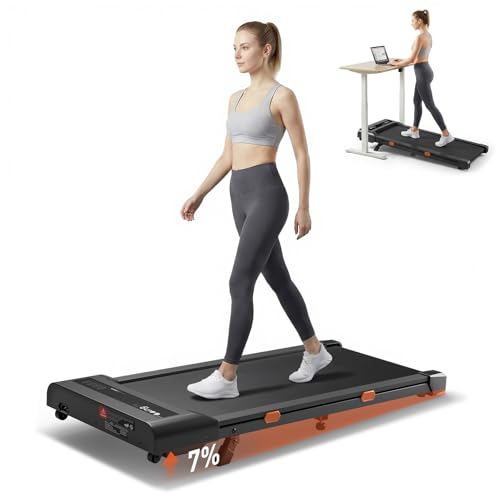
The best under desk treadmill for most people is a quiet, low-profile walking treadmill rated for at least 2.5 hours of daily use, with a top speed of roughly 4 mph, a usable remote control, and a deck short enough to fit your workspace without restricting your stride.
For occasional walking in a small room, a foldable model such as the WalkingPad C2 is a practical choice. For frequent workday use, look for a heavier commercial-style unit such as the LifeSpan TR1000-Classic. If you want the lowest possible profile and are willing to accept a shorter deck, a compact model such as the Egofit Walker Pro M1 can make sense. The right choice depends less on peak speed than on noise, belt length, portability, and whether your desk can accommodate the machine safely.
Our top picks



As an Amazon Associate we earn from qualifying purchases at no extra cost to you. Ratings are shown as listed on Amazon.
Best under desk treadmills by situation
| Situation | Best fit | What to prioritize | Typical market range |
|---|---|---|---|
| Small apartment or shared office | Compact folding walking pad | Under 6 inches high, wheels, quiet motor, vertical or flat storage | $250–$600 |
| Walking while typing several days per week | Midweight under desk treadmill | 2.5–4 mph range, belt at least 40 inches long, stable frame | $400–$800 |
| Long workdays and frequent use | Heavy-duty office treadmill | Longer deck, stronger frame, replaceable parts, low continuous noise | $800–$1,500+ |
| Occasional use and easy relocation | Lightweight walking pad | Below 55 pounds, integrated transport wheels, simple remote | $200–$450 |
Head-to-head: notable options
WalkingPad C2: best for compact storage
The WalkingPad C2 is designed around its folding deck. Its walking surface is approximately 47 by 16 inches, and its folded height is close to 6 inches, depending on the version. The machine is commonly rated for walking speeds up to about 3.7 mph and weighs roughly 55 pounds.
That combination makes it attractive when the treadmill must slide beneath a sofa or stand upright in a closet. The trade-off is a narrower, shorter-feeling deck than a full-size treadmill. Taller users or people with a long stride should check the actual belt dimensions rather than relying on the outside measurements. The C2 is better suited to walking than jogging, and its remote control is important because most users will not want to reach down to operate the treadmill during a meeting.
LifeSpan TR1000-Classic: best for frequent office use
The LifeSpan TR1000-Classic is a more substantial under desk treadmill intended for regular workplace walking. Depending on the configuration, its belt is about 46 inches long and 20 inches wide, with a walking range reaching approximately 4 mph. It is heavier than many folding walking pads, generally around 115 pounds, which improves stability but makes moving it between rooms less convenient.
This type of treadmill is a stronger fit for someone who plans to walk for multiple work sessions each week. The wider deck gives more lateral room, while the heavier frame is less likely to shift on a hard floor. Storage is the main disadvantage: it usually needs a permanent position beneath a compatible desk rather than being lifted onto a shelf.
Egofit Walker Pro M1: best for a very low profile
The Egofit Walker Pro M1 is built for users who value a short footprint and low deck height. Its walking area is approximately 38.5 by 16 inches, and its maximum walking speed is around 3.1 mph. The compact design can work well in a small workstation, but the shorter belt leaves less room for a long stride.
Choose this style if you expect slow walking while reading, taking calls, or performing light computer work. It is less suitable if you naturally walk quickly, have a long stride, or want to alternate between walking and faster exercise. Confirm the maximum user weight and the clearance around the front and rear before purchase.
Specifications that matter more than maximum speed
| Specification | Useful target | Why it matters |
|---|---|---|
| Walking speed | 0.5–4 mph | Allows slow typing pace as well as brisk walking without paying for unnecessary running capability |
| Belt length | 40–47 inches minimum for many adults | Short decks can make a natural stride feel cramped |
| Belt width | 16 inches or wider | Provides useful side-to-side tolerance while attention is on work |
| Deck height | About 5–7 inches | Leaves more legroom and makes the desk easier to set at a comfortable height |
| Machine weight | 45–70 pounds for portability; 90+ pounds for stability | Light units are easier to store, while heavy units tend to move less |
| Noise | Approximately 55–65 dB during walking | Important for calls, shared rooms, and microphones |
Noise specifications are difficult to compare because manufacturers measure at different speeds, distances, and floor conditions. A treadmill described as “quiet” may still transmit a low-frequency thump through a hard floor. A dense rubber mat can reduce vibration, but it cannot correct a loose belt, worn roller, or unstable floor.
Check desk compatibility before buying
A treadmill does not make a desk automatically suitable for walking. Measure the desk’s lowest and highest working positions, then add your standing height and the treadmill deck height. For example, if your elbow-height working position is 40 inches from the floor and the treadmill deck is 6 inches high, your desk surface may need to rise to about 46 inches. A fixed sitting-height desk will usually be too low.
Leave enough clearance for the full belt length, the front motor housing, and at least 2 feet behind the machine. Do not place the rear edge directly against a wall. You need room to step off safely, and the treadmill should not block a doorway or emergency route.
Also check whether the desk legs interfere with the side rails. A treadmill can fit beneath a desktop by width but still fail in practice because its motor housing collides with a crossbar or pedestal. Cable trays should be secured above the moving belt, and monitor arms should not swing into the user’s walking path.
Remote controls and portability
A remote control is not a minor accessory. It should provide start, stop, speed up, and speed down functions, with buttons that are easy to distinguish without looking away from the screen. Some models also offer an app, but an app should not be the only control method; phone pairing can fail, and reaching for a phone during a meeting is inconvenient.
For storage, compare more than the listed weight. A 50-pound machine with small wheels can be harder to move than a 65-pound model with large, well-positioned rollers. Measure the storage route, including doorways and closet openings. Folding units generally save floor space, but their hinges and locking mechanisms add parts that should be kept free of dust and checked periodically.
Ownership realities: maintenance and durability
The belt and deck are the parts most likely to need attention. Dust, carpet fibers, and grit increase friction, which makes the motor work harder and can raise noise. Vacuum around the motor housing and underneath the treadmill regularly, particularly if it sits on carpet. Follow the manufacturer’s lubrication schedule rather than applying lubricant whenever the belt feels slow; excessive lubricant can attract dirt and cause slipping.
- Inspect belt alignment every few weeks. A belt drifting to one side can wear its edge.
- Keep shoes clean and dry. Small stones can damage the belt surface.
- Use a level, firm surface and a suitable treadmill mat.
- Do not exceed the stated user-weight limit, especially during long sessions.
- Allow the motor to cool if the manual specifies a duty-cycle limit.
- Replace a remote battery promptly if speed commands become intermittent.
One common mistake is using a compact walking pad for continuous high-speed exercise. These machines are designed primarily for walking while standing at a desk. Repeated jogging can increase impact, noise, and heat beyond what the frame and motor were intended to handle.
How much use justifies a more expensive model?
Consider usage rather than the advertised feature count. Suppose a $350 walking pad lasts two years and is used three times per week. That is about 312 sessions, or roughly $1.12 per session before electricity and maintenance. A $1,000 office treadmill used five times per week for three years provides about 780 sessions, or approximately $1.28 per session. The heavier model costs more initially, but frequent use can make its stability, serviceability, and longer deck worthwhile.
If you expect to use the treadmill only once or twice per week, prioritize storage and portability. If it will remain beneath your desk every workday, prioritize belt dimensions, continuous-use guidance, noise behavior, warranty support, and access to replacement belts and remotes.
Bottom line
Choose the WalkingPad C2 when compact folding storage is the deciding factor, the LifeSpan TR1000-Classic when stability and frequent office use matter most, and the Egofit Walker Pro M1 when you need an especially short, low-profile walking machine and have a moderate stride. Whichever model you select, verify the actual belt dimensions, desk height, user-weight limit, noise conditions, and storage footprint before ordering. A treadmill that fits your routine and workspace will be more useful than one with a higher speed rating you never use.

Write Your Review
No reviews yet. Be the first to share your experience!