

Our Short List of 3

- Bar spacing: 0.5 inch
- Dimensions: 31 x 20.5 x 53 inches including the stand
- Doors: 2 large front doors and 6 smaller side doors
- Tray type: pull-out tray with removable bottom grille
- Bar spacing: 0.625 inch (5/8 inch, listed as 0.6 inch in some listings)
- Dimensions: 31 x 20.5 x 52 inches including the stand
- Doors: front access door plus feeder doors
- Tray type: slide-out tray beneath the cage floor

- Bar spacing: 0.5 inch
- Dimensions: 53 inches tall on the stand, wide flight cage body
- Doors: 1 large front door with latch, plus feeder access
- Tray type: bottom slide-out tray with removable metal grate
All 4 Picks at a Glance
| Product | Specs | Action |
|---|---|---|
| Prevue Pet Products Wrought Iron Flight Cage with Stand F040 |
| Check price on Amazon |
| Yaheetech 52-Inch Wrought Iron Flight King Bird Cage with Stand |
| Check price on Amazon |
| ZENY 53-Inch Bird Cage with Stand |
| Check price on Amazon |
 Yaheetech 69-Inch Extra Large Bird Cage |
| Check price on Amazon |
Key takeaways
- Compare the best bird cages on bar spacing, flight space, tray design and ease of cleaning to give pet birds a safe, roomy and healthy home every day.
As an Amazon Associate we earn from qualifying purchases.
Disclosure: This article contains affiliate links. If you buy through these links, we may earn a commission at no extra cost to you.
A bird cage is not furniture for a bird. It is the bird’s bedroom, dining room, gym and safe place, all in one footprint, and many pet birds spend most of their hours inside it. That is why the best bird cages are chosen on measurements first and looks second. A cage wide enough for a short flight, with bars spaced closely enough that a small head cannot slip through, will do more for a parakeet, cockatiel or finch than any decorative shape.
This guide compares five cages for small and medium pet birds: finches, canaries, parakeets and budgies, cockatiels, lovebirds and small conures. The five include wide flight cages, a tabletop cage with a deep debris base, and cages on rolling stands. Each pick is described with its bar spacing, dimensions, doors and tray design, because those details decide whether a cage works day after day.
How to Choose a Bird Cage
Bar spacing comes first
Bar spacing is a safety measurement, not a style choice. For finches, canaries and parakeets, look for spacing of about half an inch or less, so a bird cannot push its head between the bars. Cockatiels and lovebirds also do well at half an inch, and many keepers accept up to five-eighths of an inch for a larger cockatiel or small conure. Wider spacing than the bird’s head width is a trap risk. If you keep mixed sizes, choose spacing for the smallest bird.
Buy width before height
Birds fly sideways, not upward. A wide cage lets a parakeet make a real, if short, flight from perch to perch, and lets finches exercise the way they naturally move. A tall, narrow cage looks generous in a photo but gives less usable flight room. For a pair of parakeets or a small group of finches, a cage around thirty inches wide is a practical target. For a cockatiel, width plus enough depth for a long tail to turn matters just as much.
Doors you will actually use
A large front door makes it easier to place perches, hang toys and reach a bird calmly. Smaller feeder doors let you change cups from outside, which disturbs the birds less and reduces escape chances. Check how doors latch: a latch a clever cockatiel can lift from inside will be lifted, so look for latches that resist beak work.
Trays, grilles and cleaning
You will clean this cage hundreds of times, so tray design decides whether cleaning is a two-minute job or a chore you postpone. A slide-out tray under a fixed grille keeps birds away from droppings while you work. Deep bases and debris guards keep seed hulls and feathers inside the cage instead of on the floor. Smooth surfaces wipe down faster than ornate shapes with crevices.
Perches, cups and layout
Dowel perches included with a cage are a beginning, not a finished setup. Birds need perches of varied diameter and texture to keep feet healthy, so add natural wood or rope perches at different heights. Leave the middle open for flight rather than filling it with toys, and place cups where droppings will not fall into food or water.
The Five Cages Compared
Prevue Pet Products Wrought Iron Flight Cage with Stand F040
- Bar spacing: 0.5 inch
- Dimensions: 31 x 20.5 x 53 inches including the stand
- Doors: 2 large front doors and 6 smaller side doors
- Tray type: pull-out tray with removable bottom grille
The Prevue F040 is the classic wide flight cage in this group, putting space where birds use it. At thirty-one inches long it gives a pair of parakeets or a small group of finches a genuine horizontal run, and the half-inch spacing suits finches, canaries and parakeets as well as cockatiels. Two large front doors open the front for arranging perches, while six smaller side doors handle cups, baths and nest boxes.
Cleaning follows the pattern keepers prefer: a removable grille and a pull-out tray, so the floor can be serviced while the birds stay above the grille. The stand rolls on casters and adds a storage shelf. Three wood dowel perches and four divided cups are included, enough to set up on day one before you add varied perches.
Choose the F040 if you keep several small birds together and want one wide, proven layout rather than stacking smaller cages.
Vision M02 Wire Bird Cage, Tall Medium
The Vision M02 takes a different approach to the mess problem. Instead of a drawer, the wire top detaches from a deep plastic base, and you empty the base directly. Drawers leave waste trapped around their edges, while a deep base with debris guards keeps hulls and feathers inside and wipes clean in one piece. For a tabletop cage for budgies, canaries, finches or parrotlets, that is easier to live with in a small room.
The M02 is the tall medium model, giving small birds two levels of climbing height in a compact footprint. Wire spacing is just under half an inch, well matched to the smallest birds here. The front doors pivot inward and form a landing platform for birds learning to come out and return. Cups are reached from outside, so feeding does not require opening the main doors.
Specs
- Bar spacing: 0.48 inch (12.3 mm centre to centre)
- Dimensions: 24.6 x 15.6 x 34.3 inches
- Doors: double-pivoting front doors that open inward as a landing platform
- Tray type: no drawer; detachable deep plastic base with debris guards and waste shields
- Included: 2 seed and water cups, 4 multi-grip perches, 2 waste shields
- Assembly: snap-fit, knock-down construction with carrying handles
Choose the M02 if scatter is your main frustration and your birds are small.
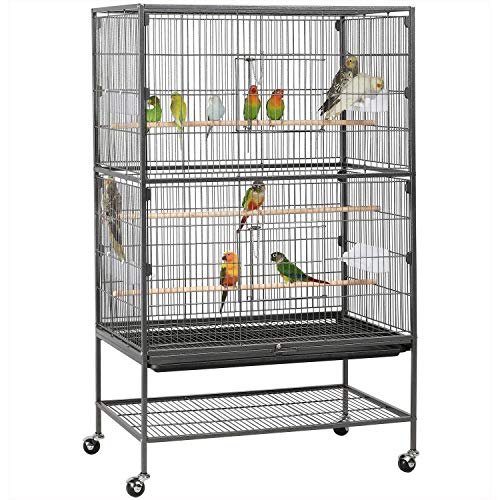
Yaheetech 52-Inch Wrought Iron Flight King Bird Cage with Stand
- Bar spacing: 0.625 inch (5/8 inch, listed as 0.6 inch in some listings)
- Dimensions: 31 x 20.5 x 52 inches including the stand
- Doors: front access door plus feeder doors
- Tray type: slide-out tray beneath the cage floor
This Yaheetech pairs a wide flight body with a rolling stand. The interior gives small to medium birds room to move between perches, and the stand raises the cage to a comfortable handling height. Bar spacing is listed at five-eighths of an inch, which suits cockatiels, lovebirds and small conures well; keepers of very small finches should measure the gap on arrival and house the tiniest birds only if it is safe for them.
Daily care is simple: a slide-out tray, feeder access through side doors, and casters that let one person roll the cage aside to clean the floor beneath it. The hammered paint finish over steel wipes down without special products. Wooden perches and plastic feeders are included, so the cage can be set up immediately and personalised later.
Choose this Yaheetech if you want cockatiel-sized space on a stand and a simple tray routine, and your smallest bird is a lovebird or larger.
ZENY 53-Inch Bird Cage with Stand
- Bar spacing: 0.5 inch
- Dimensions: 53 inches tall on the stand, wide flight cage body
- Doors: 1 large front door with latch, plus feeder access
- Tray type: bottom slide-out tray with removable metal grate
The ZENY 53-inch cage is a wrought iron flight cage on a stand, built around a large front door and half-inch spacing. That spacing is the headline: it keeps the cage suitable for parakeets and finches as well as cockatiels and small conures, which wider-spaced tall cages cannot honestly claim. The front door has a firm latch and opens wide enough for arranging perches and adding a bath.
Underneath, a bottom slide-out tray and a removable metal grate handle the daily clean, and a lower shelf stores food and liner paper where you need them. Two wooden perches and four cups are included. The stand keeps the cage at a sociable height, which matters for tame birds that watch household activity.
Choose the ZENY if you want tall-cage presence on a stand without giving up the half-inch spacing that small birds need.
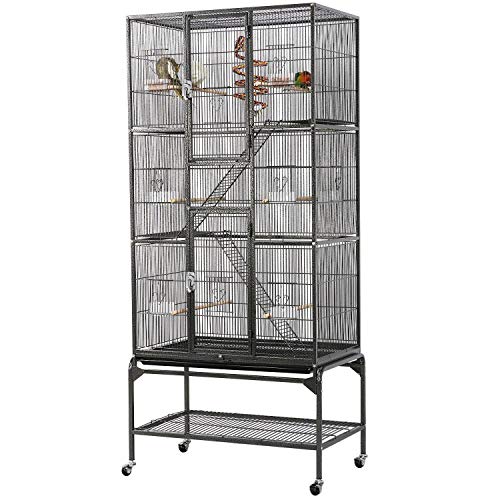
Yaheetech 69-Inch Extra Large Bird Cage
- Bar spacing: 0.4 inch
- Dimensions: 30.3 x 18.1 x 51.2 inches for the cage body, 69 inches tall overall class including stand and top
- Doors: 2 large front doors with crescent locks
- Tray type: slide-out tray at the base
The tallest pick here is a tiered Yaheetech that uses height differently: three connected levels with ladders give climbing birds, lovebirds, parakeets and small conures separate zones for feeding, playing and resting. That suits active climbers and households keeping several small birds that benefit from spreading out, rather than a pair that mainly needs one long flight run.
Bar spacing is a snug 0.4 inch, the tightest here, a sensible option for budgies that could test a wider gap. Two large front doors with crescent locks address the escape problem, and a rolling base lets a tall unit move for cleaning. The body is about thirty inches wide, so each tier keeps a useful footprint. Arrange perches so droppings from above do not fall into cups below, and keep one tier open for wing stretching.
Choose this cage if your birds climb more than they fly across a room, and you want several levels in one footprint with tight bar spacing.
Comparison Summary
For a single wide flight space for several small birds, the Prevue F040 is the most direct answer, with half-inch spacing and the best door count here. For the least scatter on a tabletop, the Vision M02 and its deep detachable base stand apart. For cockatiels and small conures on a stand, the Yaheetech 52-inch cage gives wide space, with wider spacing that suits those birds best. The ZENY 53-inch keeps half-inch spacing in a tall stand format, the safer tall option for mixed small birds. The tiered Yaheetech 69-inch trades a single flight run for three climbing levels and the tightest spacing of the five.
Across all five, the pattern is the same: match spacing to your smallest bird first, then buy the widest space your room allows, then pick the tray you will clean without complaint.
FAQ
What bar spacing is safe for a parakeet or finch?
For parakeets, budgies, finches and canaries, choose spacing of half an inch or less. At that gap a small bird can grip and climb the bars but cannot push its head through and become trapped. Always match spacing to the smallest bird in the cage, even if larger birds also live there.
How big should a cage be for two cockatiels?
Look for a cage at least thirty inches wide with enough depth for a long tail to turn freely, and half-inch to five-eighths-inch spacing. Width matters more than height because cockatiels move and flap horizontally. The birds also need daily time out of the cage, so treat the cage as a home base, not their only exercise space.
Is a tall cage better than a wide cage?
Usually not for the birds in this guide. Finches and parakeets fly across a cage, so a wide cage gives more real exercise than a narrow tall one. Tall and tiered cages still work well for climbers such as lovebirds and small conures, provided each level is wide enough and perches are arranged so birds can stretch their wings.
How often should I clean the tray and base?
Empty and wipe the tray or base at least every two to three days, and more often for a group of birds. Wash cups daily, and give the grille, tray and base a thorough scrub weekly. A slide-out tray or detachable base makes this routine quick, which is why tray design deserves weight in your choice.
Conclusion
The best bird cages share honest measurements: safe spacing, real width, doors that latch, and a tray you can clean in minutes. Pick the Prevue F040 for a wide flock cage, the Vision M02 for a tidy tabletop home, the Yaheetech 52-inch for cockatiel space on a stand, the ZENY 53-inch for tall format with small-bird spacing, or the tiered Yaheetech 69-inch for climbers. Measure your room and the spacing for your smallest bird, and your birds get a home that supports flight, rest and health daily.
More from Amazon
Programs that pair well with the guide above. Offers and eligibility are set by Amazon and may change.
Collect the home and kitchen items you want in one registry that guests can shop from.
Create a wedding registrySet up recurring deliveries of everyday items on eligible products. Terms and savings are set by Amazon.
Explore Subscribe & SaveFree shipping on eligible items, Prime Video and more. Eligible new members can start with a free trial.
Start a Prime free trialAudiobooks and podcasts to listen to on the go. Eligible new members can start with a free trial.
Try Audible freeAs an Amazon Associate we earn from qualifying purchases.







Write Your Review
No reviews yet. Be the first to share your experience!