

Key takeaways
- Documented material: Look for nylon or polyester fabric intended for aerial, circus, or load-bearing use rather than decorative mesh or ordinary yoga straps.
- Width: Around 2.8–3 m is a useful all-purpose range. Narrower fabric may feel restrictive during wraps; wider fabric can be harder to control in a small room.
- Seam construction: Reinforced edges and professionally finished seams are preferable to visibly loose stitching, raw edges, or a single lightly sewn seam at a suspension point.
- Stretch: A small amount of give can feel comfortable, but excessive stretch makes height inconsistent and can increase the difficulty of getting in and out.
- Load information: Prefer products that state the test method, working load, or relevant certification. A fabric rating without a hardware rating is incomplete.
- Surface condition: The fabric should be smooth, continuous, and free of snags, cuts, discoloration, or chemical odor that persists after airing.
The best aerial yoga hammocks for home practice are wide, low-stretch nylon or polyester hammocks with clearly stated load ratings, secure two-point suspension, and hardware matched to a properly engineered ceiling or freestanding frame.
Our top picks


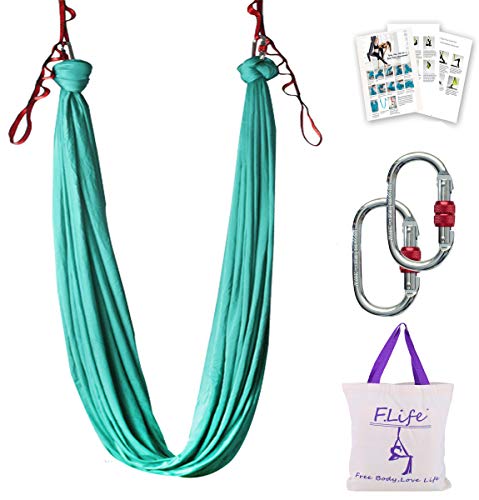
As an Amazon Associate we earn from qualifying purchases at no extra cost to you. Ratings are shown as listed on Amazon.
Quick recommendations by situation
| Home-practice situation | Best hammock specification | Why it fits | Typical equipment budget |
|---|---|---|---|
| First-time user with a suitable ceiling | 2.8–3 m wide, 5–6 m long, low-stretch fabric; adjustable two-point kit | Provides room for seated poses without excessive fabric management | $90–$180 |
| Small room or low ceiling | 2.5–2.8 m wide fabric with short, adjustable extension straps | Reduces floor spread and makes height adjustment easier | $80–$160, excluding structural work |
| Frequent practice or multiple users | 3 m wide fabric, documented breaking strength, rated hardware, replaceable straps | Offers more comfort and makes inspection and replacement practical | $150–$300 |
| Renter or uncertain ceiling | Hammock with a purpose-built freestanding aerial frame | Avoids drilling into unknown joists or ceiling systems | $350–$900 or more |
What makes a hammock suitable for aerial yoga?
Aerial yoga hammocks are usually made from tightly woven nylon or polyester fabric. Nylon is common because it is strong, smooth, and comfortable against the skin. Polyester generally has lower moisture absorption and can be useful in humid rooms, although fabric quality and construction matter more than the fiber name alone.
Look for a fabric width of approximately 2.8–3 m for a full-body practice. This gives enough material for cocooning, supported inversions, and seated poses. Length is commonly around 5–6 m, but the correct length depends on ceiling height and how much adjustment hardware is supplied. A long hammock is not automatically better: excess fabric can gather on the floor, while a short hammock may not form a comfortable seat.
Do not compare hammocks solely by a large “maximum weight” number. A listing should distinguish between fabric breaking strength, hardware capacity, and the recommended working load. Dynamic movement creates higher forces than simply sitting still, so a conservative product should provide a substantial safety margin rather than treating the maximum number as a target.
Fabric strength and comfort: the specifications that matter
- Documented material: Look for nylon or polyester fabric intended for aerial, circus, or load-bearing use rather than decorative mesh or ordinary yoga straps.
- Width: Around 2.8–3 m is a useful all-purpose range. Narrower fabric may feel restrictive during wraps; wider fabric can be harder to control in a small room.
- Seam construction: Reinforced edges and professionally finished seams are preferable to visibly loose stitching, raw edges, or a single lightly sewn seam at a suspension point.
- Stretch: A small amount of give can feel comfortable, but excessive stretch makes height inconsistent and can increase the difficulty of getting in and out.
- Load information: Prefer products that state the test method, working load, or relevant certification. A fabric rating without a hardware rating is incomplete.
- Surface condition: The fabric should be smooth, continuous, and free of snags, cuts, discoloration, or chemical odor that persists after airing.
For home use, choose a working load comfortably above the combined user weight and any equipment. For example, a 90 kg user should not select a system whose recommended working load is only 90 kg. The extra margin must also account for swinging, climbing into the hammock, and asymmetrical loading.
Suspension hardware: two points are usually better than one
A two-point suspension spreads the hammock into a stable seat and allows the fabric to open across the body. The attachment points are often spaced roughly 45–75 cm apart, but the ideal distance depends on the hammock design, ceiling structure, and the positions recommended by the manufacturer.
A complete kit may include carabiners, daisy chains or adjustable straps, swivels, webbing, and ceiling anchors. Each component must be load-rated. Decorative carabiners, climbing-style connectors with no stated rating, and hardware sold for light household hanging are not suitable substitutes.
- Carabiners: Use locking connectors with a clearly stated working or breaking load. Keep the gate fully closed and oriented so it cannot rub against the ceiling anchor.
- Daisy chains: These make height adjustment convenient, but every loop must be used as intended and protected from sharp edges.
- Swivels: Useful for controlled rotation, but they add another component that must be rated and inspected. They are not essential for basic restorative practice.
- Webbing: Straps should be wide enough to avoid cutting into the fabric and should not be twisted while loaded.
- Anchor plates: A plate with multiple fasteners can distribute force better than a single small eye bolt, provided it is installed into suitable structural material.
Ceiling requirements before you buy
Do not attach an aerial hammock to drywall, plasterboard, a suspended ceiling, a decorative beam, or an unverified ceiling hook. The anchor must connect to structural framing capable of handling repeated, dynamic loads. In many homes, that means a properly located joist or engineered beam; concrete ceilings may require an appropriate expansion or chemical anchor selected for the specific substrate.
Installation is not just a matter of finding a stud. Joist direction, timber condition, fastener type, edge distance, and the possibility of hidden utilities all matter. If you cannot identify the structure confidently, ask a qualified installer or use a purpose-built frame. A professional assessment is especially sensible for renters, older buildings, vaulted ceilings, and any ceiling with visible cracking or movement.
Allow clear space around the hammock. A practical starting point is at least 1.5 m of unobstructed space to each side and approximately 2 m in front and behind, adjusted for the movements you plan to perform. Keep the hammock away from ceiling fans, light fittings, sharp furniture, radiators, and glass.
Beginner-friendly setup in five steps
- Measure the room. Record ceiling height, anchor spacing, and the available clear floor area. Confirm that the supplied fabric length can be adjusted without bunching on the floor.
- Verify the structure. Identify the joist, beam, or concrete fixing point and confirm the anchor system is approved for that substrate. Do not rely on a visual inspection of drywall alone.
- Install both anchors at the manufacturer’s spacing. Keep them aligned on the same structural line. Uneven spacing can make the seat twist and place extra force on one side.
- Attach and level the fabric. Use locking connectors and equal strap settings. With the hammock unloaded, the lowest part of the seat is often positioned around hip height for beginners, but the exact height varies by exercise and user.
- Perform a gradual static check. Inspect every connection, then apply weight slowly while standing close to the floor. Test one side at a time only if the manufacturer permits it; never test by jumping or dropping into the hammock.
Start with low-risk seated and supported movements. Practice entering, exiting, and controlling the fabric before attempting inversions. A qualified aerial-yoga instructor can help assess technique, especially if you have limited mobility, balance concerns, recent surgery, pregnancy, or a medical condition affected by inversion or pressure.
Ownership realities: what wears first
The fabric is not always the first component to fail. Friction at carabiner gates, anchor edges, and strap loops can create localized wear long before the hammock looks generally old. Adjustable webbing may flatten, fuzz, or develop cuts. Metal hardware can corrode in damp rooms, and locking sleeves can become stiff or fail to close smoothly.
- Inspect the entire fabric before every session, particularly seams, gathered ends, and contact points.
- Replace fabric or webbing after a cut, burn mark, chemical exposure, broken stitching, or unexplained stretching.
- Retire hardware with cracks, deformation, deep scratches, corrosion, or a gate that does not lock reliably.
- Wash according to the manufacturer’s instructions, usually with mild detergent and cool or lukewarm water.
- Air-dry completely away from direct heat and strong sunlight; do not store the hammock damp.
- Keep the fabric away from oils, lotions, bleach, rough jewelry, zippers, and pet claws.
As a simple ownership calculation, a $150 hammock used twice weekly for two years provides about 208 sessions, or approximately $0.72 per session before replacement hardware. That value depends on safe installation and maintenance; saving money on an anchor or ignoring visible wear is not an economical trade-off.
Final buying checklist
Choose the hammock with the clearest safety information, not merely the brightest fabric or highest advertised weight. Before ordering, confirm the fabric dimensions, material, working-load guidance, hardware ratings, anchor compatibility, adjustment range, cleaning instructions, and replacement-part availability. If your ceiling cannot be verified, a properly rated freestanding frame is the safer choice than improvising an anchor.

Write Your Review
No reviews yet. Be the first to share your experience!