

Key takeaways
- Feedback method: rhythmic feel, balance and audible club movement rather than numerical data.
- Adjustability: limited; select the appropriate length model rather than changing the club during a session.
- Space required: roughly a 9-by-9-foot clear area for controlled indoor swings, with more room preferred outdoors.
- Best use: short daily sessions of 10 to 20 swings before hitting balls.
The best golf swing trainers for home practice depend on the fault you need to change: choose the Tour Striker Smart Ball for connection, the Orange Whip or SKLZ Gold Flex for tempo and sequencing, an alignment-stick or impact-bag setup for path and contact, and a launch monitor such as the Garmin Approach R10 when you need measured ball-flight feedback.
A useful buying rule is to match the trainer’s feedback to the mistake you can actually identify. A weighted club can make a swing feel smoother, but it cannot tell you whether the clubface was open at impact. Conversely, a launch monitor supplies numbers but does little to physically prevent an over-the-top move. The comparison below separates those jobs.
Our top picks

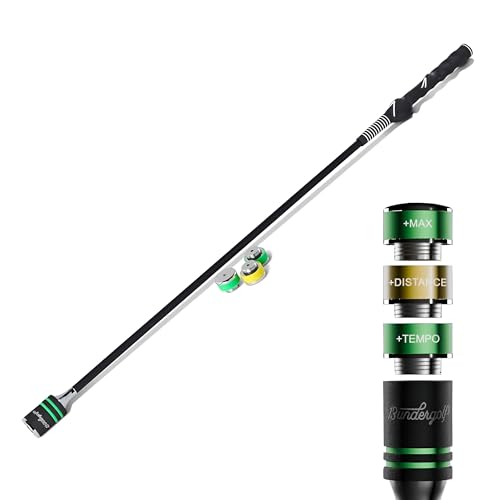


As an Amazon Associate we earn from qualifying purchases at no extra cost to you. Ratings are shown as listed on Amazon.
Best golf swing trainers by swing fault
Best for poor tempo and rushed transition: Orange Whip Trainer
The Orange Whip uses a flexible shaft, counterweight and weighted orange ball to exaggerate the sensation of a smooth backswing-to-downswing transition. It is most useful for golfers who snatch the club away, cast from the top or lose balance when trying to create speed.
- Feedback method: rhythmic feel, balance and audible club movement rather than numerical data.
- Adjustability: limited; select the appropriate length model rather than changing the club during a session.
- Space required: roughly a 9-by-9-foot clear area for controlled indoor swings, with more room preferred outdoors.
- Best use: short daily sessions of 10 to 20 swings before hitting balls.
It is not a clubface or launch monitor. If your main problem is a slice caused by face angle, use the Orange Whip for sequencing and pair it with video or a face-impact training aid.
Best for connection and arm-body coordination: Tour Striker Smart Ball
The Tour Striker Smart Ball is an inflatable ball held between the forearms or upper arms, depending on the drill. If it drops immediately, the arms and torso are separating. If it is squeezed excessively, the golfer may be restricting natural arm movement.
- Feedback method: tactile feedback; the ball falls or shifts when the connection drill breaks down.
- Adjustability: its inflation level changes firmness, although it is not a substitute for a fitted brace.
- Space required: a narrow indoor area is usually sufficient because it is a drill aid, not a full-speed club.
- Best use: slow-motion rehearsals and half-swings, followed immediately by normal swings.
Do not keep the ball pinned against your body for every full swing. The objective is to learn coordinated motion, not to freeze the arms to the torso.
Best for swing-plane and path awareness: alignment sticks or an alignment-stick trainer
Two ordinary alignment sticks can create more useful practice stations than many specialized gadgets. Place one on the ground to establish target line and use a second stick, angled safely outside the ball, as a visual reference for the club’s approach. Some manufactured alignment-stick trainers add a base, guide rod or adjustable angle.
- Feedback method: visual feedback and occasional contact with the guide when the path is excessively outside or inside.
- Adjustability: high when the sticks are repositioned; angle and distance can be changed for different drills.
- Space required: about 8 feet of width and 10 to 12 feet of length for slow indoor rehearsals; full swings require a safe ceiling and striking zone.
- Best use: correcting alignment, takeaway direction and an over-the-top pattern.
Never aim an exposed stick toward your body during a full-speed swing. Use foam or purpose-built guide rods indoors, and leave generous clearance from walls, lights and furniture.
Best for low-point control and fat or thin contact: impact bag
An impact bag gives immediate resistance when the club reaches the ball position. It can help a golfer rehearse forward shaft lean, a stable lead side and a controlled finish without repeatedly hitting a ball.
- Feedback method: sound, resistance and the bag’s position after impact.
- Adjustability: fill level is adjustable; a partially filled bag is softer and easier to move, while a fuller bag offers more resistance.
- Space required: approximately 6 feet by 6 feet for short-impact drills, plus room behind the golfer.
- Best use: 10 to 15 controlled rehearsals, not maximum-effort swings.
The first parts likely to wear are the outer fabric, handle stitching and zipper. Keep the bag dry, avoid dragging it over concrete and do not strike it with excessive force. A towel or old clothing is usually safer filler than hard material that can damage the club or seams.
Best for speed training: SuperSpeed Golf system
The SuperSpeed system uses multiple weighted clubs to train faster movement through overspeed and contrasting-load drills. It suits golfers who already have a reasonably repeatable motion and want a structured speed routine, rather than beginners still learning basic contact.
- Feedback method: movement speed measured with an optional radar or speed sensor, plus the feel of different club weights.
- Adjustability: several club weights are supplied in system-specific sets, but the golfer should follow the prescribed order instead of improvising heavy loads.
- Space required: a clear full-swing area; an indoor ceiling of about 10 feet may be insufficient for taller golfers or steep swings.
- Best use: two or three sessions weekly with rest between demanding sessions.
Speed equipment should not replace technique work. Stop if the movement becomes strained, and consider professional instruction if you have a recurring injury or pain.
Best for measured practice: Garmin Approach R10
The Garmin Approach R10 is a portable launch monitor that uses radar to estimate metrics such as club speed, ball speed, launch angle, carry distance and spin-related data, depending on the shot and setup. It is the strongest choice when your decision depends on measurable results rather than feel alone.
- Feedback method: app-based numerical feedback and simulated practice modes.
- Adjustability: setup depends on ball position, target alignment, indoor mode and available space; accuracy is highly sensitive to placement.
- Space required: follow the manufacturer’s minimum indoor distance, with roughly 15 feet of total ball-to-net depth often needed for a comfortable indoor setup.
- Best use: golfers who practice frequently and will record trends instead of reacting to one unusual shot.
A launch monitor is not automatically the best slice-correction device. It tells you what happened; it does not physically guide the club. Use it with video, alignment aids or instruction when the cause is unclear.
Head-to-head comparison
| Trainer or type | Primary fault | Feedback | Typical size or setup | Adjustability | Typical market range |
|---|---|---|---|---|---|
| Orange Whip Trainer | Rushed tempo, poor balance | Feel and rhythm | About 47 inches long; 9-by-9 feet clear | Low | $100–$130 |
| Tour Striker Smart Ball | Loss of arm-body connection | Tactile; ball movement | Small inflatable drill aid | Medium through inflation | $40–$60 |
| Impact bag | Fat contact, weak impact position | Resistance and position | About 12–18 inches wide; 6-by-6 feet | Medium through fill level | $30–$70 |
| SuperSpeed system | Limited swing speed | Feel; optional speed measurement | Full-swing clearance required | High through multiple weights | $200–$300 |
| Garmin Approach R10 | Uncertain ball-flight results | Radar and app metrics | Small unit; roughly 15 feet total indoor depth | High through data and drills | $500–$650 |
Dimensions and prices are practical buying ranges rather than guarantees. Product versions, regional pricing and package contents can change, so verify the current manufacturer specification before purchase.
Decision matrix: which trainer fits your situation?
| Your situation | Best starting choice | Why | What to add later |
|---|---|---|---|
| Beginner with little space | Smart Ball or short alignment drill | Low cost, quiet and easy to control | One lesson or video feedback |
| Intermediate golfer who slices | Alignment trainer plus video | Shows face, path and alignment relationships | Launch monitor for confirmation |
| Frequent golfer wanting more speed | SuperSpeed system | Provides a repeatable weighted routine | Speed sensor and recovery days |
| Data-focused golfer with a net | Garmin Approach R10 | Tracks trends across repeated sessions | Impact tape or slow-motion video |
| Golfer correcting fat or thin shots | Impact bag and low-point drill | Rehearses controlled impact without ball expense | Foam balls and a hitting mat |
How to use a home trainer without reinforcing a bad motion
- Choose one fault. Do not alternate between speed, path and release drills in the same five-minute block.
- Make 5 to 10 slow rehearsals. Slow movement reveals whether you understand the desired change.
- Hit or simulate 5 normal swings. Transfer the feeling without forcing the exaggerated drill position.
- Record one measurement. Use face contact, start direction, carry distance or video—not every available metric.
- Stop when quality drops. Fatigue turns a useful trainer into a repetition of the old fault.
For example, assume a $50 impact bag is used twice weekly for 26 weeks. That is 52 sessions, or about $0.96 per session before replacing worn materials. A $550 launch monitor used twice weekly for the same period costs about $10.58 per session. The monitor becomes more economical only if you will continue using it for several seasons and will act on the data.
Ownership details that matter
Inspect flexible shafts for cracks, weighted-club grips for slipping and impact bags for split seams. Wipe sweat from grips, store inflatable aids partly deflated when recommended, and keep radar equipment protected from moisture and extreme temperatures. A hitting mat can also affect results: a very soft mat may hide low-point errors, while a thin hard mat can encourage painful, abrupt contact.
For most home golfers, the best first purchase is the least expensive trainer that gives clear feedback on the fault they can name. Add a second device only when it answers a different question—for example, pair a tempo trainer with video, or an impact bag with a launch monitor. If you cannot identify the cause of a persistent swing problem, a qualified golf professional can help prevent weeks of practicing the wrong correction.




Write Your Review
No reviews yet. Be the first to share your experience!