

Key takeaways
- Before each use: inspect the guard, handle, harness connection, head, and throttle. Confirm that the head is tight and that the line is cut to the specified length.
- After each use: brush grass from the cylinder cover, air-intake area, guard, and head. Packed debris restricts cooling and can contribute to overheating.
- Every several operating hours: check the air filter and clean or replace it according to the manual. A dirty filter reduces power and encourages hard starting.
- Periodically: inspect and lubricate the gearhead if the manufacturer specifies grease. Check the spark plug, flexible drive shaft, and fasteners.
- Before storage: use fresh, properly specified fuel, stabilize it if appropriate, and follow the manufacturer’s procedure for draining or treating the fuel system.
The best gas string trimmers for tough yard work are the ECHO SRM-2620 for maximum cutting performance, the STIHL FS 91 for heavy grass and property maintenance, the Husqvarna 525L for lighter frequent use, and the Honda HHT25SLT for buyers who prioritize four-stroke fuel economy and low emissions.
Gas trimmers still make sense when you maintain large lots, thick weeds, fence lines, drainage areas, or several properties. They generally offer longer uninterrupted work time than battery models and are less dependent on charging infrastructure. The tradeoff is more noise, exhaust, vibration, fuel handling, and routine maintenance. The right choice depends less on the largest engine and more on how much vegetation you cut, how often you work, and how much weight you can comfortably control.
Our top picks
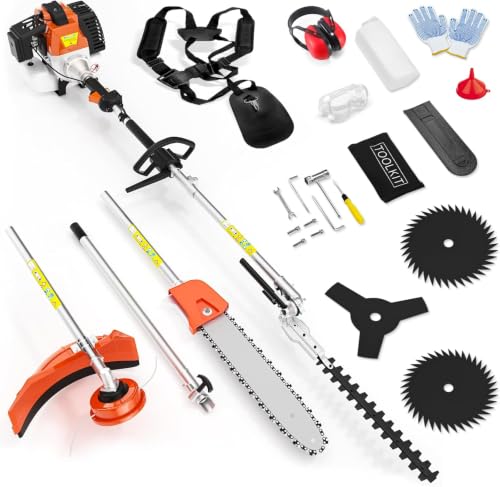


As an Amazon Associate we earn from qualifying purchases at no extra cost to you. Ratings are shown as listed on Amazon.
Best gas string trimmers compared
| Model | Engine class | Cutting swath | Shaft and handle | Approximate dry weight | Best suited to |
|---|---|---|---|---|---|
| ECHO SRM-2620 | 25.4 cc, 2-stroke | 17 inches | Straight shaft, loop handle | About 13 lb | Dense weeds, tall grass, frequent heavy work |
| STIHL FS 91 | 28.4 cc, 4-MIX | 16.5 inches | Straight shaft, bicycle handle | About 12.8 lb | Large properties and extended mowing |
| Husqvarna 525L | 25.4 cc, 2-stroke | 18 inches | Straight shaft, loop handle | About 9.7 lb | Routine trimming with less fatigue |
| Honda HHT25SLT | 25 cc, 4-stroke | 17 inches | Straight shaft, loop handle | About 13.3 lb | Users who prefer straight gasoline |
| STIHL FS 56 RC-E | 27.2 cc, 2-stroke | 16.5 inches | Straight shaft, loop handle | About 12.5 lb | Residential users needing extra capacity |
Weights and cutting widths can vary by configuration, guard, and included cutting head, so use the table as a comparison guide rather than a substitute for the current manufacturer specification sheet.
Head-to-head: engine size and cutting performance
ECHO SRM-2620: best for thick, stubborn growth
The SRM-2620 is a strong choice when the job includes waist-high grass, vines, heavy roadside weeds, or neglected fence lines. Its 25.4 cc professional-grade two-stroke engine provides a useful balance between torque and manageable weight. The 17-inch cutting swath covers ground quickly without demanding excessive power from the engine.
Its Speed-Feed 400 head is designed to load line without completely disassembling the head. That matters when you are working through a large property and need to reload quickly. The loop handle is maneuverable around trees and posts, although users who mow broad open areas may prefer bicycle-style handles.
STIHL FS 91: best for extended property maintenance
The FS 91 uses STIHL’s 4-MIX engine, which runs on a gasoline-and-two-stroke-oil mixture but has four-stroke-style valve operation. Its bicycle handle, shoulder harness compatibility, and relatively large engine make it well suited to long passes across fields, ditches, and large lawns.
A bicycle handle spreads steering effort across both hands and works particularly well with a harness. It is less convenient than a loop handle in tight beds, so this is a situation-dependent recommendation rather than an automatic winner. The FS 91 is also heavier and more expensive than a homeowner-grade trimmer, but the extra capacity can be worthwhile when smaller machines bog down repeatedly.
Husqvarna 525L: best lightweight professional-style option
The 525L stands out for its low weight and efficient 25.4 cc engine. It is a good fit for someone who trims every week or two, maintains several residential properties, or wants a straight-shaft tool that is easier to carry between obstacles. Its 18-inch swath is among the widest in this group.
The limitation is simple: a wide swath does not create more torque. In dense woody stems or wet, matted vegetation, a heavier machine with a more aggressive head may maintain speed better. For grass, lawn edges, and ordinary weeds, however, the lower weight can reduce fatigue more than a larger engine would improve productivity.
Honda HHT25SLT: best four-stroke-style ownership choice
The HHT25SLT uses a 25 cc four-stroke engine and runs on straight gasoline rather than premixed fuel. That can appeal to users who do not want to measure two-stroke oil for every fuel can. Four-stroke engines are often quieter in tone and can be economical during repeated trimming, though the complete trimmer is not necessarily lighter.
Remember that “four-stroke” does not mean maintenance-free. It still needs engine oil checks and changes, and storing old gasoline can cause starting problems. Honda’s design is most attractive when fuel simplicity and regular property maintenance matter more than the lowest possible weight.
Decision matrix: which type fits your yard?
| Your situation | Recommended direction | Why | What to avoid |
|---|---|---|---|
| Small yard, occasional edging | 25–27 cc loop-handle trimmer | Enough capacity without unnecessary bulk | 28 cc bicycle-handle models unless you also clear fields |
| Large lot or weekly commercial work | 25–30 cc professional-grade model with harness | Better cooling, serviceability, and sustained cutting | Light homeowner models used continuously at full throttle |
| Thick weeds and woody stems | Higher-torque straight-shaft model, 17-inch swath or less | Maintains head speed and is easier to control | Oversized swaths that cause bogging |
| Limited hand strength or long sessions | Lightweight loop-handle model with harness | Lower carrying fatigue and easier turning | Choosing by engine size alone |
| Dislike of fuel mixing | Four-stroke gasoline trimmer | Uses straight gasoline, with separate oil maintenance | Assuming it requires no seasonal service |
Shaft design, vibration, and control
A straight shaft usually provides better reach beneath shrubs, decks, and fences than a curved shaft. It is also the more common design on professional-grade machines and typically accommodates heavier-duty heads. A loop handle gives better control in confined spaces, while a bicycle handle is more comfortable for broad, repetitive sweeps when paired with a properly adjusted harness.
Vibration is affected by the engine, clutch, shaft, head balance, line diameter, and how aggressively the head contacts vegetation. Anti-vibration mounts can reduce discomfort, but they cannot compensate for a bent shaft or badly balanced line. If the machine suddenly vibrates more than usual, stop and inspect the head, guard, line, and shaft instead of continuing through it.
For normal grass, .095-inch line is a practical starting point. Thick weeds may justify .105-inch line if the trimmer’s manual permits it. Larger line increases cutting resistance and fuel use, so it is not automatically better. Match the diameter and head to the manufacturer’s limits.
Fuel use and a realistic operating calculation
Gas trimmer fuel consumption varies with throttle position, vegetation, line diameter, and engine condition. A useful planning estimate for a 25–30 cc trimmer is roughly 0.4 to 0.7 fluid ounces of fuel per minute while actively cutting. At 30 minutes of cutting per session, that equals approximately 12–21 fluid ounces, or 0.09–0.16 gallon.
For example, if premixed fuel costs about $8 per gallon, fuel for 20 half-hour sessions would be approximately:
20 sessions × 0.12 gallon per session × $8 = $19.20.
This excludes line, spark plugs, filters, oil, and repairs. The calculation also shows why idling is wasteful: a machine left running while you move debris consumes fuel without increasing trimmed area.
Line-loading systems and ownership details
Rapid-load heads are convenient because you can thread a measured length of line through the head and wind it with a knob. Traditional bump-feed heads may be more familiar and can be dependable when kept clean, but they require more manual winding. Fixed-line heads load quickly with short segments and work well for abrasive weeds, although they may use line faster.
The parts that usually wear first are the cutting line, bump knob, eyelets, head housing, drive shaft, air filter, and spark plug. Rocks and concrete accelerate head wear. Running too much line, fitting the wrong diameter, or striking hard surfaces at full throttle can damage the eyelets and overload the clutch.
Maintenance routine that prevents common failures
- Before each use: inspect the guard, handle, harness connection, head, and throttle. Confirm that the head is tight and that the line is cut to the specified length.
- After each use: brush grass from the cylinder cover, air-intake area, guard, and head. Packed debris restricts cooling and can contribute to overheating.
- Every several operating hours: check the air filter and clean or replace it according to the manual. A dirty filter reduces power and encourages hard starting.
- Periodically: inspect and lubricate the gearhead if the manufacturer specifies grease. Check the spark plug, flexible drive shaft, and fasteners.
- Before storage: use fresh, properly specified fuel, stabilize it if appropriate, and follow the manufacturer’s procedure for draining or treating the fuel system.
Never remove the debris guard to gain a wider cutting path. The guard controls line length, helps protect the operator, and reduces the chance of stones being thrown. Wear eye and hearing protection, long trousers, sturdy footwear, and gloves, and keep people and pets well away from the cutting area.
Bottom line
Choose the ECHO SRM-2620 when dense growth and rapid line changes are your priorities. Choose the STIHL FS 91 for sustained large-property work with a bicycle handle and harness. Choose the Husqvarna 525L when low weight matters most, and consider the Honda HHT25SLT when straight gasoline and four-stroke-style operation simplify your routine. In every case, match the cutting swath and line diameter to the engine rather than assuming the widest head will finish the job fastest.




Write Your Review
No reviews yet. Be the first to share your experience!