

Key takeaways
- Sealed bearings: help keep fur and dust away from moving parts.
- Adjustable resistance: can prevent a light wheel from spinning too freely or rattling at speed.
- Rubber feet: reduce vibration on hard floors.
- Rigid frame: limits clicking and side-to-side movement.
- Replaceable bearing assemblies: are preferable to discarding the entire wheel when noise develops.
Best Cat Exercise Wheels for Indoor Cats & Small Spaces
For most indoor cats, the best cat exercise wheels are a 40–48 inch wheel with a 10–14 inch running track, a solid non-slip surface, and a quiet bearing system; choose the smaller end only for compact, lighter cats that run with a level back.
A cat wheel can add useful activity without requiring a large climbing tower, but the right choice depends on more than the outside diameter. A wheel that is too small may force a cat to curve its spine, while a wheel that is too wide or heavy can dominate a small room. Noise, assembly, stability, and cleaning also determine whether the wheel becomes daily equipment or an expensive piece of furniture.
Our top picks
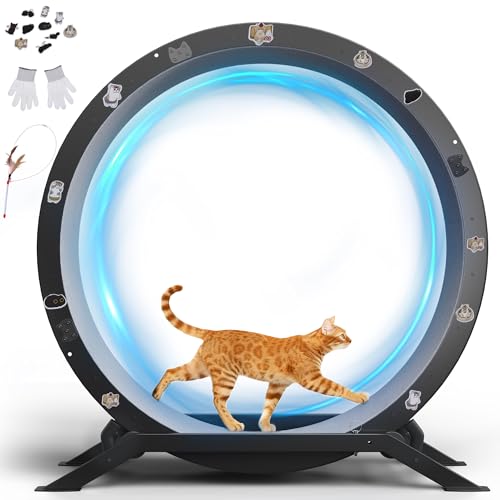


As an Amazon Associate we earn from qualifying purchases at no extra cost to you. Ratings are shown as listed on Amazon.
Quick comparison: which wheel fits your situation?
| Situation | Recommended specification | Best wheel type | Typical market range |
|---|---|---|---|
| Small room or apartment | 40–42 in diameter; 10–12 in track; under 55 lb | Compact single-track wheel | $180–$350 |
| Average adult cat | 43–47 in diameter; 12–14 in track | Full-size enclosed or open-frame wheel | $250–$550 |
| Large, long-bodied, or heavy cat | 47–52 in diameter; at least 14 in track; 40 lb-plus capacity | Heavy-duty full-size wheel | $350–$700 |
| Several cats sharing one wheel | 46 in or larger; wide running surface; high lateral stability | Reinforced frame with replaceable running panels | $400–$800 |
| Noise-sensitive household | Sealed bearings, adjustable resistance, rubber feet | Quiet bearing-based wheel | $300–$700 |
These are buying ranges rather than guarantees. Construction, shipping, replacement-part availability, and whether the wheel arrives assembled can change the total cost substantially.
Diameter matters more than the product photo
The wheel diameter determines how sharply a cat must bend its back while running. A 40-inch wheel has a running radius of approximately 20 inches, while a 48-inch wheel has a radius of approximately 24 inches. That difference reduces the curve of the cat’s body and is particularly useful for tall, long-backed, or heavier cats.
As a practical rule, measure the cat from the floor to the top of its back while standing naturally, then add several inches of clearance. A petite cat may manage a 40–42 inch wheel, but a large adult should generally have a 45–48 inch wheel or larger. If the cat’s back visibly arches, its paws bunch toward the front of the track, or it repeatedly jumps off, the wheel may be undersized or poorly introduced.
Track width and surface
A 10–12 inch track is often adequate for one small or average cat. Choose 13–16 inches for a large cat, a cat that runs enthusiastically, or a multi-cat home. A wider track gives the cat more room to correct its footing, but it also increases the wheel’s overall footprint and weight.
Look for a continuous, textured running surface rather than widely spaced slats. Gaps can catch claws, tails, or loose bedding. Carpet-like surfaces provide traction but collect fur and may retain odors. Plastic, rubberized, or sealed composite surfaces clean more easily, provided they are not slick. Removable panels or a replaceable running belt are valuable because the running surface is usually the first component to become worn or soiled.
Best choices by home and cat
Best for very small spaces: a compact 40–42 inch wheel
A compact wheel is the sensible choice when floor space is limited, especially in a studio apartment or bedroom. Allow more room than the wheel’s listed diameter: a 42-inch wheel may need roughly 48–54 inches of clear floor depth once the frame, side clearance, and safe exit area are included.
Choose a stable base rather than simply the lightest model. A narrow, tall wheel can be harder to keep steady when a cat accelerates. Place it against a wall only if the manufacturer permits that arrangement and leave enough space for the cat to exit without being trapped between the wheel and the wall.
Best for most adult indoor cats: a 43–47 inch full-size wheel
This is the most versatile range. It accommodates many adult cats without requiring the largest possible footprint. Open-frame designs can be easier to inspect and clean, while enclosed side panels may reduce visual distractions and help prevent a hesitant cat from stepping off sideways.
One Fast Cat is a recognizable example of the modular open-wheel approach. Its appeal is the relatively simple structure and replaceable-style component philosophy, but buyers should still check the current dimensions, weight limit, and surface design before ordering because specifications can change between versions.
Best for large cats or frequent running: a reinforced 47–52 inch wheel
A large wheel is preferable for a long-bodied cat, a cat above approximately 15 pounds, or a household where the wheel will receive vigorous daily use. Confirm the stated load capacity and inspect the base width, not just the wheel diameter. A nominal capacity of 40 pounds does not automatically mean the frame will remain stable if two cats run together.
Heavy-duty wheels usually cost more and can be difficult to move after assembly. They make sense when the wheel will be used often, but they are poor choices for owners who need to store the equipment regularly.
Noise: what to check before buying
Wheel noise usually comes from bearings, frame flex, an uneven floor, or the running surface rubbing against a side panel. Manufacturer noise claims are difficult to compare because there is no consistent household testing standard, so examine the mechanism instead.
- Sealed bearings: help keep fur and dust away from moving parts.
- Adjustable resistance: can prevent a light wheel from spinning too freely or rattling at speed.
- Rubber feet: reduce vibration on hard floors.
- Rigid frame: limits clicking and side-to-side movement.
- Replaceable bearing assemblies: are preferable to discarding the entire wheel when noise develops.
For a bedroom or shared wall, place the wheel on a dense rubber exercise mat and keep it level. Do not lubricate a bearing unless the manufacturer specifically allows it; some lubricants attract fur and turn a small noise problem into a maintenance problem.
Assembly and safety checklist
- Measure the intended location first. Record floor width, ceiling height, doorway width, and clearance around the wheel. A wheel that fits the room may not fit through the doorway after packaging.
- Assemble on a flat surface. Tighten fasteners evenly and confirm that the wheel is centered in the frame. Uneven spacing can create rubbing or wobbling.
- Check the running surface. Run a hand over the track and remove sharp edges, exposed staples, loose screws, or raised seams.
- Test stability without the cat. Push gently from several directions. The base should not rock, slide, or tip.
- Introduce the wheel gradually. Leave it stationary at first and reward investigation. Later, use a toy or treat to encourage a few steps; never force a cat onto the wheel.
- Supervise early sessions. Stop if the cat slips, becomes frightened, runs with an extreme back curve, or tries to climb the side panels.
Keep cords, dangling toys, and loose fabric away from the moving wheel. Do not allow children to spin it while a cat is using it. If a cat has a known orthopedic problem, unexplained lameness, breathing difficulty, or sudden reluctance to exercise, ask a veterinarian before encouraging wheel use.
Ownership costs and maintenance
The purchase price is only part of the cost. A useful budgeting example is a $400 wheel used four times per week for two years: 4 uses × 104 weeks equals 416 sessions, or approximately $0.96 per session before replacement parts. If the wheel is used once per week, the same purchase costs about $3.85 per session. Frequency of use therefore matters more than choosing a premium finish.
Vacuum or brush loose fur from the track weekly, wipe the surface with a pet-safe cleaner, and dry it fully before use. Inspect the wheel every month for loose hardware, cracked panels, bearing play, and worn traction material. In homes with multiple cats, cleaning may need to be more frequent.
The parts most likely to wear first are the running belt or panels, bearing assemblies, rubber feet, and fasteners. Before buying, verify that these parts can be purchased separately. A cheaper wheel with no replacement parts may cost more over its useful life than a moderately priced modular model.
Final buying recommendation
Choose a 40–42 inch wheel for a genuinely small cat and a tightly constrained room, a 43–47 inch wheel for most adult indoor cats, and a 47-inch-plus reinforced wheel for large cats or heavy daily use. Prioritize a level running posture, a track at least 12 inches wide for average cats, sealed bearings, stable feet, and a cleanable or replaceable running surface. Brands such as One Fast Cat and Ferris Cat Wheel are established names to compare, but the current model’s measured dimensions, weight rating, replacement-part policy, and assembly requirements should decide the purchase—not the brand name alone.

Write Your Review
No reviews yet. Be the first to share your experience!