

Key takeaways
- Buying by hood width alone: 30-inch and 36-inch hoods can use several different filter layouts.
- Ignoring ductless hardware: Some hoods need a recirculation kit, air deflector, or conversion plate in addition to a carbon filter.
- Installing carbon without a grease filter: Oil can clog carbon quickly and reduce odor capacity.
- Trimming a framed cartridge: Cutting a rigid frame can remove the seal or expose loose media to the fan.
- Leaving gaps at the edges: Air takes the path of least resistance, bypassing the carbon when the filter does not seal.
- Expecting complete odor removal: Carbon filtration reduces many cooking odors but does not replace exterior exhaust, source control, or ventilation of steam and heat.
Best Carbon Filter Replacement for Range Hood: Fit Guide
The best carbon filter replacement for range hood use is the one that matches your hood’s exact model, filter dimensions, thickness, retaining tabs, and ductless configuration—not simply the one with the largest amount of charcoal.
For most recirculating or ductless hoods, choose a replacement made for the hood model or an exact dimensional equivalent, with a pleated grease prefilter plus an activated-carbon layer. A washable metal filter alone will capture grease but will not remove cooking odors. Before ordering, record the hood model number, measure the old filter, and confirm whether the carbon filter attaches to the grease filter or fits directly into the blower housing.
Our top picks
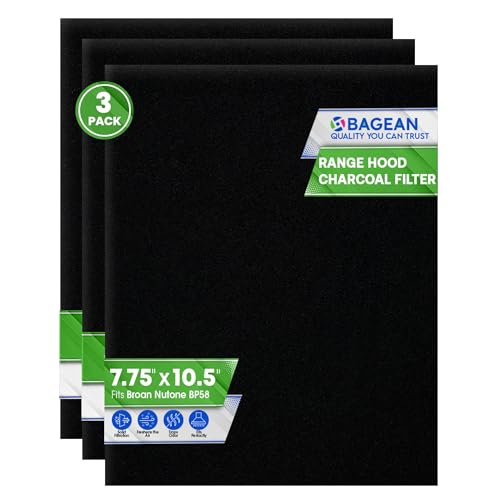


As an Amazon Associate we earn from qualifying purchases at no extra cost to you. Ratings are shown as listed on Amazon.
What to Match Before You Buy
1. Hood model and filter shape
The model number is the safest starting point. It is commonly printed on a label inside the hood, behind the filter, on the underside of the cabinet, or in the installation manual. Filters that appear interchangeable may use different clips, magnets, corner cuts, or airflow directions.
Search by the complete model number rather than by the hood’s advertised width. A “30-inch hood” may use one filter around 10 by 12 inches, two filters around 9 by 12 inches, or a custom filter with a central notch. A filter that is slightly too small can allow unfiltered air around its edges; one that is too large can restrict airflow or prevent the grease filter from locking in place.
2. Length, width, and thickness
Measure the old filter after removing it. Record length and width to the nearest 1/16 inch, then measure thickness at an undamaged edge. Do not compress a flexible carbon pad while measuring. Also compare the frame, tabs, holes, and fastening method.
| Common replacement type | Typical dimensions | Typical thickness | Best use | Main limitation |
|---|---|---|---|---|
| Thin cut-to-size carbon pad | 12 x 24 inches or larger sheets | 1/4 to 1/2 inch | Older or unusual ductless hoods with a retaining grille | Easy to install incorrectly; sealing can be poor |
| Clip-on carbon filter | About 9 x 10 to 12 x 13 inches | 1/2 to 1 inch | Hoods designed for a carbon insert over a metal grease filter | Tabs and hole positions must match |
| Framed charcoal filter | About 10 x 12 to 12 x 15 inches | 3/4 to 1-1/4 inches | Model-specific recirculating hoods | Usually not compatible with a different frame design |
| Round or cartridge-style filter | Approximately 5 to 8 inches in diameter | 1 to 2 inches | Compact hoods with a circular blower intake | Requires the correct locking mechanism |
These are fitting ranges, not universal standards. The exact model specification takes priority over a nominal size.
Best Choices by Situation
| Your situation | Best filter choice | Why it fits the situation | Trade-off |
|---|---|---|---|
| Occasional light cooking | Standard model-matched carbon filter | Lower purchase cost and adequate odor adsorption | May need replacement sooner after frying or searing |
| Frequent frying, grilling, or stir-frying | Thicker, high-capacity carbon cartridge with a substantial grease prefilter | More carbon surface and better protection from grease loading | Higher cost and potentially greater airflow resistance |
| Small apartment with no exterior duct | Hood-specific recirculating kit and carbon filter | Confirms that the blower path is designed for filtered return air | Odor control remains less complete than exterior venting |
| Rare or discontinued hood model | Correctly sized universal pad or compatible framed equivalent | Can keep an older hood operating when a branded cartridge is unavailable | May require careful trimming or retaining hardware |
| Lowest ownership cost | Reusable metal grease filter plus replaceable carbon pad, if designed for the hood | Only the odor medium needs regular replacement | More maintenance and greater risk of an imperfect seal |
Carbon Capacity Versus Airflow
Activated carbon removes odors by adsorption: odor molecules cling to the carbon’s internal surface. A thicker or denser carbon layer can last longer, but thickness alone does not prove better performance. If the material is packed too tightly, the blower may move less air. Reduced airflow can also allow steam and cooking particles to escape around the filter.
For a high-use kitchen, a model-specific cartridge containing roughly 100 to 250 grams of activated carbon is a practical range for many residential hood designs. Compact cartridges may contain less, while large filters can contain more. Treat the stated carbon weight as one comparison point, not a guarantee: fit, air sealing, grease protection, and the hood’s fan design matter just as much.
Do not install a thick universal pad in a space designed for a thin filter unless the manufacturer’s instructions permit it. A filter that presses against the blower wheel, blocks a latch, or leaves no clearance can create noise and reduce ventilation.
How to Confirm Compatibility in Five Steps
- Find the model number. Photograph the label before removing the filter. Include every letter, number, and suffix.
- Identify the ventilation configuration. Confirm whether the hood exhausts outdoors or returns filtered air to the kitchen. Carbon filters are normally used for recirculating operation.
- Remove and inspect the existing filter. Note whether the carbon material is a separate clip-on insert, a framed cartridge, a circular filter, or a loose pad behind a grille.
- Measure the filter and mounting points. Check length, width, thickness, tabs, holes, magnets, and airflow arrows. A dimensional match without a mounting match is not enough.
- Check clearance and the replacement instruction. Confirm that the new filter does not obstruct the fan, grease filter, latch, or return-air openings.
Install the carbon filter on the correct side of the grease filter. The grease filter should generally face the cooking area so it intercepts oil before the oil reaches the carbon. Follow the hood manual if its airflow arrangement differs.
Replacement Interval and Cost per Use
Many residential recirculating hoods need a carbon filter replacement about every three to six months. Light use may extend that interval toward six to twelve months, while daily frying can require replacement closer to one to three months. Odor persistence, visible grease contamination, weaker airflow, and a filter that has become dark or saturated are practical warning signs.
Use this simple ownership calculation:
Cost per cooking month = filter price ÷ months of service.
For example, a $25 filter lasting four months costs about $6.25 per month. A $40 high-capacity filter lasting six months costs about $6.67 per month. The more expensive filter is not automatically the better value if the hood cannot accommodate its thickness or if grease rapidly blocks it.
Carbon filters are generally consumables, not washable components. Washing can remove some surface grease while also damaging the carbon structure, frame, adhesive, or filter media. Wash the reusable metal grease filter according to the hood instructions, but replace the carbon insert unless the manufacturer specifically labels it washable or regenerable.
Common Fit and Performance Mistakes
- Buying by hood width alone: 30-inch and 36-inch hoods can use several different filter layouts.
- Ignoring ductless hardware: Some hoods need a recirculation kit, air deflector, or conversion plate in addition to a carbon filter.
- Installing carbon without a grease filter: Oil can clog carbon quickly and reduce odor capacity.
- Trimming a framed cartridge: Cutting a rigid frame can remove the seal or expose loose media to the fan.
- Leaving gaps at the edges: Air takes the path of least resistance, bypassing the carbon when the filter does not seal.
- Expecting complete odor removal: Carbon filtration reduces many cooking odors but does not replace exterior exhaust, source control, or ventilation of steam and heat.
Final Buying Recommendation
Choose the exact model-matched carbon filter when it is available and reasonably priced. It offers the lowest fit risk, the correct mounting hardware, and a predictable airflow path. Choose a universal carbon pad only when the hood has a proper retaining grille and you can match the thickness and cut dimensions accurately. For frequent high-grease cooking, prioritize a substantial grease prefilter and an appropriately thicker carbon cartridge rather than simply selecting the cheapest replacement.
The best carbon filter replacement for range hood performance is therefore a balanced choice: exact fit first, ductless compatibility second, carbon capacity and grease protection third, and price per service month last. That order prevents the most expensive mistake—buying a filter that technically fits the cabinet but fails to seal, restricts the blower, or wears out after only a few weeks.




Write Your Review
No reviews yet. Be the first to share your experience!