

Key takeaways
- Comparing MPH alone and overlooking CFM.
- Using boost mode for the entire job and exhausting the battery quickly.
- Buying a large battery without checking the resulting tool weight.
- Trying to lift wet leaves from grass when a rake or mower collection system would be more efficient.
- Blowing debris toward roads, storm drains, windows, people, or neighboring property.
- Operating without eye protection when gravel, sticks, or hard debris may be present.
Best Cordless Leaf Blowers for Yards and Small Properties
The best cordless leaf blower for most small properties is a mid-power 40V–56V model with roughly 500–650 CFM, while large properties benefit from an 80V blower producing 700 CFM or more and smaller yards are usually better served by a lighter 18V–20V tool.
Voltage is not a direct measure of blowing power, but it is a useful guide to the size of the motor and battery system. The figures that matter most are air volume, measured in cubic feet per minute (CFM), air speed, measured in miles per hour (MPH), battery capacity, weight, and noise. A high MPH rating helps loosen wet leaves; high CFM moves larger piles across lawns and driveways.
Our top picks
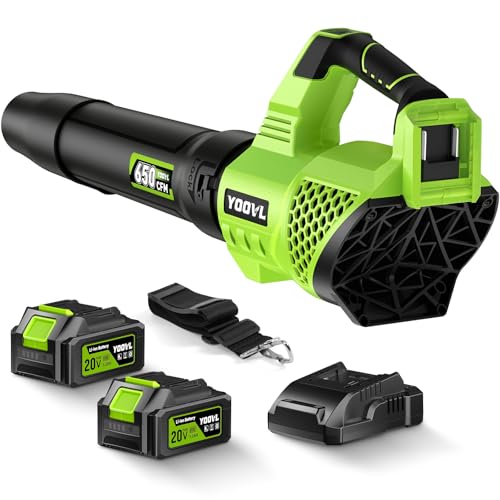


As an Amazon Associate we earn from qualifying purchases at no extra cost to you. Ratings are shown as listed on Amazon.
Quick comparison: cordless blowers for different property sizes
| Blower type or example | Battery system | Maximum airflow | Approx. bare-tool weight | Typical useful runtime | Best fit |
|---|---|---|---|---|---|
| Compact handheld blower | 18V–20V | 300–450 CFM; up to about 125 MPH | 4–6 lb | 10–25 minutes | Patios, decks, garages, and very small yards |
| DeWalt DCBL722-class blower | 20V MAX | Up to about 450 CFM; up to about 125 MPH | About 5.4 lb bare | 15–30 minutes with a larger battery | Cleanup after mowing and smaller suburban lots |
| Ryobi 40V HP Whisper Series-class blower | 40V | Up to about 730 CFM; up to about 190 MPH | About 10–12 lb with battery, depending on pack | 15–35 minutes | Medium yards and users prioritizing lower perceived noise |
| EGO Power+ LB6504-class blower | 56V | Up to about 650 CFM; up to about 180 MPH | About 10–12 lb with battery | 15–35 minutes | Frequent cleanup and medium-to-large residential yards |
| Greenworks Pro 80V-class blower | 80V | About 700–730 CFM; up to about 170 MPH | About 10–12 lb with battery | 15–30 minutes | Large properties and heavy leaf accumulation |
These are representative published specifications for widely sold models and product classes; exact weight and runtime change with battery size, nozzle, operating mode, and the manufacturer’s measurement method. A “maximum” runtime usually means low-speed operation, not continuous full power.
Best choices by yard and workload
Best for a small yard: a compact 18V–20V blower
Choose a compact blower if your normal job is clearing a driveway, walkway, deck, porch, or a lawn under roughly one-quarter acre. These tools are easier to carry and generally cost less if you already own batteries from a drill or string trimmer.
The tradeoff is limited sustained power. A 20V blower may move dry leaves effectively, but it can struggle with wet oak leaves, pine needles embedded in grass, or large piles. Battery capacity matters: a compact 2.0Ah pack keeps the tool light, while a 5.0Ah pack extends working time but makes the blower noticeably heavier.
Best all-rounder: a 40V or 56V handheld blower
For most suburban properties, a 40V–56V model offers the most useful balance. Airflow around 500–650 CFM is enough for regular fall cleanup, grass clippings, light debris, and leaves gathered along fences. Variable-speed triggers are more valuable than an impressive top-speed figure because they let you clear delicate mulch without scattering it.
The EGO Power+ LB6504 class is a strong choice for users already invested in a 56V battery platform. A Ryobi 40V HP Whisper Series model suits households that want high airflow within the broad 40V ecosystem. Compare the complete tool weight with the battery installed, not just the bare-tool specification.
Best for a large property: an 80V high-airflow blower
Large lawns, long driveways, mature trees, and frequent wet-leaf cleanup justify an 80V blower producing approximately 700 CFM or more. Higher airflow reduces the number of passes needed to create one large pile, particularly on hard surfaces.
A high-output blower is not automatically faster everywhere. It is heavier, can drain a battery quickly at full throttle, and may be excessive for a small patio. It also requires more storage space for larger batteries and chargers. For properties over roughly one-half acre, buying a second battery may improve productivity more than choosing a slightly higher MPH rating.
How to compare the specifications
CFM versus MPH
CFM describes how much air the blower moves. It is the more useful figure for shifting a broad layer of leaves. MPH describes the speed of the air leaving the nozzle. It helps break up compacted or damp debris, but a narrow nozzle can increase MPH while reducing the total area covered.
For a small yard, 300–450 CFM is often adequate. For general residential use, target 500–650 CFM. For large leaf piles or acreage, 700 CFM and above provides a meaningful advantage. Look for a variable-speed trigger and a boost button rather than relying on maximum speed continuously.
Runtime and battery capacity
Battery watt-hours provide a better comparison than amp-hours alone. A simple calculation is:
Watt-hours = volts × amp-hours.
For example, a nominal 56V, 5.0Ah battery stores approximately 280 watt-hours before accounting for conversion losses. If a blower averages 700 watts during practical use, the theoretical runtime is about 24 minutes. In real work, intermittent triggering may extend the session, while boost mode, cold temperatures, and an aging battery may reduce it.
As a planning rule, a 10-minute cleanup does not require the same battery as a 30-minute property-wide cleanup. If your expected session is 25 minutes and the blower’s realistic runtime is 15 minutes, either purchase a larger compatible pack or keep a charged spare. Avoid choosing a battery solely by its amp-hour number because battery voltage differs between platforms.
Weight, balance, and noise
Weight is most noticeable when the blower is held one-handed at shoulder height. A lighter 20V tool may be more comfortable for a short job, while a heavier high-voltage unit can finish a large property sooner. A well-positioned battery and adjustable handle can matter as much as a one-pound difference.
Cordless blowers are usually quieter than gas models, but they are not silent. “Whisper” or low-noise branding does not eliminate high-frequency motor and air noise. Use hearing protection when operating at full power for extended periods, especially near walls where sound reflects. Check the manufacturer’s stated decibel rating when available, and remember that ratings taken at different distances are not directly comparable.
Decision matrix
| Your situation | Recommended specification | Why |
|---|---|---|
| Occasional patio and driveway cleanup | 18V–20V, 300–450 CFM, 2.0–5.0Ah battery | Lowest cost and easiest handling |
| Weekly cleanup on a typical suburban lot | 40V–56V, 500–650 CFM, 4.0–6.0Ah battery | Balanced power, runtime, and weight |
| Large lawn with several mature trees | 56V–80V, 650–730+ CFM, 5.0Ah or larger battery | Moves larger piles with fewer passes |
| Already own batteries from a tool system | Choose a compatible blower first; upgrade battery size if needed | Shared batteries can reduce total ownership cost |
| Noise-sensitive neighborhood | Variable-speed, lower-noise model with moderate CFM | Allows slower operation instead of continuous boost |
Ownership costs and maintenance
Tool-only prices commonly range from about $100–$200 for compact 18V–20V blowers, $200–$350 for many 40V–56V kits, and $300–$500 or more for high-output 80V kits with a battery and charger. Batteries are often the most expensive replacement component, so an apparently inexpensive tool can cost more if it uses a proprietary pack that you do not already own.
The first parts likely to show wear are the battery, trigger, fan housing, and nozzle connection. Keep the intake vents clear of grass and leaves, because restricted airflow increases heat and reduces performance. Remove the battery before cleaning, brush debris from the housing, and use a dry or slightly damp cloth rather than spraying water into the motor area.
Store lithium-ion batteries indoors in a dry location, away from extreme heat. Do not leave a pack permanently on the charger unless the manufacturer permits that practice. Let a hot battery cool before charging, and recycle swollen, cracked, or damaged batteries rather than using them.
Common mistakes to avoid
- Comparing MPH alone and overlooking CFM.
- Using boost mode for the entire job and exhausting the battery quickly.
- Buying a large battery without checking the resulting tool weight.
- Trying to lift wet leaves from grass when a rake or mower collection system would be more efficient.
- Blowing debris toward roads, storm drains, windows, people, or neighboring property.
- Operating without eye protection when gravel, sticks, or hard debris may be present.
For a small yard, choose the lightest 18V–20V model that meets your workload. For the typical home, a 40V–56V blower around 500–650 CFM is the safest all-purpose recommendation. Choose an 80V model when property size, wet leaves, or repeated heavy cleanup makes shorter work time more valuable than minimum weight and purchase cost.

Write Your Review
No reviews yet. Be the first to share your experience!