

Key takeaways
- Pre-mixed floss sugar: best for predictable color, flavor, and texture.
- Plain granulated sugar: usable only when the manual specifically permits it; results may be less consistent.
- Hard candy: convenient for small batches, but avoid filled or creamy varieties.
- Homemade colored sugar: avoid liquid coloring, which adds moisture; use dry ingredients only if approved.
The best cotton candy machines for most homes are compact countertop models with a 10–16-inch bowl, a removable splash guard, and a heating element that reaches operating temperature in about 5 minutes; frequent party hosts should step up to a metal-bowl commercial-style machine with a 20–21-inch bowl.
Our top picks



As an Amazon Associate we earn from qualifying purchases at no extra cost to you. Ratings are shown as listed on Amazon.
Best cotton candy machines by situation
| Best for | Recommended machine type | Typical bowl size | Typical heat-up time | Typical price range |
|---|---|---|---|---|
| First-time home users | Compact plastic-bowl countertop machine | 10–12 inches | 3–5 minutes | $35–$70 |
| Families and occasional parties | Larger home machine with removable bowl | 14–16 inches | 4–7 minutes | $60–$130 |
| Regular birthday parties | Commercial-style machine with metal bowl | 20–21 inches | 5–10 minutes | $180–$400 |
| High-volume events | Commercial floss machine with dedicated motor and heater | 26 inches or larger | 5–10 minutes | $500–$1,500+ |
These figures are typical ranges rather than guarantees. Heat-up time depends on room temperature, voltage, sugar quantity, and the machine’s heater design. A larger bowl gives you more room to collect floss but does not automatically mean the machine spins sugar faster.
Our top picks by use case
Best for occasional home use: a compact Nostalgia-style machine
Nostalgia’s compact cotton candy makers, including its retro-style countertop models, are aimed at families that may use the machine a few times a year. Their small footprint, simple controls, and compatibility with hard candies make them approachable for beginners. A typical unit in this category has a bowl around 10–12 inches across and a power rating of roughly 400–500 watts.
Choose this type when storage space matters more than serving speed. It is suitable for a few children at a time, but its smaller bowl can make collection awkward if several people are waiting. The plastic bowl is also more prone to scratching or cracking than a stainless-steel bowl, so it should not be cleaned with abrasive pads.
Best for family parties: a larger home machine with a 14–16-inch bowl
A larger home machine is the better compromise for birthday parties, holiday gatherings, and occasional entertaining. Models in this class generally provide a wider collection area, steadier floss production, and more room around the spinning head. Some include a clear dome or splash guard, which helps contain sugar strands and reduces the amount of floss that lands on the counter.
The extra bowl diameter matters more than many buyers expect. If a 12-inch bowl provides about 113 square inches of collection area, a 16-inch bowl provides about 201 square inches—approximately 78% more area. That makes it easier to form a cone without repeatedly brushing against the rim.
Best for repeated parties: a commercial-style 20–21-inch machine
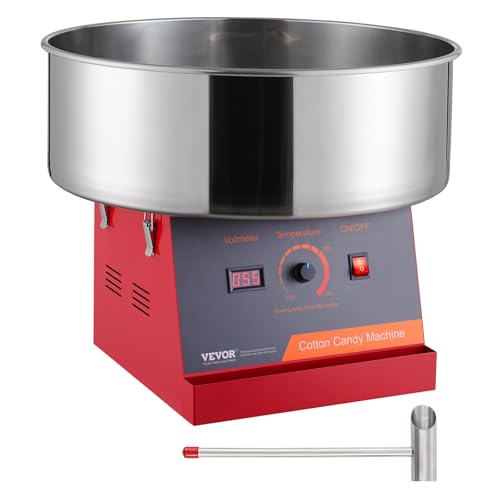
For frequent use, look for a stainless-steel bowl, a steel or aluminum housing, a belt-driven or commercial-grade motor, and separately controlled heat and spin switches. Commercial-style machines from brands such as Great Northern Popcorn and VEVOR commonly fall into this category, although specifications vary by model.
Their advantages are durability, a wider working area, and better tolerance for consecutive servings. Their disadvantages are size, weight, noise, and cleanup. Many weigh approximately 25–45 pounds and need a dedicated, stable table. They are poor choices for a small kitchen if the machine will spend most of the year in a cupboard.
Sugar versus floss: check compatibility before buying
“Cotton candy sugar” and “floss sugar” are often used interchangeably, but the machine’s instructions matter. Most machines accept pre-mixed floss sugar made from fine granulated sugar, coloring, and flavoring. This is the most consistent option because the sugar crystals are prepared for spinning.
Some home machines also accept ordinary hard candies. The candy must be completely hard and free from fillings, chocolate, gum, nuts, or soft coatings. Candy containing fat or moisture can melt unevenly, smoke, clog the spinning head, or leave a sticky residue. Do not assume that every machine rated for hard candy can handle sugar crystals, and do not exceed the manufacturer’s stated fill line.
- Pre-mixed floss sugar: best for predictable color, flavor, and texture.
- Plain granulated sugar: usable only when the manual specifically permits it; results may be less consistent.
- Hard candy: convenient for small batches, but avoid filled or creamy varieties.
- Homemade colored sugar: avoid liquid coloring, which adds moisture; use dry ingredients only if approved.
A useful ownership calculation is the sugar cost per serving. If a 3-pound container costs $15 and each cone uses approximately 1 ounce, it provides about 48 servings. The sugar cost is therefore about 31 cents per cone, before adding cones, bags, or toppings. Larger commercial machines may use more sugar per serving because they are designed for faster production.
What to look for beyond the headline wattage
Bowl size and working clearance
Choose a bowl based on the number of people you will serve at once. A 10–12-inch bowl is compact but leaves little room for a large cone. A 14–16-inch bowl is easier for families. A 20-inch bowl is more comfortable for parties, but it requires a larger counter and more storage space.
Heating and recovery
A machine that heats in five minutes may still struggle if the heater loses temperature after several servings. Look for independent heat and motor switches, ventilation around the motor, and instructions that specify how long the machine may run continuously. For occasional home use, a short warm-up is convenient. For parties, recovery between servings is more important than saving one or two minutes at startup.
Cleaning design
The spinning head is usually the most important component to clean. Sugar buildup can create imbalance, reduce output, and put extra strain on the motor. Prefer a model with a removable bowl, accessible spinning head, and smooth surfaces without deep grooves.
Durability
The parts most likely to wear first are the spinning head, belt or motor coupling, plastic bowl, and power switch. A metal bowl may resist cracking, but it can still dent and may be harder to remove. Replacement spinning heads and belts are worth checking before purchase, especially for a machine intended for annual parties.
Setup and cleaning routine that prevents common failures
- Place the machine on a level, heat-resistant surface. Level positioning helps the spinning head remain balanced and keeps floss from collecting unevenly.
- Install the bowl and splash guard securely. Do not operate a machine with a loose bowl or missing guard.
- Preheat with the motor off if the manual allows it. This lets the heater reach its working temperature before sugar enters the head.
- Add only the recommended amount of sugar. Overfilling can throw sugar into the motor area or cause clumping.
- Turn on the spinning function and collect the floss lightly. Pressing the cone hard against the bowl can scrape sugar onto the rim instead of forming a stable cone.
- Empty leftover sugar after the session. Do not leave sugar in the spinning head overnight.
- Allow the unit to cool completely before cleaning. Wipe the head and housing with a damp cloth, wash removable parts according to the manual, and dry everything before storage.
Never immerse the motor housing or electrical controls. Avoid spraying water directly into the spinning head. A small soft brush can remove dry sugar from crevices, but do not force tools into the heater or motor assembly.
Decision matrix: which machine fits your household?
| Your situation | Best choice | Why | What to accept |
|---|---|---|---|
| Budget under $70, one or two uses per year | Compact home model | Low entry cost and easy storage | Smaller batches and more plastic parts |
| Small kitchen, several children at a time | 14–16-inch home model | Better collection area without commercial bulk | More cupboard or countertop space |
| Monthly parties or repeated servings | 20–21-inch commercial-style model | Improved durability and serving speed | Higher cost, weight, and cleaning effort |
| Large events or paid service | Commercial machine with replaceable parts | Built for longer duty cycles | Requires transport, storage, and maintenance |
Final buying advice
For most households, the best cotton candy machines are not the largest or most powerful models. Buy a compact machine if you want a novelty appliance for occasional use and do not mind making small batches. Choose a 14–16-inch model if you regularly entertain at home. Select a commercial-style stainless-steel machine only when repeated parties justify its size and maintenance.
Before ordering, confirm the bowl diameter, permitted sugar types, maximum continuous runtime, removable parts, replacement-part availability, and cleaning instructions. Those details predict the ownership experience more reliably than wattage alone.

Write Your Review
No reviews yet. Be the first to share your experience!