

Key takeaways
- Inspect and retighten frame bolts after the first few sessions, then check them monthly.
- Keep guide rails clean and follow the manual for lubrication; excess lubricant attracts grit.
- Inspect wheels, bearings, cables, and pulley grooves for flat spots, fraying, or unusual noise.
- Load both sides evenly. Uneven plates can increase carriage friction and twist components.
- Use the mechanical safety stops every session rather than relying on strength if a set fails.
- Store plates on dedicated pegs when possible so loading horns do not become overloaded storage racks.
Best Leg Press Machines for Home Gyms
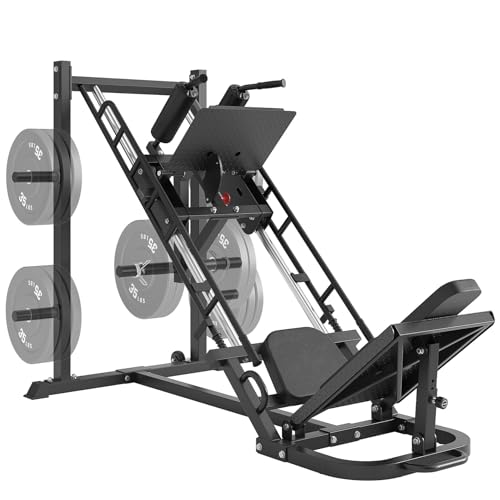
The best leg press machines for most home gyms are plate-loaded 45-degree models: they provide a high weight ceiling, straightforward mechanics, and better value than selectorized machines, while compact horizontal presses suit low ceilings and limited space.
Your choice should come down to five practical questions: how much floor space and ceiling height you have, whether you want to load plates manually, how far the carriage travels, how much resistance you need, and whether you can assemble a large steel machine safely.
Our top picks


As an Amazon Associate we earn from qualifying purchases at no extra cost to you. Ratings are shown as listed on Amazon.
Quick picks by home-gym situation
| Situation | Best machine type or example | Why it fits | Main compromise |
|---|---|---|---|
| Lowest practical cost | Compact plate-loaded 45-degree press | Usually about $900–$1,500 and uses standard or Olympic plates | More loading and unloading; often less refined carriage motion |
| Frequent heavy training | Body-Solid GLPH1100 or Powertec Leg Press | Large platforms, substantial frames, and high stated capacities | Requires a dedicated footprint and careful assembly |
| Small room or low ceiling | Horizontal or compact 45-degree press | Typically needs less height than a tall hack-squat/leg-press combination | May offer less natural carriage travel and fewer adjustment options |
| Several people sharing the machine | Selectorized leg press | Resistance changes in seconds and does not require plates | Higher purchase price, greater complexity, and often a shorter weight ceiling |
| One machine for legs and upper body | Force USA Ultimate 45 or another leg-press/hack-squat combination | Combines multiple lower-body movements in one frame | Uses more floor and vertical space than a dedicated press |
Best leg press machines compared
Best value for most lifters: a compact plate-loaded 45-degree press
A conventional 45-degree plate-loaded machine is the safest starting point for most buyers. Your back is supported, the carriage runs on fixed rails, and resistance can be increased in small increments as your collection of plates grows. A compact model is normally less expensive and easier to place than a commercial-size unit.
Look for four weight horns, a footplate broad enough for your stance, mechanical safety catches on both sides, and a carriage that does not bind when loaded unevenly. A stated capacity of 600–1,000 pounds is common in this category, although capacity is not a guarantee that every component will feel equally stable at the top of the range.
Best for high-capacity training: Body-Solid GLPH1100
The Body-Solid GLPH1100 is a large plate-loaded leg press and hack-squat machine aimed at serious home gyms. Manufacturer-listed specifications include an approximately 1,000-pound capacity, a machine weight of roughly 300 pounds, and a footprint close to 83 inches long by 34 inches wide, with height around 56 inches. Verify the current manual before purchase because dimensions can vary by configuration and revision.
Its appeal is not only the capacity. The larger frame, broad footplate, and multiple lower-body positions make it more suitable for frequent use than a lightweight budget press. The cost is substantial floor area, a heavy assembly job, and enough plate storage that the room can become crowded around the machine.
Best dedicated press: Powertec Leg Press
The Powertec Leg Press is a dedicated plate-loaded machine with a long carriage and a large footplate. It is a better fit than a combination unit when you already have a squat rack or do not need a hack-squat station. Its long travel can accommodate different user heights, but that same travel requires measuring the room carefully from the rear of the machine to the furthest forward position.
Powertec lists a high load capacity for this machine, commonly around 1,000 pounds depending on the model and market. Treat the published maximum as a structural limit rather than a target. At-home users often run out of storage space for plates before they approach it.
Best for maximum versatility: Force USA Ultimate 45
The Force USA Ultimate 45 combines a 45-degree leg press with hack-squat functionality and other training stations, depending on the package. It is attractive for a garage gym that wants one large frame to cover several movements. The adjustable back and shoulder support can also make it easier for two users of different heights to find a workable position.
This is not the best choice if you only want a leg press. Combination machines usually have the largest footprint, more assembly steps, and more points that may need adjustment. Measure ceiling height as well as floor area, particularly if you plan to use the hack-squat position.
Plate-loaded versus selectorized resistance
| Factor | Plate-loaded | Selectorized |
|---|---|---|
| Typical home-gym price | About $900–$3,000 | About $2,500–$7,000 or more |
| Resistance changes | Manual; usually 45–90 seconds between sets | Pin selection; usually 5–15 seconds |
| Weight ceiling | Often 600–1,000 pounds stated capacity | Commonly a 200–400-pound weight stack |
| Space requirements | Needs room for plates and loading access | Needs room for the weight stack and its travel |
| Maintenance | Rails, wheels, bearings, and bolts | All of those plus cables, pulleys, and stack guides |
| Best use | Progressive overload and heavy, infrequent loading | Shared gyms, circuits, and fast resistance changes |
Selectorized resistance is not automatically easier on the machine or better for beginners. It is primarily more convenient. A commercial-style selectorized unit can be excellent when several people train at different loads, but the additional cables and pulleys create more wear points. For a single user who already owns Olympic plates, plate loading usually delivers more resistance per dollar.
What to compare before buying
Footprint and clearance
Measure the machine’s assembled length, width, and height, then add working clearance. Leave at least 24 inches beside the loading horns and enough space in front of the footplate for the carriage’s full travel. A machine listed as 83 inches long may need roughly 100–110 inches of usable length once you include access and a safe walking path.
Check the floor, too. A loaded machine can concentrate considerable force through its feet. Place it on a level, solid surface and use a suitable rubber gym mat to protect the floor and reduce vibration.
Carriage travel and user fit
Long travel is useful for taller users and for choosing a comfortable range of motion, but it is not a reason to force the carriage into the deepest possible position. The carriage should have a clear stop and adjustable safety catches. Before buying, check that you can reach the release handles from your normal starting position and that the back pad does not push your hips into an uncomfortable angle.
Seat and back-pad adjustment matters more than a large maximum capacity for a shared machine. A press with one fixed angle may fit one person well and feel awkward for another. If possible, select a model with multiple back-pad positions and safety-stop settings.
Capacity and loading
Do not compare capacities without checking what they mean. Some manufacturers specify total plate load, while others describe a recommended working load or a maximum carriage rating. Also confirm whether the machine accepts Olympic plates, standard one-inch plates, or requires adapters. Four loading horns are more convenient than two because they distribute plates and reduce the need to stack everything on one side.
Assembly and ownership realities
Large leg presses are rarely sensible one-person projects. Plan for two or three adults, a level floor, several hours of assembly, and a way to move heavy subassemblies into position. Keep bolts finger-tight until the frame is square; tightening each section immediately can make later alignment difficult.
After assembly, run the unloaded carriage through its full travel. It should move smoothly without scraping, rocking, or sudden resistance. Then add a small amount of weight to each side and repeat the check before attempting a heavy set.
- Inspect and retighten frame bolts after the first few sessions, then check them monthly.
- Keep guide rails clean and follow the manual for lubrication; excess lubricant attracts grit.
- Inspect wheels, bearings, cables, and pulley grooves for flat spots, fraying, or unusual noise.
- Load both sides evenly. Uneven plates can increase carriage friction and twist components.
- Use the mechanical safety stops every session rather than relying on strength if a set fails.
- Store plates on dedicated pegs when possible so loading horns do not become overloaded storage racks.
The parts most likely to need attention are wheels or bearings, cable assemblies on selectorized models, upholstery, and locking pins. None is necessarily expensive, but replacement availability matters. Before purchase, confirm that the manufacturer supplies wear parts and publishes an assembly or service manual.
Bottom line
Choose a compact plate-loaded 45-degree press if you want the best balance of price, capacity, and simplicity. Choose the Body-Solid GLPH1100 or Powertec Leg Press when heavy, frequent training justifies a larger frame. Choose a Force USA Ultimate 45-style combination machine only if the extra exercises justify its footprint. A selectorized machine is worth the premium when quick weight changes, multiple users, and a clean training area matter more than maximum load per dollar.
Before ordering, mark the machine’s full dimensions on the floor, add loading clearance, confirm ceiling height, and decide where every plate will be stored. That short planning exercise prevents the most common home-gym mistake: buying a capable leg press that cannot be used comfortably in the room available.



Write Your Review
No reviews yet. Be the first to share your experience!