

Key takeaways
- First-time treadmill user: Choose a motorized model with a low starting speed, clear controls, side rails, and an emergency stop. Favor simple operation over a long list of programs.
- Limited floor space: Measure the assembled footprint and the extra room needed behind the treadmill for safe access. A folding frame can help with storage, but verify that it locks firmly when open.
- Dog with a long stride: Choose belt length before considering incline or speed. A dog that must shorten its steps to stay on the belt is not a good fit for that machine.
- Frequent sessions: Look for a sturdy frame, a belt intended for repeated use, accessible adjustment and lubrication instructions, and a warranty that covers the motor and deck.
- Budget-conscious buyer: General market prices range from a few hundred dollars for basic compact units to over a thousand dollars for larger, more robust dog-specific models. Include delivery, assembly, and any recommended maintenance supplies in the budget.
Best Dog Treadmills for Safe Indoor Exercise
The best dog treadmill depends on your dog’s stride and weight, available floor space, and whether you need occasional indoor walks or regular training: choose a full-length motorized model with a broad, low-noise belt for larger dogs, or a compact walking treadmill for a small dog and limited space. Before buying, compare the usable running surface—not just the machine’s footprint—with your dog’s body length and natural gait.
Compare the main treadmill types
Dog treadmills generally fall into three categories. Motorized walking treadmills offer adjustable speeds and are the most practical for controlled indoor sessions. Slat-mill or self-powered designs move as the dog walks, giving experienced handlers more control but requiring more training and typically costing more. Compact models for small dogs save space, but their short belts may not suit longer-legged or high-stepping dogs.
Our top picks


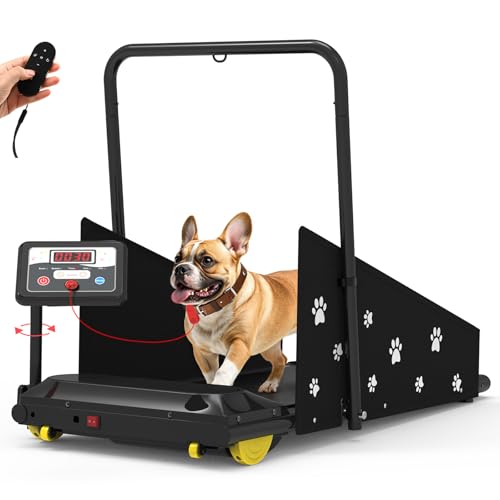
As an Amazon Associate we earn from qualifying purchases at no extra cost to you. Ratings are shown as listed on Amazon.
Specifications vary by model and can change. The figures below are useful buying targets, not guaranteed specifications for every product. Confirm the current manufacturer’s dimensions, weight limit, and operating instructions before ordering.
| Dog and use | Useful running-surface target | Speed range to look for | Incline and noise priorities | Best fit |
|---|---|---|---|---|
| Small dog, occasional walks | About 30–40 in long × 12–16 in wide | Roughly 0.5–5 mph, with small increments | Flat or modest incline; quiet, smooth starts | Compact motorized dog treadmill |
| Medium dog, regular walking | About 40–55 in × 16–20 in | Roughly 0.5–7 mph | Adjustable incline is useful but optional; low vibration | Full-size motorized model |
| Large or long-striding dog | About 55–70 in × 20–24 in | Low walking speeds through at least 6–8 mph | Prioritize belt width, stability, and gradual speed control | Long-deck, higher-capacity model |
| Experienced handler, structured training | Size belt to the dog’s full walking stride | Depends on training plan and dog | Check resistance, control method, and stopping procedure | Self-powered slat mill or purpose-built training treadmill |
These ranges are screening guidelines, not a substitute for checking fit. A product’s advertised maximum speed is less important for most household dogs than a stable belt that starts slowly and allows a relaxed walk.
How to choose by your situation
- First-time treadmill user: Choose a motorized model with a low starting speed, clear controls, side rails, and an emergency stop. Favor simple operation over a long list of programs.
- Limited floor space: Measure the assembled footprint and the extra room needed behind the treadmill for safe access. A folding frame can help with storage, but verify that it locks firmly when open.
- Dog with a long stride: Choose belt length before considering incline or speed. A dog that must shorten its steps to stay on the belt is not a good fit for that machine.
- Frequent sessions: Look for a sturdy frame, a belt intended for repeated use, accessible adjustment and lubrication instructions, and a warranty that covers the motor and deck.
- Budget-conscious buyer: General market prices range from a few hundred dollars for basic compact units to over a thousand dollars for larger, more robust dog-specific models. Include delivery, assembly, and any recommended maintenance supplies in the budget.
Fit the belt to your dog—not the other way around
Measure your dog from the nose to the base of the tail, then observe a comfortable walk on level ground. The belt should let the dog take normal steps without the paws nearing the front or rear edge. As a practical check, look for clear space at both ends during several natural strides. Belt width matters too: the dog should be able to walk without repeatedly brushing the side rails.
Check the stated weight capacity with a margin rather than choosing a treadmill rated exactly at your dog’s current weight. A capacity rating does not guarantee a comfortable stride or stable operation. Also consider whether the dog’s coat, leg length, or movement makes a narrow frame a poor match.
Safety and noise details worth checking
Useful safety features include side panels or rails that discourage stepping off, a dependable emergency stop, a leash attachment positioned to prevent tangling, and controls that cannot be bumped accidentally. A leash should never be used to hold a dog in place on a moving belt. Keep children and other pets away during a session, and supervise the dog throughout.
Noise is more than a comfort issue: a motor’s pitch, belt vibration, and rattling frame can make a cautious dog reluctant to approach. If possible, ask the seller about operating noise under load, not just an empty machine. A thick, level floor mat may reduce vibration, but it cannot correct a loose frame or poorly adjusted belt. Confirm that the treadmill sits level and that nothing obstructs the belt.
Incline can increase effort, so it is not automatically an upgrade. For ordinary indoor walking, a flat deck is often the simpler choice. If you plan to use incline, check that adjustments are secure and incremental, and introduce changes gradually. Ask your veterinarian before starting treadmill exercise if your dog has a health condition, is recovering from injury, is very young, or has mobility concerns.
Introduce the treadmill in short, calm steps
- Make it familiar while switched off. Let the dog investigate and reward calm interest. This helps separate the machine’s appearance from its movement and sound.
- Practice standing on the stationary belt. Keep sessions brief and allow the dog to leave. Do not pull or force the dog onto the machine.
- Start at the lowest practical speed. Stay beside the dog, use the emergency stop as instructed, and end the session while the dog is still comfortable.
- Build duration before intensity. Increase time in small increments before considering faster speeds or incline. Stop if the dog appears distressed, unsteady, or unusually tired.
A treadmill is not a replacement for every outdoor walk, sniffing time, or play. It is one way to provide controlled indoor movement when conditions or schedules make outdoor exercise difficult.
Ownership: what needs attention over time
The belt and its tracking are common wear points. Check periodically for fraying, slipping, unusual heat, or a belt that drifts to one side; follow the manufacturer’s instructions for tensioning and lubrication rather than guessing. Hair and dust can collect around the belt, rollers, and motor vents, so unplug the unit before cleaning and use only the recommended method. Avoid spraying cleaner directly onto moving or electrical parts.
Loose fasteners, rattling rails, and changes in motor sound are reasons to stop and inspect the machine before the next session. Do not exceed the stated weight limit or use a damaged belt. Keep a clear area around the treadmill, and store the power cord where it cannot become a trip or chew hazard.
Bottom line
For most households, the best dog treadmill is a quiet, stable motorized model with a low starting speed, an emergency stop, and a running surface long and wide enough for the dog’s natural stride. Small dogs in tight spaces can use compact units if the belt fits; medium and large dogs usually need a longer deck and a sturdier frame. Choose fit and safe control first, then treat incline, maximum speed, and foldability as secondary features.


Write Your Review
No reviews yet. Be the first to share your experience!