

Key takeaways
- Seal: Close the lid gently and listen for a soft, cushioned release of air. A sharp slam with no resistance can indicate a weak seal.
- Construction: Look for square corners, even lid gaps, firmly attached hinges, and an interior without exposed glue or rough splinters.
- Interior finish: The cedar should be clean and unfinished or treated with a finish specifically intended for humidors. Strong chemical odors are a warning sign.
- Tray design: Removable trays should leave space below and around them so humidity can circulate.
- Hygrometer placement: A sensor mounted in the lid can read differently from cigars stored near the bottom. A removable digital hygrometer is easier to verify.
Best Cigar Humidors: Wood, Glass & Travel Options
The best cigar humidors are Spanish-cedar desktop boxes for most regular smokers, acrylic containers for low-maintenance storage on a budget, glass-top humidors when display matters, and purpose-built travel humidors when portability and impact resistance come first.
The right choice depends less on appearance than on four practical questions: how many cigars you store, how often you open the container, how stable the room is, and whether you can verify the seal and humidity with an accurate hygrometer. A beautiful humidor with a poor seal will protect cigars less effectively than a plain airtight container with a calibrated humidity device.
Our top picks



As an Amazon Associate we earn from qualifying purchases at no extra cost to you. Ratings are shown as listed on Amazon.
Quick comparison: which type fits your situation?
| Humidor type | Typical capacity | Typical size | Humidity stability | Best for | Common drawback |
|---|---|---|---|---|---|
| Desktop Spanish-cedar box | 25–100 cigars | 10–18 in wide | Good when properly sealed | Regular home storage and aging | Wood can warp; requires setup and maintenance |
| Glass-top wooden humidor | 25–75 cigars | 10–16 in wide | Good to moderate | Display and frequent selection | Glass adds another potential leak point |
| Acrylic or clear plastic container | 10–50 cigars | 6–14 in wide | Very good if the lid seals tightly | Beginners, apartments, and low budgets | Less traditional and may scratch |
| Travel humidor | 3–20 cigars | 6–14 in long | Good for short trips | Air travel, driving, and outdoor use | Limited capacity and less convenient for aging |
| Electric cabinet humidor | 100–500+ cigars | 18–72 in tall | Consistent when powered | Large collections and controlled rooms | Cost, noise, electricity, and maintenance |
Best overall: a Spanish-cedar desktop humidor
A quality wooden desktop humidor is the strongest all-purpose choice for someone who stores roughly 25 to 75 cigars and wants a traditional box that can also support longer-term storage. Spanish cedar is valued because it can buffer small humidity changes, helps protect against some pests, and contributes a distinctive aroma over time.
Capacity should not be treated as a number to fill completely. A box advertised for 50 cigars may hold substantially fewer if you store large ring gauges, keep cigars in boxes, or want enough air circulation to inspect and rotate them. For practical use, choose a humidor rated for at least 25% more cigars than you currently own. Someone with 30 cigars should usually look at a nominal 40- to 50-cigar capacity rather than a tightly packed 30-count box.
What to inspect before buying
- Seal: Close the lid gently and listen for a soft, cushioned release of air. A sharp slam with no resistance can indicate a weak seal.
- Construction: Look for square corners, even lid gaps, firmly attached hinges, and an interior without exposed glue or rough splinters.
- Interior finish: The cedar should be clean and unfinished or treated with a finish specifically intended for humidors. Strong chemical odors are a warning sign.
- Tray design: Removable trays should leave space below and around them so humidity can circulate.
- Hygrometer placement: A sensor mounted in the lid can read differently from cigars stored near the bottom. A removable digital hygrometer is easier to verify.
Glass-top versus solid wood: display or stability?
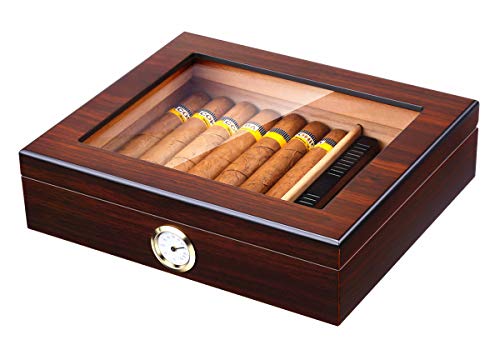
A glass-top humidor is a sensible compromise if you regularly choose cigars from the box and want to see the contents without opening it. The trade-off is that the glass panel and its gasket create an additional area where air can leak. A glass top is not automatically inferior, but seal quality becomes especially important.
Solid wood generally offers fewer seams and less exposure to room light. It is preferable for a collection that is opened less often or stored away from direct sunlight. Glass-top models work well on a desk or bar, provided the unit is kept out of strong sunlight and the glass remains firmly seated.
Do not select a humidor solely because it contains more cedar. A thin cedar lining inside a well-sealed acrylic or composite body can perform better than a thick cedar box with a warped lid. The outer material controls much of the structural stability; the lining contributes buffering and aroma.
Acrylic and airtight containers: the practical beginner choice
Acrylic humidors and airtight food-storage containers are often the easiest way to establish reliable humidity control. They do not absorb and release moisture as much as wood, so the humidity can respond more quickly to the humidification pack or device. Clear walls also make mold, leaks, and condensation easier to spot.
The main disadvantage is presentation rather than performance. Acrylic can scratch, and a plastic container does not provide the same cedar aroma or traditional appearance. If you use one, adding a correctly sized Spanish-cedar tray or thin cedar sheets can provide some of the benefits of wood without relying on a wooden box to hold the seal.
Choose a container with a silicone gasket and locking latches. A loose snap-on lid may be adequate for short-term storage but is a poor foundation for months of humidity control. Avoid storing cigars in a container that has retained food, soap, solvents, or strong plastic odors.
Best travel option: a crush-resistant travel humidor
Travel humidors should be judged by protection first and capacity second. A compact hard case with a rubber gasket, secure latches, and a foam or cedar insert protects cigars from compression and sudden environmental changes. Soft cases are lighter, but they generally provide less crush protection and may not maintain humidity as consistently.
For a weekend trip, a case rated for 5 to 10 cigars is usually more useful than a larger case packed tightly. Leave enough room to remove cigars without scraping wrappers against the interior. Use a small, appropriately sized humidity pack rather than placing a large water reservoir in a confined travel case; excess moisture can raise humidity too quickly.
Hygrometer accuracy matters more than the display
A hygrometer that reads 65% when the real humidity is 58% can lead you to add moisture unnecessarily. Digital hygrometers are generally easier to read, but neither digital nor analog instruments should be trusted without verification.
How to check a hygrometer
- Place the hygrometer in a sealed plastic bag or airtight container with a humidity calibration pack or a salt-test setup.
- Leave it undisturbed for about 8 to 12 hours at normal room temperature.
- Compare the reading with the known reference value.
- Record the offset. If the device reads 67% against a 65% reference, subtract about 2 percentage points from future readings.
- Repeat the check every 6 to 12 months, or sooner if the reading changes suddenly.
For a home humidor, an error of roughly 2 to 3 percentage points is manageable if it is consistent. Replace or stop relying on a device that fluctuates widely, responds very slowly, or differs markedly from a second calibrated hygrometer.
Humidity setup and maintenance
Never soak the wooden interior with tap water. Excess liquid can swell joints, stain the cedar, encourage mold, and create an unstable humidity spike. Instead, use a properly sized two-way humidity pack or a controlled humidification system. Two-way packs add or release moisture as needed, reducing the risk of repeated overcorrection.
- Inspect the empty humidor. Remove dust and check that the lid, hinges, and gasket or contact surfaces are intact.
- Condition gradually. Add the recommended humidity source and allow the interior to stabilize for several days. New wood may take longer than an already conditioned box.
- Verify independently. Put in a calibrated hygrometer and wait until the reading is stable before adding cigars.
- Load loosely. Leave space for air movement and avoid pressing cigars tightly against the lid.
- Monitor trends. Check the reading weekly at first, then less often once the humidor is stable.
- Clean carefully. Remove debris with a dry, soft cloth. Do not use household cleaners, essential oils, or scented wipes inside the humidor.
What wears out first is usually the humidity pack, gasket, hinge alignment, or hygrometer battery—not the cedar itself. Replace consumables according to their instructions, keep the lid from being slammed, and inspect the seal whenever humidity falls unexpectedly.
Decision matrix for choosing the best cigar humidor
| Your situation | Recommended option | Target specification |
|---|---|---|
| New smoker with fewer than 25 cigars | Acrylic or small desktop humidor | 10–25 cigar capacity, digital hygrometer, gasketed lid |
| Weekly smoker with 30–60 cigars | Spanish-cedar desktop box | 50–75 nominal capacity, removable tray, two-way humidity control |
| Collector prioritizing presentation | Glass-top humidor | Strong gasket, UV-conscious placement, calibrated hygrometer |
| Frequent traveler | Hard-shell travel humidor | 5–20 cigar capacity, rubber seal, crush-resistant case |
| More than 100 cigars | Large cabinet or multiple smaller humidors | Independent humidity monitoring and enough unused capacity |
Bottom line
Choose a Spanish-cedar desktop humidor for the best balance of tradition, capacity, and long-term usability; choose acrylic when dependable sealing and simplicity matter more than appearance; choose glass when display is central; and choose a hard travel case for transport. In every category, prioritize a tight seal, spare capacity, two-way humidity control, and a calibrated hygrometer over decorative hardware or a larger advertised capacity.




Write Your Review
No reviews yet. Be the first to share your experience!