

Key takeaways
- Natural rubber: Usually the most secure option on a hard floor. It is dense, stable, and often more durable, but it is heavier and can smell strongly at first. Avoid it if you have a known latex allergy.
- TPE: Lighter and commonly more affordable. It can provide good cushioning and is often easier to carry, but very soft TPE may compress under the hands and develop permanent dents.
- PVC or other foam composites: These can be inexpensive and cushioned, but examine the construction carefully. A thin decorative cork layer over soft foam may not deliver the firm, durable feel associated with cork.
The best cork yoga mats are the ones that match your sweat level and support needs: choose a dense cork-and-natural-rubber mat for frequent hot practice, a thicker cork-and-TPE mat for extra cushioning, or a thin cork travel mat when portability matters more than comfort.
Our top picks


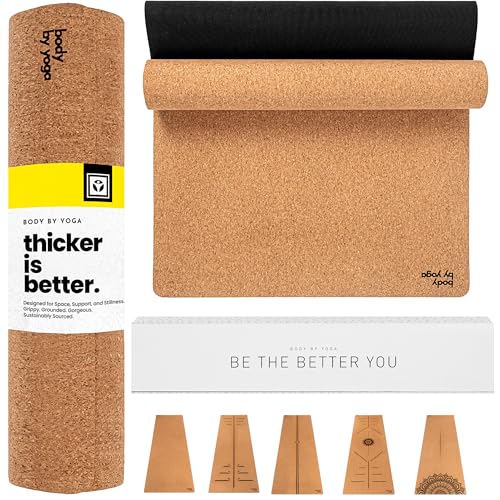
As an Amazon Associate we earn from qualifying purchases at no extra cost to you. Ratings are shown as listed on Amazon.
Best cork yoga mats by use case
| Best for | Recommended mat type | Typical specification | Why it works | Typical market range |
|---|---|---|---|---|
| Hot yoga and very sweaty hands | Dense cork over natural rubber | 4–5 mm thick; 4.5–6.5 lb | Cork grip improves as moisture reaches the surface, while rubber keeps the mat stable | $90–$150 |
| Everyday practice and mixed workouts | Medium-density cork over TPE or rubber | 5–6 mm thick; 3–5.5 lb | Balances grip, joint comfort, weight, and price | $45–$100 |
| Beginners or sensitive knees | Thicker cork composite | 6–8 mm thick; 4–7 lb | More forgiving during kneeling poses and floor exercises | $50–$110 |
| Travel and small spaces | Thin cork sheet or foldable cork mat | 2–3 mm thick; 1.5–3.5 lb | Easy to carry and store, but usually needs a softer surface underneath | $30–$80 |
These are useful buying ranges rather than universal specifications. Dimensions, densities, backing materials, and weights vary by manufacturer and model.
Top picks among the best cork yoga mats
Yoloha Original Cork Yoga Mat: best premium all-rounder
The Yoloha Original is a strong choice for people who want a cork surface with a supportive, stable base. Its cork construction is designed for yoga rather than general-purpose foam exercise, and the standard format is approximately 72 by 24 inches and about 4.5 mm thick. It is most appealing to regular practitioners who value a firm, low-slip feel and a natural surface.
The trade-off is cushioning. Dense cork does not feel as plush as a thick foam mat, particularly on hard floors. It also has a higher purchase price than many cork-coated mats. If your practice includes frequent kneeling, add a folded towel or use a separate knee pad rather than expecting the mat to behave like an 8 mm foam product.
Gaiam Cork Yoga Mat: best accessible option
Gaiam’s cork yoga mats are a practical entry point for shoppers who want the feel and appearance of cork without moving immediately into premium pricing. Depending on the model, thickness and backing can differ, so check whether the product uses TPE, rubber, or another composite base before ordering.
This type of mat suits light-to-moderate practice, stretching, balance work, and home use. It can be a better value than a premium natural-rubber mat if you practice two or three times per week. Look closely at the actual dimensions: some budget mats are shorter or narrower than the common 72-by-24-inch format.
Dense cork over rubber: best for hot practice
A specialist cork mat with a natural-rubber backing is the better choice when grip and floor stability matter more than low weight. The rubber adds traction against the floor and resists the mat shifting during lunges, transitions, and repeated sun salutations.
Natural rubber does have two ownership considerations: it is heavier than TPE and may have a noticeable rubber odor when new. People with latex sensitivity should avoid natural rubber unless the manufacturer clearly confirms that the product is appropriate for them.
Cork density matters more than the word “cork”
Two mats can both be advertised as cork but feel completely different. A dense cork top generally feels firm, smooth, and stable. It is less likely to compress under the hands, and it tends to last longer when regularly cleaned. A lower-density cork layer may feel warmer and softer, but the surface can wear, flake, or become uneven sooner, especially where the hands repeatedly load the mat.
Manufacturers do not use a consistent consumer-facing density scale, so a claimed cork percentage does not tell the whole story. Compare thickness, backing, total weight, and warranty terms as indirect clues. For a full-size mat, an unusually low weight can indicate a thin cork layer or a lightweight foam backing. That is not automatically bad, but it usually means less cushioning and less resistance to compression.
Backing materials: rubber versus TPE
- Natural rubber: Usually the most secure option on a hard floor. It is dense, stable, and often more durable, but it is heavier and can smell strongly at first. Avoid it if you have a known latex allergy.
- TPE: Lighter and commonly more affordable. It can provide good cushioning and is often easier to carry, but very soft TPE may compress under the hands and develop permanent dents.
- PVC or other foam composites: These can be inexpensive and cushioned, but examine the construction carefully. A thin decorative cork layer over soft foam may not deliver the firm, durable feel associated with cork.
The backing also determines floor grip. A cork surface can feel secure under your palms while the entire mat slides across wood or tile if the underside is too smooth. For vigorous practice, prioritize a textured or high-friction underside and a weight that keeps the mat planted.
How cork grip changes when you sweat
Dry cork can feel less tacky than a sticky PVC mat. That is normal. Many cork surfaces become more grippy as a small amount of moisture reaches the cork, which makes them attractive for hot yoga and sweaty flows. However, excessive moisture can still make hands slide, especially if the mat has a polished finish or a low-density cork coating.
If your palms sweat heavily, use a small towel at the front edge rather than covering the entire mat with a towel. A full towel may conceal the cork’s grip and can bunch during transitions. For consistently damp hands, compare the mat’s wet-grip description, not just its dry texture, and consider a cork mat with alignment markings only if those markings do not create a slick printed layer.
Cushioning and comfort: calculate what you are giving up
Cork is firm, so thickness does not translate directly into softness. A 5 mm dense cork mat may feel less cushioned than a 6 mm foam mat. If you practice on tile or concrete, a 2–3 mm travel cork mat is usually best placed over a carpet, exercise mat, or thin foam pad.
For a simple fit check, measure your height and add at least 6 inches. A 68-inch mat gives a 5-foot-2-inch person roughly 6 inches of extra length, while a 72-inch mat gives a 5-foot-6-inch person the same margin. Taller users or anyone who frequently moves from downward dog to plank may prefer a 78-inch-long model. Width is commonly 24 inches; a 26-inch mat provides more room but takes up more storage space.
Odor, cleaning, and everyday care
Cork itself usually has a mild woody smell, while natural-rubber backing can produce the stronger new-mat odor. Air the mat flat or loosely rolled in a shaded, well-ventilated room for several days. Direct sun can dry or distort rubber and may fade the surface.
- After practice, wipe the cork with a lightly damp cloth.
- For sweat or body oil, use diluted mild soap or the cleaner specified by the manufacturer.
- Do not saturate the mat, soak it, or use bleach, abrasive scrubbers, essential oils, or alcohol-heavy sprays.
- Dry it completely before rolling, with the cork surface facing outward if the manufacturer permits.
- Store it away from radiators, hot cars, and prolonged humidity.
Cleaning after every session reduces salt and oil buildup, which can make the surface feel slick. If the mat develops a persistent sour smell, inspect the backing and drying routine rather than masking it with fragrance.
Long-term durability: what wears first
On a well-made cork mat, the first visible wear usually appears in high-pressure areas: the heel of the hands, the front of the mat, and the spot where the toes repeatedly push off. Low-density cork can pit or shed; soft backing can develop compressed channels; rubber edges may curl if the mat is rolled tightly while damp.
A mat used four times per week receives about 208 sessions per year. If a $120 mat remains comfortable and stable for three years, its purchase cost works out to approximately $120 ÷ 624 sessions, or about $0.19 per use, before cleaning supplies. A cheaper $45 mat that needs replacement after one year of the same schedule costs about $0.43 per use. The more expensive mat is not automatically better, but durability can matter more than the initial price for frequent practice.
Decision guide before you buy
- Budget under $60: Choose a medium-thickness cork-and-TPE mat, and verify that the underside grips your floor.
- Practice once or twice weekly: Prioritize comfortable thickness, manageable odor, and easy cleaning over maximum density.
- Practice four or more times weekly: Spend more on dense cork and a durable rubber or firm TPE backing.
- Small apartment: Measure both the storage area and the practice area. A full-size mat may fit the floor but not the closet.
- Very sweaty practice: Select a cork surface specifically described for wet grip and keep a hand towel nearby.
- Knee or wrist discomfort: Consider extra padding or professional guidance rather than relying only on mat thickness.
Bottom line
The best cork yoga mats combine a sufficiently dense cork top with a backing suited to your floor, body comfort, and cleaning habits. Choose premium rubber-backed cork for stability and frequent sweaty practice, a TPE-backed model for lighter everyday use, and a thin travel mat only when portability is the main priority. Check the complete construction—not just the cork label—because backing quality, density, dimensions, and maintenance will determine how the mat feels long after its first unboxing.

Write Your Review
No reviews yet. Be the first to share your experience!