

Key takeaways
- You make several types of projects rather than only decals.
- You want a beginner-friendly app and a large library of project ideas.
- You expect to add fabric, scoring or engraving tools later.
The best die cutting machines in 2026 depend on what you cut most: Cricut Maker 3 is the safest all-round choice for mixed materials, Silhouette Cameo 5 suits detailed vinyl work and design control, Brother ScanNCut is the most convenient for scanning and offline work, and a manual roller machine remains the simplest option for paper and occasional projects.
Our top picks


As an Amazon Associate we earn from qualifying purchases at no extra cost to you. Ratings are shown as listed on Amazon.
Quick picks by crafting situation
| Situation | Best fit | Why | Main compromise |
|---|---|---|---|
| Beginner making cards, labels and decorations | Cricut Explore 4 | Simple app workflow, broad accessory availability and support for common materials | Less capable with thick or unusual materials than a Maker-series machine |
| Frequent crafter using fabric, leather and thicker sheets | Cricut Maker 3 | Large tool ecosystem and compatibility with many material types | Higher purchase cost and more tool-specific setup |
| Detailed vinyl work or users who want more design control | Silhouette Cameo 5 | Strong software features, accurate registration and matless cutting options | Silhouette Studio takes longer to learn |
| Scanning drawings, fabric pieces or printed outlines | Brother ScanNCut SDX125E | Built-in scanner and automatic blade adjustment | Less attractive if you already design everything on a computer |
| Occasional paper projects with no software | Manual roller die cutter | No updates, files or electronic calibration | Limited to compatible physical dies and manual pressure |
Best all-round electronic machine: Cricut Maker 3
The Cricut Maker 3 is the strongest general-purpose choice when a single machine must handle cardstock, adhesive vinyl, iron-on material, poster board, fabric and some thicker craft materials. Its tool system supports rotary cutting, scoring, writing, engraving and other operations, although each function requires the appropriate accessory.
It accepts materials up to about 12 inches wide on standard mats and can work with more than 300 material types when the correct blade or tool is used. Bluetooth and USB connectivity make it practical for laptops, tablets and phones. Design Space is approachable for beginners, with ready-made projects and straightforward cut settings.
The important limitation is that “compatible with 300-plus materials” does not mean every material cuts in one pass. Dense leather, chipboard and fabric may require several passes, a stronger mat grip or a special blade. The machine also needs more preparation than a basic vinyl cutter: selecting the correct tool, securing the material and checking the pressure setting matter as much as motor power.
Choose it if
- You make several types of projects rather than only decals.
- You want a beginner-friendly app and a large library of project ideas.
- You expect to add fabric, scoring or engraving tools later.
Best for detailed digital design: Silhouette Cameo 5
The Silhouette Cameo 5 is a strong head-to-head alternative to the Maker 3 for users who care about custom layouts, lettering and precise vinyl work. It has a cutting width of approximately 12 inches, supports matless cutting for suitable roll materials, and provides a tool-clearance capacity of around 3 mm depending on the accessory and material.
Silhouette Studio gives users more control over node editing, offsets, nesting, registration marks and cut settings. That flexibility is useful for stickers, garment graphics, labels and small-business production. The trade-off is a steeper learning curve: newcomers may spend more time understanding blade depth, force, speed and software editions.
Cameo 5 is not automatically better for thick materials simply because it is a newer electronic cutter. Material stiffness, blade condition and the cutting mat have a large effect. For detailed work, a fresh blade and a clean, firmly adhesive mat often produce a bigger improvement than increasing pressure.
Best for scanning and reduced computer dependence: Brother ScanNCut SDX125E
Brother’s ScanNCut SDX125E stands apart because it includes a built-in scanner. You can place a hand-drawn image, printed outline or small fabric shape on the mat, scan it, remove the background in the machine interface and create a cut line without tracing the design manually in separate software.
Its 12-by-12-inch working format is suitable for common cards, appliqué pieces and paper crafts. Automatic blade sensing adjusts the blade depth for many materials, reducing one beginner error. The machine can also operate with designs transferred through USB or wireless features, depending on the configuration.
Scanning is especially useful for teachers, children’s artwork, quilting templates and one-off shapes. If nearly all your designs begin as SVG files on a computer, however, the scanner may add cost without changing your workflow much.
Best low-tech option: manual roller die cutter
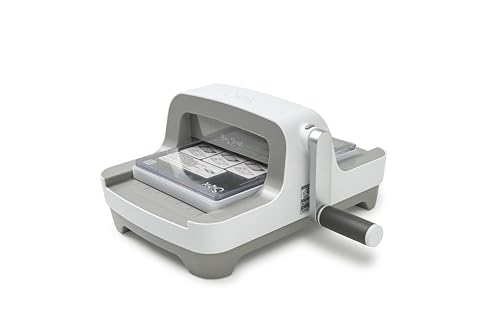
A manual die cutting machine uses a sandwich of a physical die, material and cutting plates passed through rollers. The Spellbinders Platinum 6 is an example of this compact format, while larger manual machines are available for wider dies and bigger projects.
Manual machines are excellent for repeated shapes in cardstock, felt, foam sheets and similar materials. They do not need software, Bluetooth, firmware updates or a dedicated computer. They are also predictable for beginners: the die determines the shape, and the roller supplies the pressure.
The disadvantages are equally clear. You cannot freely create any SVG shape, intricate designs require a suitable physical die, and turning the handle becomes inconvenient for large batches. Plates are consumables: they develop cuts and bends over time, so a machine’s long-term cost includes replacement plates and dies.
Head-to-head buying criteria
| Machine or type | Typical cut width | Approximate thickness capability | Material strengths | Software or setup | Approximate machine weight |
|---|---|---|---|---|---|
| Cricut Maker 3 | 12 in / 30.5 cm | Up to about 2.4 mm with suitable materials and tools | Paper, vinyl, fabric, leather, poster board, selected chipboard | Design Space; phone, tablet or computer; cutting mat usually required | About 4.8 kg |
| Silhouette Cameo 5 | 12 in / 30.5 cm | About 3 mm clearance, tool- and material-dependent | Vinyl, paper, cardstock, heat-transfer film, stickers and roll materials | Silhouette Studio; computer-oriented workflow; matless cutting for suitable media | About 3.5 kg |
| Brother ScanNCut SDX125E | 12 in / 30.5 cm | About 3 mm, depending on material and blade | Paper, fabric, vinyl and scanned shapes | Built-in scanner, touchscreen and computer transfer options | About 6 kg |
| Compact manual roller machine | Usually 6–9 in / 15–23 cm | Determined by the die, plates and roller gap | Cardstock, felt, foam and compatible thin craft materials | No software; physical dies and plates | About 2–7 kg |
These figures are useful for comparison, not guarantees. Actual results vary with blade type, material density, mat condition and the number of passes. Check the manufacturer’s current material chart before cutting expensive media.
How much space and setup do you need?
Allow more than the machine’s footprint. A 12-inch electronic cutter commonly needs roughly 24 inches of clear front-to-back space when a mat enters and exits. Leave room beside it for tools, material rolls and a laptop or tablet. A manual machine needs less electronic equipment but still needs a stable surface because hand pressure can make a lightweight table move.
For a first electronic project, use this setup sequence:
- Install the design software, create an account if required and update the machine before starting a large project.
- Choose a small test shape and inexpensive material rather than beginning with a full sheet of specialty vinyl.
- Clean the mat, align the material to the marked corner and press it down evenly with a brayer or scraper.
- Confirm the material setting, blade or tool, pressure and number of passes.
- Perform a small test cut, then check whether the design weeds cleanly without cutting through the backing.
- Unload only after the cut is complete; lifting the mat early can ruin alignment.
This process takes a few extra minutes but prevents a common failure: wasting a full sheet because a blade is too deep, the mat has lost adhesion or the selected material profile is unsuitable.
Ownership costs and durability
The cutting machine is only part of the budget. Plan for mats, blades, replacement rollers or housings, transfer tape, weeding tools, scoring tools and specialty media. A frequent crafter may replace a standard adhesive mat every few months, while a careful occasional user may keep one much longer. Dust, paper fibers and adhesive residue are usually the first maintenance problems.
To extend service life, remove scraps after each project, cover mats when stored, avoid forcing thick material through the rollers and keep blades free from adhesive buildup. Do not assume a failed cut requires more pressure: a dull blade, incorrect mat, curled material or tiny design details may be the real cause. Excessive pressure can mark mats and accelerate wear.
For a simple cost-per-use comparison, a $300 electronic machine used for 100 projects costs $3 per project before consumables. Adding $80 for mats, blades and tools raises that to $3.80 per project. A $120 manual machine used for 20 projects costs $6 per project, but it may remain the better purchase if you value occasional, software-free use. Frequency and material range matter more than the initial price alone.
Final recommendation
Buy the Cricut Maker 3 for the broadest mix of materials and the gentlest beginner learning curve. Pick the Silhouette Cameo 5 when detailed digital layout and vinyl production are priorities. Choose Brother ScanNCut when scanning physical artwork is central to the workflow. For occasional cardstock projects, a manual roller die cutter is cheaper to maintain and avoids software entirely. Before choosing, measure your workspace, list the materials you will actually cut and budget for blades and mats rather than comparing machine prices alone.




Write Your Review
No reviews yet. Be the first to share your experience!