

Key takeaways
- Full steam: Best for delicate foods and recipes where moisture matters more than browning.
- Low steam, roughly 20–40%: Useful for bread, roasted vegetables, poultry, and reheating.
- High-combination steam, roughly 60–100%: Helps prevent large roasts and casseroles from drying out.
- Steam injection: Adds short bursts of moisture rather than maintaining a measured humidity level. It is useful for bread but offers less control.
- Regeneration or reheating: A dedicated moist reheating mode can restore texture to rice, pasta, meat, and prepared meals better than dry microwave or oven heat.
- Proofing: Holds a warm, humid environment for dough. Check that the temperature can remain low; some programs run warmer than ideal for delicate yeast work.
The best steam ovens for most home cooks are combination steam ovens with adjustable humidity, a 30–40 litre cavity, a 208–240-volt connection, and an automatic rinse-and-descaling program; choose a countertop model instead if you rent, cook for one or two people, or want to avoid installation work.
Our top picks

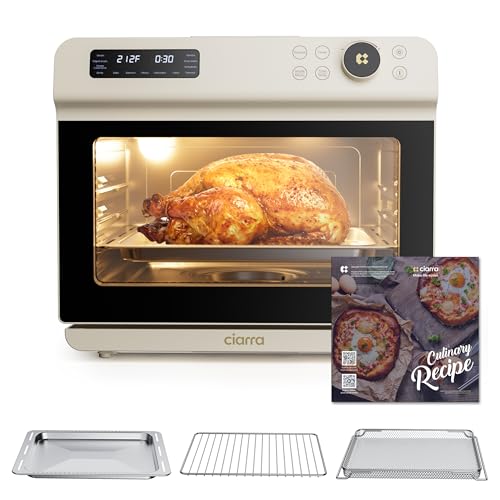


As an Amazon Associate we earn from qualifying purchases at no extra cost to you. Ratings are shown as listed on Amazon.
Best steam ovens by cooking situation
| Situation | Best oven type | Useful capacity | Typical market range | Main compromise |
|---|---|---|---|---|
| Small kitchen or rental | Countertop steam-convection oven | 15–25 litres | $250–$900 | Less interior height and more counter space used |
| Frequent family cooking | 30-inch built-in combination steam oven | 40–70 litres | $2,000–$5,500 | Requires cabinet planning and professional electrical work |
| Serious baking and batch cooking | Full-size combi-steam oven | 60–75 litres | $4,000–$9,000+ | Higher purchase price and more demanding cleaning |
| Occasional steaming only | Standard oven plus a stovetop steamer | Depends on cookware | $100–$1,500 additional | No automated humidity control or integrated programming |
Among established premium examples, Miele, Bosch, Wolf, Thermador, and Gaggenau offer built-in steam or combination steam ovens in North America. Exact features vary by model and region, so confirm the installation manual rather than relying on a retailer’s headline dimensions.
What “steam oven” actually means
A pure steam oven heats water to produce moist heat, usually around 212°F at atmospheric pressure. It is excellent for vegetables, fish, rice, dumplings, and reheating food without drying it out, but it does not brown food effectively.
A combination steam oven adds a conventional heating element and convection fan. It can switch between dry heat, steam, and a controlled combination of both. This is the more versatile choice for most households because it can roast chicken, bake bread, reheat leftovers, proof dough, and steam vegetables in one appliance.
Steam settings that matter
- Full steam: Best for delicate foods and recipes where moisture matters more than browning.
- Low steam, roughly 20–40%: Useful for bread, roasted vegetables, poultry, and reheating.
- High-combination steam, roughly 60–100%: Helps prevent large roasts and casseroles from drying out.
- Steam injection: Adds short bursts of moisture rather than maintaining a measured humidity level. It is useful for bread but offers less control.
- Regeneration or reheating: A dedicated moist reheating mode can restore texture to rice, pasta, meat, and prepared meals better than dry microwave or oven heat.
- Proofing: Holds a warm, humid environment for dough. Check that the temperature can remain low; some programs run warmer than ideal for delicate yeast work.
Humidity percentages are not always directly comparable between brands. One manufacturer may calculate humidity from the oven sensor, while another labels a program by steam output. Look for adjustable humidity, not just a menu containing the word “steam.”
Capacity: choose usable shelf space, not just litres
Capacity determines whether the oven is a daily tool or an expensive single-dish appliance. A 20-litre countertop unit may handle a tray of vegetables or a small chicken, but it will not comfortably fit a large roasting pan. A 40–50 litre built-in cavity is more practical for two or three people, while families cooking multiple dishes should consider 60 litres or more.
Also check the internal width, rack spacing, and pan dimensions. A cavity can have a generous advertised volume but limited usable space if the water tank, fan housing, or curved corners reduce the flat cooking area.
A practical capacity calculation
Suppose a family wants to cook four salmon portions, each approximately 6 ounces, plus 2 pounds of vegetables. A single perforated tray around 12 by 16 inches is usually enough, but the vegetables may need a second solid tray to collect liquid. In that case, two rack positions matter more than an extra 10 litres of total volume. For batch cooking, prioritize at least two usable rack levels and an internal width of roughly 18 inches.
Installation requirements that can change the decision
Countertop models normally need a grounded electrical outlet, ventilation clearance, and a heat-resistant surface. Do not push one tightly beneath a cabinet unless the manual permits it; steam and heat can damage cabinetry and create condensation problems.
Built-in models usually require a dedicated cabinet cutout, front ventilation clearance, and either a 120-volt or 208–240-volt circuit depending on the model. Some smaller units operate on 120 volts, while larger combination ovens may need a 30-amp or higher circuit. Many use a refillable tank and drain container, but plumbed models connect to household water and drainage.
- Measure the cutout, not only the appliance’s front width.
- Confirm whether the door needs extra clearance to open fully.
- Check whether the cabinet must withstand heat and moisture.
- Ask an electrician to verify voltage, amperage, grounding, and local code requirements.
- For plumbed models, plan an accessible shutoff valve and service access.
A refillable tank simplifies installation and avoids a plumber, but it requires filling and emptying during use. A plumbed model is convenient for frequent cooking but adds installation cost and creates more possible service points.
Cleaning and ownership demands
Steam does not make an oven self-cleaning. Moisture loosens some residue, but fats, starches, and mineral deposits still accumulate. The easiest models have a removable water tank, removable rack supports, a drain or rinse program, and a clearly defined descaling cycle.
A sensible maintenance routine
- After each use, wipe standing water from the cavity, door seal, and floor. Leaving water overnight encourages odors and mineral spotting.
- Empty the tank and drain container, unless the manual specifically instructs otherwise.
- Run a rinse program periodically, especially after cooking fatty foods or using full steam for extended periods.
- Descale according to the warning indicator or manual, commonly every few months in hard-water areas. Use only the approved descaling product.
- Inspect the door gasket and drain filter, if fitted. A damaged seal can allow steam to escape into cabinetry.
The parts most likely to need attention are the door gasket, water pump, tank seals, drain filter, and steam generator. Hard water increases scale inside the generator and can shorten service intervals. Do not pour vinegar into the appliance unless the manufacturer explicitly allows it; acidity and concentration requirements differ, and an unsuitable cleaner can damage seals or sensors.
Cooking performance: where steam helps and where it does not
Steam is particularly effective at preserving moisture. Fish remains tender, vegetables retain a firm texture, and reheated rice or pasta is less likely to become crusty. Combination steam can also improve bread by delaying crust formation during the first stage of baking.
Dry convection remains better for crisp skin, French fries, cookies that need a dry surface, and foods where browning is the main goal. Steam can soften a crust or prevent surface crisping if used too long. For roast chicken, a useful approach is moderate steam early in cooking, followed by dry convection to brown the skin.
Steam ovens also cook differently from standard ovens because humid air transfers heat efficiently. Begin checking food earlier than a conventional recipe suggests, particularly for fish, vegetables, and thin meat. Use a reliable food thermometer for meat and poultry rather than judging doneness from time alone.
Built-in versus countertop: the head-to-head decision
Choose countertop when flexibility matters
Countertop steam-convection ovens usually cost less, plug in without cabinet modification, and suit renters or smaller households. Their limitations are smaller trays, less even multi-level cooking, visible water tanks, and the need to reserve counter space. They are also more likely to require manual wiping because their cleaning programs are simpler.
Choose built-in when steam will be used several times a week
Built-in models provide larger cavities, better ergonomics, stronger insulation, and more precise automation. They integrate neatly with a wall oven and may offer plumbed water, drain connections, temperature probes, and guided programs. The trade-off is a higher total cost: the appliance price is only part of the project once electrical work, cabinetry, delivery, and installation are included.
Features worth paying for
- Adjustable humidity: More useful than a long list of preset recipes.
- Removable tank and easy-access drain: Reduces daily friction.
- Temperature probe: Valuable for large roasts and repeatable results.
- Two or more rack levels: Essential for family portions and meal prep.
- Descaling reminders: Helpful, particularly with hard water.
- Strong door seal and insulated cavity: Reduces steam leakage and cabinet exposure.
- Manual controls or clearly organized menus: Faster for everyday cooking than navigating a phone app.
Wi-Fi, recipe libraries, and voice control can be convenient, but they should come after capacity, steam control, cleaning access, and installation compatibility. A connected oven cannot compensate for an undersized cavity or an inconvenient water tank.
Bottom line
The best steam ovens are not necessarily the largest or most automated. For most buyers, a combination steam oven with adjustable humidity, at least two rack positions, a manageable cleaning system, and installation requirements that fit the kitchen is the strongest choice. Select a countertop model for modest portions and low commitment; choose a built-in, preferably plumbed model, when frequent steaming, reheating, baking, and family-size cooking justify the added cost and maintenance.

Write Your Review
No reviews yet. Be the first to share your experience!