

Key takeaways
- Compare the best whole house water filters on filtration stages, flow rate, filter life, housing build and installation to clean water at every tap.
As an Amazon Associate we earn from qualifying purchases.
Disclosure: This article contains affiliate links. If you buy through these links, we may earn a commission at no extra cost to you.
Our top pick: iSpring WGB32B 3-Stage Whole House Water Filter. Runner-up: iSpring WGB32B-KS 3-Stage Whole House Water Filter.
A whole house water filter treats water at the point where it enters your home, so every shower, faucet, washing machine and water heater draws from the same filtered supply. That single placement changes the job completely compared with a filter that serves one tap. The system has to keep up with a home running several fixtures at once, hold enough media to last months between service visits, and stand up to full line pressure day after day. It also protects the plumbing itself, stopping sediment and rust before they can clog aerators or settle inside a water heater tank.
The five systems below are all point-of-entry designs, but they take different routes to clean water. Some use replaceable cartridges in oversized housings, which makes upkeep simple and lets you swap media as your water changes. Others lean on a specific stage, such as a lead reducing cartridge or a KDF stage for heavy metals. One pick is a bare heavy-duty housing that you load with the cartridge your water report calls for. Read the buying criteria first and match the system to your water source and household size.
How to Choose a Whole House Water Filter
Start with your water source. City water usually arrives disinfected with chlorine or chloramine, so carbon filtration sized for taste, odor and chemical reduction does most of the work. Well water is a different problem set: sediment, iron and manganese are common, and the right answer depends on a water test rather than a guess.
Flow rate is the second filter for your shortlist. Whole house systems are commonly rated between 7 and 20 gallons per minute. A small home with one or two bathrooms can live comfortably at the lower end, while a larger home with several bathrooms and laundry running at once should look for 15 gallons per minute or more so pressure does not sag when fixtures overlap. Port size plays into this as well: 1-inch connections preserve flow better than smaller fittings on a busy main line.
Next, look at filtration stages and what each one actually does. A typical three-stage layout opens with a sediment cartridge that traps sand, silt and rust, follows with carbon for chlorine and organic chemicals, and finishes with a specialty cartridge aimed at lead, heavy metals or iron. More stages are not automatically better; each housing adds pressure drop, so a stage should earn its place by targeting something present in your water. Cartridge sets in this group are rated anywhere from 50,000 to 100,000 gallons. Match the rating to your household’s yearly use, and note the physical size too: 20-inch by 4.5-inch cartridges hold far more media than 10-inch versions, which is why they stretch service intervals.
iSpring WGB32B 3-Stage Whole House Water Filter

The WGB32B is the reference point for cartridge-based whole house filtration: three oversized housings on a single bracket, plumbed into the main line with 1-inch connections. The first stage is a 5-micron polypropylene sediment cartridge that catches sand, silt, dirt and rust before they reach the carbon stages. Stages two and three are both coconut shell carbon block cartridges, and running two in series gives the water long contact time with the media, which is how the system reduces up to 99 percent of chlorine along with its tastes and odors.
Because the housings take standard 20-inch by 4.5-inch cartridges, replacements are easy to source. The set is rated for up to 100,000 gallons, which for many households works out to roughly a year of service. With a flow rating up to 15 gallons per minute, it suits homes with two or three bathrooms without choking pressure when a shower and a washing machine run together. It is a city water specialist: it does not soften or disinfect, and heavy iron needs a different stage, but for chlorine and sediment duty it is a proven, flexible layout.
Specs
- Filtration stages: 3 (sediment, carbon block, carbon block)
- Sediment micron rating: 5 microns
- Flow rating: up to 15 gallons per minute
- Filter capacity rating: up to 100,000 gallons per cartridge set
- Cartridge size: 20 inches x 4.5 inches
- Inlet/outlet size: 1-inch NPT
iSpring WGB32B-KS 3-Stage Whole House Water Filter

The WGB32B-KS keeps the same three-housing, 20-inch cartridge platform as its sibling and changes the media recipe for harder jobs. Its stage lineup is built to reduce heavy metals, hydrogen sulfide, chlorine, chloramine and sediment in one pass, which makes it the version to look at when a water report shows more than basic chlorine. Chloramine deserves special mention: many water systems now use it as a disinfectant, and it is harder for plain carbon to break down, so a system that names chloramine reduction directly is worth shortlisting for those homes.
Flow and capacity stay in the same practical band as the standard model, with up to 15 gallons per minute on tap and 1-inch ports that keep pressure loss modest. The cartridge format keeps service simple: shut off the main, relieve pressure, spin the housings off and drop in a fresh set. If your water carries a rotten-egg note from hydrogen sulfide, or a test flags metals you want addressed at the entry point rather than at a single tap, this is the configuration aimed at you.
Specs
- Filtration stages: 3
- Target reductions: heavy metals, hydrogen sulfide, chlorine, chloramine, sediment
- Flow rating: up to 15 gallons per minute
- Filter capacity rating: up to 100,000 gallons per cartridge set
- Cartridge size: 20 inches x 4.5 inches
- Inlet/outlet size: 1-inch NPT
Culligan WH-HD200-C Whole House Water Filter System

The WH-HD200-C takes the opposite approach to a bundled system: it is a heavy-duty point-of-entry housing sold without a cartridge, so the filtration is whatever you load into it. That flexibility is the point. Culligan’s heavy-duty cartridge line covers sediment depths and carbon options for taste and odor, so the same housing can serve a gritty well supply one year and a milder city supply the next simply by changing the cartridge family.
The housing itself is built for the main line, with 1-inch inlet and outlet connections and a pressure range that covers typical residential service. A bypass and shut-off arrangement makes cartridge changes manageable without draining the whole house, and the sump lets you see sediment loading at a glance. Rated flow reaches up to 10 gallons per minute depending on the cartridge fitted, which fits small to mid-sized homes well. Remember to plan on a cartridge alongside it, since none is included in the box.
Specs
- System type: single heavy-duty point-of-entry housing, cartridge sold separately
- Inlet/outlet size: 1 inch
- Flow rating: up to 10 gallons per minute, cartridge dependent
- Operating pressure range: 30 to 100 psi
- Compatible cartridges include: R50-BBSA, CW25-BBS, CP5-BBS, CW5-BBS, RFC-BBSA
- Housing warranty: 2 years
Express Water Whole House Water Filter System Ultimate Protection

Express Water’s Ultimate Protection system is a three-stage rig mounted on a free-standing stainless steel frame, and the hardware details are its calling card. Each housing gets its own pressure gauge, so a clogging cartridge announces itself as a pressure gap between gauges instead of a mysterious drop at the shower. Pressure release buttons make opening the housings for service far less of a wrestle, a small thing that matters twice a year for the life of the system.
The media stack pairs heavy metal reduction with a polyphosphate anti-scale stage, and the maker aims it at scale, chloramine, chlorine, PFAs, lead and arsenic. Cartridges are the tall 4.5-inch by 20-inch format, rated as a set for up to 100,000 gallons or about six to twelve months of household use. The flow figure is generous and the 1-inch connections match it, so larger homes are the natural audience. At 63 pounds on its frame, plan the install space before it arrives.
Specs
- Filtration stages: 3, including heavy metal and polyphosphate anti-scale stages
- Flow rating: up to 17 gallons per minute (0.25 gallons per second)
- Filter capacity rating: up to 100,000 gallons per set
- Frame: free-standing stainless steel with pressure gauges and release buttons
- Inlet/outlet size: 1 inch
- Operating pressure range: 20 to 80 psi
iSpring WGB21B-PB 2-Stage Whole House Water Filter
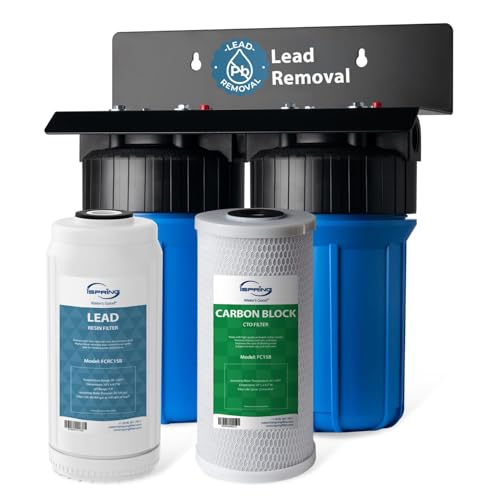
The WGB21B-PB shrinks the whole house idea down to two compact housings for homes where space or demand does not justify a three-stage rack. It pairs a CTO carbon block cartridge with a dedicated lead reducing cartridge, a combination aimed at older neighborhoods where the service line or household plumbing raises lead concerns. Putting the lead stage at the point of entry means every tap benefits, including bathroom faucets that point-of-use filters never reach.
The 10-inch by 4.5-inch cartridges keep the footprint small enough for tight utility closets, and iSpring also credits the lead cartridge with chloramine reduction, which broadens its fit for city water. Capacity is rated at 50,000 gallons per set, roughly half the big 20-inch systems, which is the honest trade for the smaller housings: expect more frequent cartridge changes in exchange for an easier install. Flow is still rated up to 15 gallons per minute through 1-inch ports, so small homes do not give up pressure to get the lead stage. For a compact home on city water with lead at the top of the worry list, this two-stage layout is the focused answer.
Specs
- Filtration stages: 2 (carbon block, lead reducing cartridge)
- Flow rating: up to 15 gallons per minute
- Filter capacity rating: up to 50,000 gallons per cartridge set
- Cartridge size: 10 inches x 4.5 inches
- Inlet/outlet size: 1-inch NPT
- Target reductions: lead, chlorine, chloramine, sediment, taste and odor
Comparison Summary
The five systems divide along two lines: fixed media recipes versus open hardware, and full-size cartridges versus compact ones. The iSpring WGB32B is the generalist for city water, with twin carbon blocks and a long cartridge set life. The WGB32B-KS swaps in media for heavy metals, hydrogen sulfide and chloramine, suiting homes whose water test shows more than chlorine. The Express Water Ultimate Protection adds a stainless frame, per-housing gauges and an anti-scale stage, aimed at larger homes that also want scale control. The Culligan WH-HD200-C is the flexible shell: one heavy-duty housing whose performance depends entirely on the cartridge you choose for it. The iSpring WGB21B-PB is the compact specialist, trading capacity for a small footprint and a dedicated lead stage. Flow ratings cluster between 10 and 17 gallons per minute, and every system here uses 1-inch connections, so the deciding factors are your water test and your household’s peak demand.
FAQ
Do whole house water filters soften water?
No. These point-of-entry systems filter sediment and reduce chemicals such as chlorine, but they do not remove the calcium and magnesium that make water hard. One pick above includes a polyphosphate anti-scale stage that helps limit scale buildup, which is scale control rather than true softening. If soft water is the goal, a dedicated softener is a separate appliance that can be plumbed alongside a filter.
Where should a whole house filter be installed?
On the main cold water line, after the meter or pressure tank and before the line branches to fixtures and the water heater. That placement treats every tap in the home. Leave enough clearance below the housings to drop them for cartridge changes, and a bypass loop is worth adding so the house keeps water service while you work on the filter.
How often do the cartridges need to be replaced?
It depends on the set’s gallon rating and your household’s use. The systems here carry ratings from 50,000 to 100,000 gallons per set, which commonly lands between six and twelve months. Rising pressure drop across the housings, or chlorine taste creeping back at the tap, are the practical signs that a change is due.
Will a whole house filter lower my water pressure?
A correctly sized system should not noticeably change pressure at the tap. Pressure loss comes from undersized ports, too many stages for the home’s demand, or cartridges left in service past their life. Choosing a flow rating above your peak demand and changing cartridges on schedule keeps pressure where it was.
Conclusion
The best whole house water filter is the one matched to your water, not the one with the longest feature list. Test your water, size the flow rating to your home’s busiest hour, and pick the media recipe that targets what the test found: the WGB32B for everyday city water, the KS version for metals and chloramine, the Express Water rig for scale control with monitoring, the Culligan housing for cartridge freedom, or the compact WGB21B-PB when lead leads the list. Any of the five will give you cleaner, better-tasting water at every tap.
More from Amazon
Programs that pair well with the guide above. Offers and eligibility are set by Amazon and may change.
Collect the home and kitchen items you want in one registry that guests can shop from.
Create a wedding registrySet up recurring deliveries of everyday items on eligible products. Terms and savings are set by Amazon.
Explore Subscribe & SaveFree shipping on eligible items, Prime Video and more. Eligible new members can start with a free trial.
Start a Prime free trialAudiobooks and podcasts to listen to on the go. Eligible new members can start with a free trial.
Try Audible freeAs an Amazon Associate we earn from qualifying purchases.

Write Your Review
No reviews yet. Be the first to share your experience!