

Key takeaways
-
For tap water: choose a laboratory kit that analyzes lead, copper, bacteria, nitrate, and other contaminants relevant to your plumbing and local supply. SimpleLab’s Tap Score offers laboratory-based drinking-water testing with results interpreted against regulatory or health-based benchmarks.
Our top picks
As an Amazon Associate we earn from qualifying purchases at no extra cost to you. Ratings are shown as listed on Amazon.
-
For well water: choose a broad laboratory panel or a well-specific kit that includes coliform bacteria, E. coli, nitrate, nitrite, pH, hardness, and metals. A strip-only kit is useful for screening but is not a strong basis for deciding whether a well is safe to drink.
-
For pools: choose a drop-count titration kit such as the Taylor K-2006C for chlorine, pH, alkalinity, calcium hardness, and cyanuric acid. It is more informative for pool maintenance than a general drinking-water kit.
-
For a low-cost first check: use a multi-parameter strip kit, but confirm any abnormal result with a laboratory analysis before installing treatment equipment or changing a household’s drinking-water source.

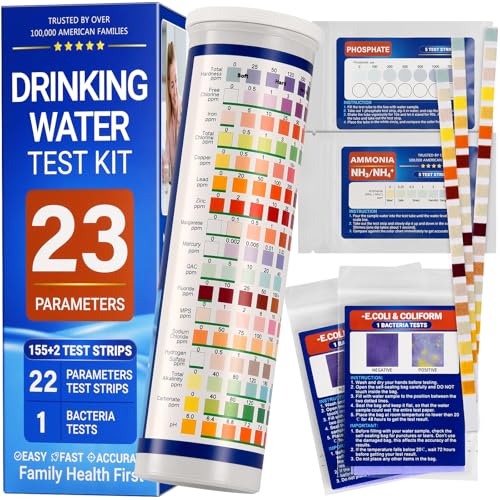

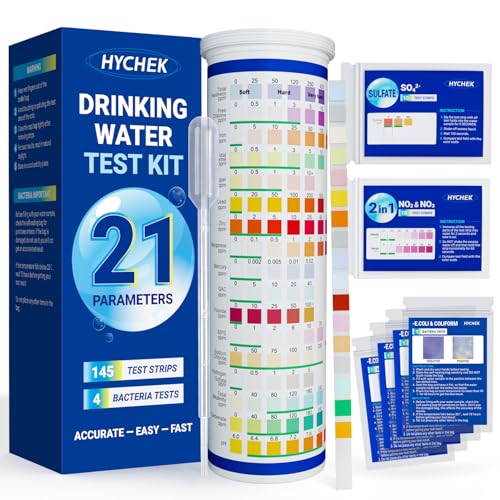
Best Home Water Testing Kit: Quick Picks by Water Source
The best home water testing kit depends on the water you need to measure: choose a certified laboratory mail-in kit for drinking-water decisions, a broad screening kit for a private well, and a liquid-drop pool kit for frequent chlorine and pH adjustments.
-
For tap water: choose a laboratory kit that analyzes lead, copper, bacteria, nitrate, and other contaminants relevant to your plumbing and local supply. SimpleLab’s Tap Score offers laboratory-based drinking-water testing with results interpreted against regulatory or health-based benchmarks.
Our top picks
As an Amazon Associate we earn from qualifying purchases at no extra cost to you. Ratings are shown as listed on Amazon.
-
For well water: choose a broad laboratory panel or a well-specific kit that includes coliform bacteria, E. coli, nitrate, nitrite, pH, hardness, and metals. A strip-only kit is useful for screening but is not a strong basis for deciding whether a well is safe to drink.
-
For pools: choose a drop-count titration kit such as the Taylor K-2006C for chlorine, pH, alkalinity, calcium hardness, and cyanuric acid. It is more informative for pool maintenance than a general drinking-water kit.
-
For a low-cost first check: use a multi-parameter strip kit, but confirm any abnormal result with a laboratory analysis before installing treatment equipment or changing a household’s drinking-water source.
Head-to-Head Comparison of Home Water Testing Methods
| Kit type | Best for | Typical parameters | Method | Typical result time | Main limitation |
|---|---|---|---|---|---|
| Multi-parameter strips | Fast screening of tap, well, or pool water | About 6–16 parameters, depending on the kit | Color blocks on a treated strip | 15 seconds to 2 minutes | Wide color steps and user-dependent interpretation |
| Color-disc or comparator kit | Repeatable pool or spa checks | Chlorine or bromine, pH, alkalinity, and sometimes hardness | Color comparison against a printed disc or block | 1–5 minutes | Lighting and color vision affect readings |
| Drop-count titration | Pool owners who need precise chemical adjustment | Free chlorine, combined chlorine, pH, alkalinity, calcium hardness, cyanuric acid | Reagent drops change or neutralize the sample | 5–10 minutes | Requires careful counting and fresh reagents |
| Laboratory mail-in kit | Drinking-water or well-water decisions | Usually 10–100+ analytes, depending on the selected panel | Preserved sample analyzed by laboratory instruments | Several business days to about two weeks | Higher cost and strict sampling and shipping instructions |
| Digital colorimeter | Frequent pool testing with less visual matching | Usually chlorine, pH, alkalinity, or hardness | Optical reading of a treated sample | 1–5 minutes | Needs batteries, calibration checks, and clean sample cells |
What Each Water Source Actually Requires
Tap water
Municipal water often has a published annual quality report, but that report describes water at the treatment plant or distribution system rather than the water coming from one particular faucet. A home test is most valuable when the concern is building plumbing, an old faucet, intermittent discoloration, taste, or a change after construction.
For a meaningful tap-water panel, look for lead and copper, arsenic where locally relevant, nitrate and nitrite, total coliform and E. coli testing when contamination is suspected, and disinfectant by-products if the panel is designed for them. A laboratory report should state the detection limit and the units, normally milligrams per liter or micrograms per liter. “Pass” by itself is less useful than a numerical result compared with an identified benchmark.
Private well water
Well owners carry more responsibility for monitoring because groundwater conditions can change after flooding, heavy rain, nearby excavation, agricultural activity, or septic-system problems. At minimum, a broad well check commonly includes total coliform, E. coli, nitrate, nitrite, pH, hardness, iron, manganese, and arsenic where geology makes it relevant. Add pesticides, volatile organic compounds, uranium, or other analytes based on local land use and guidance from the local health department.
Do not confuse a negative strip result with proof that a well is free from bacteria, solvents, or metals. Most inexpensive strips cannot detect these contaminants at the same sensitivity as a certified laboratory. If a well is used after flooding, suspected contamination, or a repair, collect a properly handled laboratory sample and follow local public-health instructions.
Pool and spa water
Pool testing has a different goal: maintaining sanitizer and water balance. The important readings are free chlorine, combined chlorine, pH, total alkalinity, calcium hardness, and cyanuric acid. A pool strip can be convenient for daily checks, but a drop-count kit gives a more useful measurement when chlorine is unusually high or low, the water is cloudy, or chemical additions need to be calculated.
Taylor’s K-2006C is a liquid-reagent DPD titration kit designed for pools and includes tests for free and combined chlorine, pH, acid demand, total alkalinity, calcium hardness, and cyanuric acid. LaMotte’s ColorQ line uses a digital colorimeter approach for several pool parameters, reducing visual color matching but still requiring clean cells and correctly measured reagents.
Decision Matrix: Which Kit Fits Your Situation?
| Your situation | Best choice | Why | Expected ownership pattern |
|---|---|---|---|
| Apartment or city home, one-time concern | Laboratory tap-water kit | Useful for plumbing-related metals and a documented result | Roughly $40–$200 depending on analyte count; buy only when needed |
| Private well, annual monitoring | Well laboratory panel plus occasional strips | Broad analysis identifies contaminants strips cannot cover | Often $100–$400 per laboratory panel; strips provide inexpensive interim checks |
| Pool owner testing several times weekly | Drop-count pool kit | Lower cost per test and better control of chlorine and alkalinity | Usually $60–$150 initially, with replacement reagents commonly $10–$40 |
| Beginner who wants a quick warning | Multi-parameter strip kit | Fast, compact, and simple to store | Often $10–$35 for approximately 25–100 tests; confirm unusual results |
| Frequent pool testing with difficulty reading colors | Digital colorimeter | Displays a numerical result rather than relying entirely on color matching | Often $100–$250; budget for batteries, cells, and reagents |
Accuracy: What Matters More Than the Number of Tests
A kit listing that claims 16 or 20 tests is not automatically better. Check four details before buying:
-
Detection limits: the lowest concentration the method can reliably report. A contaminant may be present below a strip’s readable range.
-
Method and certification: for regulatory or legal decisions, use a laboratory accredited in the relevant jurisdiction and ask whether its method is appropriate for the contaminant.
-
Expiration date: chlorine reagents, bacteria media, and test-strip chemicals degrade. Heat and humidity can shorten their useful life.
-
Result clarity: a report with units, detection limits, method names, and comparison benchmarks is clearer than a single color labeled “safe.”
For strips and comparator kits, read the result within the stated time window. Waiting several minutes can allow colors to continue developing and produce a falsely high or low interpretation. Use the sample volume specified by the manufacturer, and avoid touching reactive pads. For pool testing, rinse the cell with pool water first, collect the sample below the surface away from return jets, and keep sunlight from altering the chlorine reading.
Worked Cost-per-Use Example
Suppose a pool drop-count kit costs $90 and its reagents provide approximately 50 complete chlorine and pH checks. The initial cost is $90 ÷ 50 = $1.80 per complete check. If a replacement reagent set costs $25 and provides another 50 checks, the ongoing cost falls to about $0.50 per check, excluding water and occasional replacement cells. A $20 strip bottle containing 50 tests costs $0.40 per test, but it may provide less precise results and fewer useful measurements when the pool needs troubleshooting.
For tap or well water, the comparison is different: a $15 strip kit may be economical for screening, while a $100 laboratory panel can be better value if it prevents buying the wrong filter or provides documentation after a contamination concern.
How to Collect a Reliable Sample
-
Read the instructions before opening the container. Some laboratory bottles contain preservatives and must not be rinsed.
-
Use the specified faucet. Remove aerators only when instructed, then let cold water run for the required time so the sample represents the plumbing condition being investigated.
-
Fill to the marked line without overflowing or touching the inside of the cap.
-
Record the date, time, source, and any recent water treatment or chemical addition.
-
Keep the sample at the instructed temperature and ship it within the stated holding time. Bacteria results are especially sensitive to delays.
-
Repeat an unexpected result with a new sample or confirm it through a laboratory before making expensive treatment changes.
Durability, Consumables, and Common Mistakes
The container usually lasts longer than the chemistry. Test strips become unreliable after moisture enters the bottle, liquid reagents oxidize or evaporate, and pool comparator cells can become scratched or cloudy. Store reagents tightly closed in a cool, dry place; never transfer them into unmarked containers. Replace faded color cards and cracked cells rather than estimating results.
Common mistakes include testing hot water instead of cold tap water, using a sample bottle from another purpose, reading strips outside the time window, confusing total chlorine with free chlorine, and treating a pool based on pH alone. Another frequent error is using a drinking-water kit for pool chemistry or a pool kit to decide whether well water is safe to drink; the methods and acceptable interpretation are not interchangeable.
Bottom Line
For the best combination of accuracy and clear decision-making, choose a laboratory kit for tap or well water and a drop-count or digital pool kit for swimming-pool maintenance. Use strips as inexpensive screening tools, not as a substitute for laboratory analysis when bacteria, metals, pesticides, or other health-relevant contaminants are possible. If results suggest contamination, or if someone has symptoms after drinking the water, contact the local health department or an appropriately qualified water professional rather than relying on repeated home tests alone.

Write Your Review
No reviews yet. Be the first to share your experience!