

Key takeaways
- Ball: the most versatile choice for quads, glutes, hamstrings, and calves.
- Dampener: useful for tender areas and less muscular regions.
- Flat: suitable for broad muscle surfaces and a more distributed sensation.
- Bullet or thumb: targeted pressure; use conservatively and avoid bones.
- Fork: can pass beside, rather than over, the spine and Achilles area, following the manufacturer’s guidance.
- Wedge: useful for sweeping the shoulder blade region and larger muscle surfaces.
The best percussion massage guns for athletes are the Therabody Theragun PRO for maximum stall force and deep large-muscle work, the Hyperice Hypervolt 2 Pro for a balanced premium option, and the Ekrin Athletics B37 for long battery life and value.
A useful buying decision depends less on the number of attachments than on six practical specifications: stall force, speed range, amplitude, battery runtime, noise, and whether the device is comfortable to use on your own legs, back, and shoulders.
Our top picks
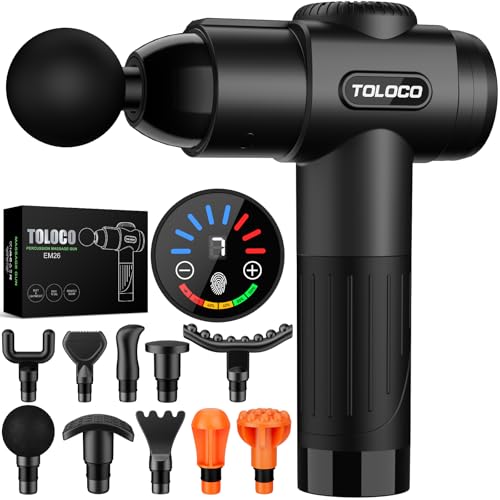


As an Amazon Associate we earn from qualifying purchases at no extra cost to you. Ratings are shown as listed on Amazon.
Best percussion massage guns for athletes: quick comparison
| Model | Stall force | Amplitude | Speed range | Battery life | Weight | Best for |
|---|---|---|---|---|---|---|
| Therabody Theragun PRO (5th Gen) | Up to 60 lb | 16 mm | 1,750–2,400 percussions/min | About 150 minutes | About 2.8 lb | Deep work on large muscle groups and frequent training |
| Hyperice Hypervolt 2 Pro | Up to 60 lb | 14 mm | 5 settings, up to about 3,000 percussions/min | About 3 hours | About 2.6 lb | Quiet, balanced recovery at home or in a gym bag |
| Ekrin Athletics B37 | Up to 56 lb | 12 mm | 1,400–3,200 percussions/min | Up to about 8 hours | About 2.0 lb | High-frequency use and long sessions between charges |
| Bob and Brad D6 Pro | Up to about 55 lb | 16 mm | About 1,500–2,500 percussions/min | About 4 hours | About 2.3 lb | Deep amplitude on a lower premium budget |
Specifications can vary slightly by revision and regional packaging. Stall-force figures describe the pressure a motor can resist before stopping; they do not mean that every user should apply that much pressure.
Our picks by athlete and situation
Best overall for serious athletes: Therabody Theragun PRO
The Theragun PRO is the strongest choice when deep amplitude, control, and repeated use matter more than low weight. Its 16-mm amplitude reaches farther into the muscle than many compact devices, while the adjustable arm and multi-grip shape make it easier to reach the hamstrings, glutes, calves, and upper back.
Its main advantage is control under pressure. A high stall-force rating is useful when working across dense gluteal or quadriceps tissue without the motor slowing immediately. The trade-off is size and weight: it can become tiring during a long self-treatment session, particularly when held overhead.
The PRO typically includes several specialized attachments, such as a dampener for sensitive areas, a standard ball for general use, a thumb attachment for targeted pressure, a wedge for shoulder blades or sweeping motions, and a micro-point attachment for stimulating sensation. The device is usually positioned at the premium end of the market, commonly around $450–$600 depending on sales and package.
Best balanced premium option: Hyperice Hypervolt 2 Pro
The Hypervolt 2 Pro is a better fit for athletes who want substantial force but prioritize a relatively quiet, refined device. Its 14-mm amplitude is deep enough for quads, hamstrings, glutes, and calves, while five speed settings make it easier to use lightly before exercise and more firmly afterward.
Compared with the Theragun PRO, its conventional pistol-style handle is familiar and easy to pass over broad muscles. That shape is less adaptable for some hard-to-reach areas, but many users will find it simpler for quick pre-training use. The battery provides roughly three hours of intermittent operation, enough for multiple weekly sessions without charging after every use.
Hyperice generally supplies a ball, fork, flat, bullet, and dampener-style attachments. The fork can be useful around the muscles beside the spine, but it should not be pressed directly onto the spine or other bony structures. Expect a premium-market price of approximately $300–$450.
Best battery life and value: Ekrin Athletics B37
The Ekrin B37 stands out when the massage gun will be used often by one person, shared by a household, or carried without a charger. Its advertised battery life can reach about eight hours, although continuous maximum-speed use and heavy pressure will reduce that figure.
Its 12-mm amplitude is shallower than the Theragun PRO and Bob and Brad D6 Pro, but it remains appropriate for warmups, cooldowns, and general work on large muscle groups. The broad speed range, reaching approximately 3,200 percussions per minute at the top setting, gives it more fine-grained control than a simple three-speed device.
The B37 is also lighter than the two premium models above. That matters during self-treatment of both legs, where the total holding time can exceed ten minutes. Its typical market range is about $200–$300. Choose it over a deeper-amplitude model if portability, runtime, and value are more important than maximum penetration.
Best lower-cost deep-amplitude choice: Bob and Brad D6 Pro
The Bob and Brad D6 Pro is worth considering when 16-mm amplitude is appealing but a top-tier price is not. It is designed for users who want a forceful device for dense muscle groups and includes several common attachments for broad, pointed, and sensitive-area use.
The compromise is usually refinement rather than basic capability: it is larger than many compact massage guns, and its motor sound and grip comfort may be less polished than premium competitors. Confirm the current included battery and attachment package before purchase, since bundles can differ. A reasonable general market range is approximately $150–$250.
How the specifications affect recovery use
Stall force
Stall force indicates how much pressure the motor can tolerate before stopping. High stall force is most useful on the glutes, quadriceps, hamstrings, and calves, where a broad attachment can encounter substantial resistance. It is less important for a light warmup, where excessive pressure can make the tool uncomfortable and needlessly fatiguing.
Amplitude
Amplitude is the distance the attachment travels with each stroke. A 16-mm device feels more pronounced than a 10- or 12-mm model, but deeper is not automatically better. Use lower pressure and a slower speed on smaller or more sensitive areas. Never use a percussion gun directly over the front or side of the neck, the spine, joints, open wounds, bruises, or areas with reduced sensation.
Speed range
Lower settings are generally more comfortable for a pre-exercise pass and for easing into a session. Higher settings can create a stronger sensation but should not be treated as a measure of effectiveness. A useful gun has enough range to move from gentle preparation to moderate post-training work without forcing one aggressive setting.
Attachments
- Ball: the most versatile choice for quads, glutes, hamstrings, and calves.
- Dampener: useful for tender areas and less muscular regions.
- Flat: suitable for broad muscle surfaces and a more distributed sensation.
- Bullet or thumb: targeted pressure; use conservatively and avoid bones.
- Fork: can pass beside, rather than over, the spine and Achilles area, following the manufacturer’s guidance.
- Wedge: useful for sweeping the shoulder blade region and larger muscle surfaces.
Warmup, cooldown, and large-muscle routines
Before training
Use a ball or dampener at a low or moderate setting for roughly 15–30 seconds per muscle area. Sweep over the quads, glutes, hamstrings, and calves rather than holding the device in one spot. Follow with your normal dynamic warmup. A massage gun should supplement movement, not replace sport-specific preparation.
After training
After exercise, use a low-to-moderate speed for about 30–60 seconds per large muscle group. Move slowly enough to notice discomfort, but do not repeatedly press into painful points. For a lower-body session, a practical sequence is glutes, hamstrings, quadriceps, and calves, using the ball attachment and reducing pressure around tendons and joints.
For a 12-minute routine covering six areas at two minutes each, a 150-minute battery theoretically provides 12.5 sessions. In real use, allowing for standby power, pressure changes, and battery aging, planning on approximately 10–12 sessions per charge is more realistic. This is why a long-runtime model can matter more to a frequent athlete than a small difference in stall force.
Durability, noise, and ownership costs
Most massage guns need little maintenance, but the attachments collect sweat, skin oils, and fabric lint. Wipe them after use with a slightly damp cloth and mild soap where the manufacturer permits; keep liquid away from the motor housing and charging port. Do not immerse the device.
The first parts likely to show wear are the attachment foam, rubberized grip, charging cable, and battery capacity. Foam heads can split if stored damp or forced onto the shaft at an angle. A replaceable attachment is inexpensive compared with replacing the whole gun, so inspect it periodically. Premium devices commonly cost roughly $200–$600, while replacement attachments and chargers vary by brand.
Noise also matters in shared spaces. Brushless motors are quieter than older designs, but a high speed combined with firm pressure is louder than idle operation. For an apartment, office, or team room, the Hypervolt 2 Pro or another quiet-design model is preferable to choosing solely by maximum force.
Bottom line
Choose the Theragun PRO if you train frequently and want maximum amplitude and strong pressure control for large muscles. Choose the Hypervolt 2 Pro for a quieter, well-balanced premium experience. Choose the Ekrin B37 for light weight, exceptional runtime, and value. Choose the Bob and Brad D6 Pro if deep amplitude is the priority on a more limited budget.
People with significant pain, recent injury, circulation problems, nerve symptoms, bleeding disorders, or a medical condition should ask a qualified clinician whether percussion massage is appropriate before using one.





Write Your Review
No reviews yet. Be the first to share your experience!