

Key takeaways
- What wears first: the rubber corners and contact points usually show scuffing before the steel handle fails. Repeated drops accelerate flattening and tearing.
- Handle connection: inspect the shoulders and end caps periodically. Movement, rattling, or a change in alignment is a reason to stop using that dumbbell.
- Storage: use a rack with cups wide enough for the largest heads. Crowding dumbbells against one another can abrade the coating and make removal unsafe.
- Cleaning: wipe sweat away after use with a damp cloth and mild soap, then dry completely. Do not soak the handles or store them while wet.
- Temperature: prolonged exposure to direct sunlight, heaters, or freezing conditions can age rubber faster and increase cracking or surface changes.
- Floor care: place a rubber mat under both the rack and lifting area. Rubber-on-rubber contact is quieter and less likely to slide than rubber on smooth tile.
The best rubber hex dumbbells for most home gyms are a matched rubber-hex set with a 28–30 mm straight or mildly contoured handle, medium-depth knurling, accurate pairs from 5 to at least 50 lb, and heads that sit flat without excessive odor or floor marking.
Our top picks

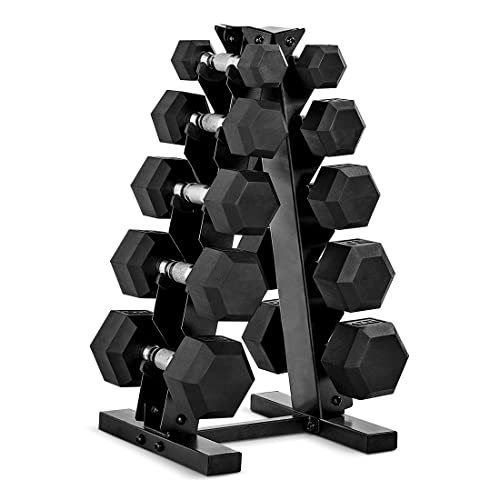


As an Amazon Associate we earn from qualifying purchases at no extra cost to you. Ratings are shown as listed on Amazon.
Best rubber hex dumbbells by home-gym situation
| Situation | Best choice | Recommended range | Why it fits |
|---|---|---|---|
| First home gym on a budget | Basic cast-iron dumbbells with rubber-coated hex heads | 5–50 lb in 5 lb increments | Low entry cost, stable heads, enough range for general strength training |
| Regular lifter training 3–5 days weekly | Commercial-grade rubber hex dumbbells | 5–75 lb, or 10–90 lb if space permits | Better knurling, stronger handle-to-head connection, greater long-term durability |
| Small room or apartment | Compact rubber hex pairs on a vertical rack | 5–40 or 5–50 lb | Hex heads prevent rolling, while a vertical rack limits floor footprint |
| Heavy pressing, rows, and split squats | Dense commercial rubber hex dumbbells | 10–100 lb, preferably in 5 lb increments | More useful progression and better resistance to repeated drops and impacts |
| Mixed household use | Moderate-knurl handles with low-odor rubber | 5–60 lb | Comfortable for varied users without sacrificing grip during heavier sets |
What makes the best rubber hex dumbbells?
Rubber hex dumbbells combine a steel handle with six-sided heads covered in rubber. The hex shape is the important home-gym feature: it resists rolling, can support certain floor-based exercises, and makes storage more predictable. Rubber reduces noise and protects hard flooring better than bare cast iron, although it is not a substitute for a proper lifting mat.
The design is not automatically high quality. Two dumbbells with the same advertised weight can differ substantially in handle diameter, head size, rubber smell, balance, and coating durability. Compare the following details before buying a full set.
Handle dimensions and grip comfort
Most useful general-purpose handles measure approximately 28–30 mm in diameter. Handles near 25 mm can feel comfortable for smaller hands but may feel less secure under heavy pressing. Handles above roughly 32 mm increase grip demand and can be tiring during high-repetition work.
Handle length also matters. A typical fixed dumbbell handle is about 12–15 cm long between the heads. Short handles feel less awkward for curls and lateral raises, while longer handles provide more clearance for pressing but can contact the forearm or torso during some movements. Very large heads can make a moderate weight feel cumbersome even when the handle itself is comfortable.
Knurling: security without unnecessary abrasion
Fine, shallow knurling is generally the most versatile choice for a home gym. It gives the palm a reference point without shredding the skin during frequent sets. Deep, sharp knurling may be useful for sweaty heavy rows, but it can be unpleasant for high-repetition presses, curls, and dumbbell circuits.
Look for knurling that covers most of the usable grip while leaving smooth shoulders near the heads. A completely smooth handle can rotate more readily, especially when the rubber is slick or the user’s hands are sweaty.
Rubber odor and floor protection
New rubber commonly has an odor caused by manufacturing residues and volatile compounds. The smell is usually strongest in dense, inexpensive coatings and in products stored in sealed packaging. A strong odor does not prove that a dumbbell is unsafe, but it is a practical ownership issue in a small room.
Air out new dumbbells in a ventilated area, wipe them with diluted mild soap, and allow them to dry fully before bringing them into a bedroom or enclosed gym. Do not use solvents, petroleum-based cleaners, or harsh degreasers; they can soften or discolor the rubber.
Rubber heads generally protect resilient flooring better than bare iron, but they can still leave marks on vinyl, wood, or light-colored tile. Use a dense rubber mat beneath the rack and lifting area. Avoid repeatedly dropping fixed dumbbells, especially on concrete. Drops can flatten the rubber, loosen the handle connection, and damage the floor beneath the coating.
Head-to-head comparison: budget, mid-range, and commercial rubber hex designs
| Design category | Typical handle | Common range | Rubber behavior | Likely trade-off |
|---|---|---|---|---|
| Budget coated hex | 25–28 mm; light-to-medium knurl | 5–50 lb | May have stronger initial odor and softer coating | Lower purchase cost, but more cosmetic wear and occasional weight variation |
| Mid-range rubber hex | 28–30 mm; medium knurl | 5–75 lb | Usually denser, more uniform coating | Good balance, though head dimensions may increase quickly at heavier weights |
| Commercial-grade rubber hex | 28–32 mm; consistent medium knurl | 5–100 lb or more | Lower odor after airing and better resistance to splitting | Higher cost and greater rack space requirements |
Established lines such as Rogue Rubber Hex Dumbbells and REP Fitness Rubber Hex Dumbbells are examples of the commercial-style category. CAP Barbell also sells budget-oriented rubber hex designs. Specifications can vary by size and production run, so verify the current handle, weight range, and warranty details rather than assuming every dumbbell in a brand’s catalog is identical.
Weight accuracy and progressive training
Weight accuracy matters most when you compare left and right sides, follow a structured program, or use dumbbells alongside a barbell. A small difference is less noticeable on a 5 lb pair than on a 90 lb pair, but mismatched dumbbells can subtly alter pressing and rowing mechanics.
For a home gym, a practical target is a pair-to-pair difference of no more than about 1–2% within the same nominal weight. That is a buying target, not a universal manufacturing guarantee. If a manufacturer publishes tolerances, use those figures; otherwise, weigh each dumbbell on a reliable platform scale after delivery and record the results.
Choose the range around your progression, not your ego lift
A 5–50 lb set in 5 lb increments provides ten pairs and works well for many beginners. It supports a simple progression: when you can complete the top of your repetition range with controlled form, move up by 5 lb per dumbbell or add repetitions first.
For an intermediate lifter, 5–75 lb is more flexible. The 55–75 lb section is especially useful for rows, presses, Romanian deadlifts, and split squats, while the lighter pairs remain important for raises, curls, and warm-up sets. If you primarily train strength, a 10–100 lb range may be more economical than buying light pairs you rarely use—but it leaves a gap for small isolation movements.
Example: suppose you perform three work sets of a dumbbell bench press at 50 lb per hand for 8–10 repetitions. Once you can complete 10, 10, and 10 with consistent technique, the next useful pair is 55 lb. A set that stops at 50 lb forces a larger jump to a different implement; a 5 lb increment keeps progression more manageable.
Durability and ownership realities
- What wears first: the rubber corners and contact points usually show scuffing before the steel handle fails. Repeated drops accelerate flattening and tearing.
- Handle connection: inspect the shoulders and end caps periodically. Movement, rattling, or a change in alignment is a reason to stop using that dumbbell.
- Storage: use a rack with cups wide enough for the largest heads. Crowding dumbbells against one another can abrade the coating and make removal unsafe.
- Cleaning: wipe sweat away after use with a damp cloth and mild soap, then dry completely. Do not soak the handles or store them while wet.
- Temperature: prolonged exposure to direct sunlight, heaters, or freezing conditions can age rubber faster and increase cracking or surface changes.
- Floor care: place a rubber mat under both the rack and lifting area. Rubber-on-rubber contact is quieter and less likely to slide than rubber on smooth tile.
Do not buy a complete set solely because the heaviest pair looks impressive. A smaller, accurately matched range that covers your actual exercises is more useful than unused weight that consumes space and encourages unsafe handling.
Final buying checklist
- Confirm the exact weight range and whether pairs are sold individually or as pairs.
- Prefer a 28–30 mm handle for broad household use unless you have a specific grip preference.
- Choose medium knurling that remains secure without feeling sharp.
- Check head dimensions at the heavier end; oversized heads can interfere with pressing and floor exercises.
- Look for published weight tolerances, warranty terms, and replacement availability.
- Plan a rack and mat before the dumbbells arrive.
- Air out and clean new rubber, especially when the gym is in a small enclosed room.
For most buyers, the best rubber hex dumbbells are not the cheapest pair or the heaviest available. They are a matched, accurately made set with comfortable 28–30 mm handles, dependable knurling, low enough odor for the intended room, flat hex heads, and enough 5 lb increments to support several years of progressive training.



Write Your Review
No reviews yet. Be the first to share your experience!