

Key takeaways
- Panel hinges should move smoothly without excessive sideways play.
- Each panel should be wide enough to avoid a top-heavy structure; 16–24 inches per panel is a useful range.
- Feet or a broad bottom rail matter more than decorative weight near the top.
- A screen should be folded slightly in both directions rather than placed in a perfectly straight line.
The best room dividers for most flexible spaces are freestanding folding panels for occasional privacy, sliding systems for frequent reconfiguration, and heavy acoustic partitions when reducing sound matters as much as separating sightlines.
Our top picks
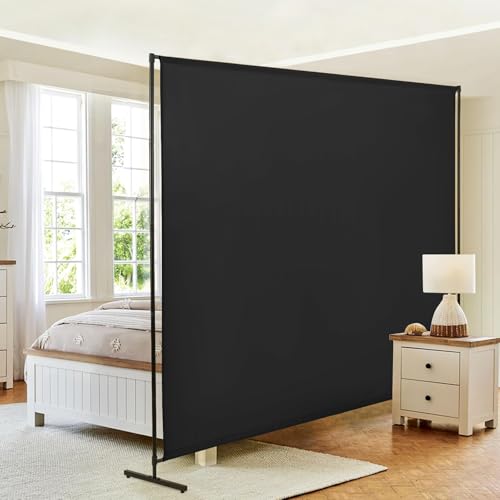


As an Amazon Associate we earn from qualifying purchases at no extra cost to you. Ratings are shown as listed on Amazon.
Best room dividers by situation
| Situation | Best choice | Recommended specification | Why it fits |
|---|---|---|---|
| Small apartment or guest room | Folding fabric or wood screen | 3 panels, 60–72 inches tall, under 35 lb | Stores in a closet and does not require installation |
| Shared home office | Acoustic freestanding panels | 72–84 inches tall, 1.5–2 inches thick, weighted feet | Reduces visual distraction and some reflected speech |
| Large open-plan room | Modular panel system | 36–48 inch panels, connectors, stabilizing feet | Allows a partition to grow or change shape |
| Frequent daily changes | Ceiling-mounted sliding panels | Two to four panels, 80–96 inches tall, roller track | Opens and closes without repeatedly lifting a screen |
| Lowest-cost separation | Curtain on a tension or ceiling track | Ceiling-to-floor fabric, 1.5–2 times track width | Lightweight, washable, and inexpensive to replace |
Folding screens: the easiest all-purpose option
Folding room dividers are usually the best starting point because they need no permanent track and can be angled to improve stability. A three-panel screen commonly measures about 108–144 inches across when fully extended, although its practical coverage is smaller once the panels are zigzagged. Heights of 60–72 inches provide seated or partial standing privacy; an 80–84 inch screen gives much stronger visual separation in a room with standard-height ceilings.
Wood, rattan, bamboo, and MDF screens offer a furniture-like appearance. Fabric-covered screens are lighter and generally absorb more reflected sound, but their frames may be less resistant to impact. Paper or translucent inserts provide light transmission but should not be treated as privacy material when a bright light is behind the divider.
What to check before buying
- Panel hinges should move smoothly without excessive sideways play.
- Each panel should be wide enough to avoid a top-heavy structure; 16–24 inches per panel is a useful range.
- Feet or a broad bottom rail matter more than decorative weight near the top.
- A screen should be folded slightly in both directions rather than placed in a perfectly straight line.
Named examples include the IKEA RISÖR room divider and IKEA HILJA curtains used with a suitable track or rod. These are different solutions: the RISÖR is a hinged freestanding screen, while HILJA is a washable fabric curtain that depends on the support hardware you choose.
Sliding panels: best for frequent reconfiguration
Sliding dividers are preferable when a room changes function every day. A ceiling track keeps the floor clear and allows panels to stack at one side, but installation must account for the ceiling structure and the weight of the panels. Wall-mounted or bypass systems can be easier where the ceiling is unsuitable, though they usually require more side clearance.
Sliding panels typically use fabric, felt, woven material, wood, glass, or composite boards. Fabric panels are quieter during movement and lighter on the track. Solid panels give better visual blocking and can improve privacy, but they demand stronger hardware. Frosted or textured glass separates areas while preserving daylight; it blocks views rather than sound.
For an 8-foot-wide opening, four 24-inch panels provide nominal coverage. Allow overlap between adjacent panels—commonly 1–3 inches per meeting edge—so the actual panel width should exceed the opening rather than match it exactly. If a system has a bottom guide, keep that channel free of dust and grit; debris is a common cause of rough movement.
Acoustic partitions versus privacy screens
A privacy divider blocks a view. An acoustic divider reduces reflected sound, and those goals are not interchangeable. Thin wood, plastic, and glass may look substantial while doing very little to control conversation or keyboard noise. For sound-related performance, look for porous materials such as PET felt, mineral-fiber cores, quilted fabric, or thick upholstered panels.
A practical acoustic panel is usually at least 1.5 inches thick and 60–84 inches high. It works best when it interrupts the direct path between people and when there are soft surfaces elsewhere in the room. One divider in a hard, reverberant room will not create a soundproof booth. Doors, ceiling height, gaps below the panel, and nearby walls still allow sound to travel around it.
Products such as VERSARE portable room dividers are designed around commercial partitioning and are available in heavier, more stable configurations than many decorative screens. Their suitability depends on the selected panel height, base, and material; compare the full assembled weight rather than the panel alone.
How much divider do you need?
Start with the opening you want to cover, then add overlap and clearance. For a folding screen, measure the diagonal path rather than the fully straightened length. A 12-foot screen made from six 24-inch panels may cover only about 8–10 feet effectively when arranged in a stable zigzag.
For a curtain, use this calculation:
Required fabric width = track width × 1.5 to 2
For a 10-foot track, buy approximately 15–20 feet of total fabric width. The lower end gives a modest ripple; the higher end gives fuller folds and fewer visual gaps. For a curtain intended to reduce sound reflections, select dense, multilayer fabric and extend it close to the floor, while leaving enough clearance to prevent dragging.
Height should match the activity. A 48–60 inch divider can separate desks while preserving light and a sense of openness. Choose 72–84 inches for standing privacy. Measure the ceiling before selecting a near-ceiling panel: allow space for track hardware, sprinklers, light fixtures, and ventilation.
Materials, stability, and safety
Wood and bamboo
These materials suit living rooms and bedrooms and can last for years if kept dry. Inspect hinge screws and feet periodically because repeated folding loosens hardware. Avoid placing a tall screen where children, pets, or a frequently opened door can strike it.
Fabric and felt
Fabric is lighter and more forgiving than rigid panels. Check whether the cover is removable and machine washable. Felt collects dust and pet hair, so vacuum it with a soft brush rather than saturating it with water.
Glass and rigid panels
Tempered glass and solid composite panels look permanent and clean easily, but they are heavy and less tolerant of impact. Use only hardware rated for the finished panel weight. Never assume a drywall ceiling can support a sliding system without locating suitable framing or using an appropriate structural mounting method.
Bases and casters
Casters improve movement but can reduce stability, especially on thick carpet. Locking casters are preferable for a divider that remains in use. A weighted base is valuable for tall panels, but weight low to the floor is more useful than a heavy decorative frame at the top.
Ownership costs and maintenance
The purchase price is only part of the decision. Decorative folding screens often fall in the broad $60–$250 range, fabric curtain solutions commonly cost about $40–$300 including basic hardware, and commercial acoustic or sliding systems can range from roughly $300 to well above $2,000 depending on size and installation. These are general 2026 market ranges, not fixed prices.
For occasional use, a $120 folding screen used twice per week for three years costs approximately:
$120 ÷ (2 × 52 × 3) = about $0.38 per use
A more expensive system can be worthwhile when it is opened daily, but only if its rollers, hinges, and mounting points are designed for that frequency. The parts most likely to wear first are hinge screws, caster wheels, track rollers, fabric edges, and connector clips. Keep spare fasteners, avoid dragging freestanding panels sideways, and lift rather than pull a screen across uneven flooring.
Final buying checklist
- Measure the opening, storage location, door swing, and ceiling height.
- Choose a folding screen for occasional use and easy storage.
- Choose sliding panels when the divider changes position daily.
- Choose thick porous panels when reflected speech and echo are the concern.
- Confirm the assembled weight, base width, and hardware rating—not just panel dimensions.
- Prefer washable covers, replaceable rollers, and accessible fasteners for long-term ownership.
- For a rental or temporary room, use a freestanding screen or tension-supported curtain instead of drilling into walls or ceilings.
The best room dividers match the way the space changes: a light folding screen for flexibility, a curtain for economical coverage, a sliding system for repeated opening and closing, or a thick acoustic partition when sound control is part of the requirement.

Write Your Review
No reviews yet. Be the first to share your experience!