

Key takeaways
- Römertopf capacity is usually expressed by the approximate weight of food the vessel can hold, not by a precise liquid volume. Choose according to the raw roast and vegetables, leaving room for the domed lid to sit securely.
The best rmertopf clay roaster for meats is the Römertopf Classic in the 3.5 kg size for most households, because it accommodates a medium chicken, pork loin, or compact beef roast without demanding the oven space or soaking time of the largest models.
Our top picks

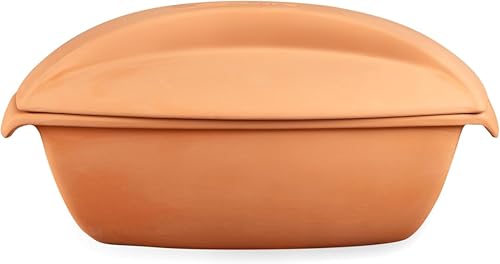
As an Amazon Associate we earn from qualifying purchases at no extra cost to you. Ratings are shown as listed on Amazon.
Quick verdict: which Römertopf size fits your roast?
Römertopf capacity is usually expressed by the approximate weight of food the vessel can hold, not by a precise liquid volume. Choose according to the raw roast and vegetables, leaving room for the domed lid to sit securely.
| Römertopf size class | Approximate capacity | Best roast size | Typical use | Approximate empty weight |
|---|---|---|---|---|
| Small / 1.5 kg | About 1.5 kg of food | Up to 1.2 kg | Small chicken, two pork chops, 2 servings | About 2–3 kg |
| Classic 2.5 kg | About 2.5 kg of food | 1.5–2 kg | Small chicken, lamb shoulder, family casserole | About 3–4 kg |
| Classic 3.5 kg | About 3.5 kg of food | 2–2.75 kg | Medium chicken, pork loin, small beef pot roast | About 4–5 kg |
| Large / 5 kg | About 5 kg of food | 3–4 kg | Large chicken, turkey breast, substantial pork shoulder | About 5–7 kg |
| Extra-large / 6 kg | About 6 kg of food | 4–5 kg | Large roasts and batch cooking | About 6–8 kg |
These figures are practical planning ranges rather than a guarantee of the internal dimensions of every production run. A bone-in roast occupies more space than a boneless roast of the same weight, and vegetables reduce usable room.
Best picks by cooking situation
Best overall: Römertopf Classic 3.5 kg
The 3.5 kg Classic is the most flexible choice for a household cooking meat for roughly four to six people. Its unglazed natural clay body and lid absorb moisture during soaking, then release steam as the dish heats. That environment suits chicken, pork, lamb, and covered beef dishes that benefit from gentle, moist cooking.
It is large enough for a whole chicken with root vegetables but usually easier to lift and store than the 5 kg and 6 kg versions. If you are buying only one clay roaster, this is the size with the fewest capacity compromises.
Best for small households: Römertopf Classic 2.5 kg
The 2.5 kg model is preferable when you normally cook for two to four people or have limited cupboard space. It handles a smaller chicken, pork tenderloin with vegetables, or a compact lamb roast. It also heats more quickly than a large vessel and creates less food waste when portions are modest.
Do not select it for a large chicken simply because the lid can be forced into place. Crowding reduces circulation and can leave the top of the meat touching the lid, which interferes with browning and makes serving awkward.
Best for entertaining: Römertopf 5 kg or 6 kg
The larger Römertopf models make sense for a big poultry joint, several portions of pork shoulder, or cooking tomorrow’s leftovers at the same time. Their advantage is capacity, not speed. A large mass of cold clay and food takes longer to heat, needs more room in the oven, and is substantially heavier when full.
Check your oven before buying. Measure the rack width, depth, and height with the rack in its normal position. Include clearance for your hands and for the lid’s raised dome. A vessel that technically fits may still be difficult to remove safely.
Clay composition and lid design
Traditional Römertopf cookware is made from porous natural clay. The cooking base is generally unglazed, while some exterior or decorative areas on certain designs may have a finish. This differs from glazed ceramic bakers, which do not absorb water in the same way.
The porous clay is central to the cooking behavior. After soaking, it contributes moisture while the food heats, helping prevent a lean roast from drying rapidly. The domed clay lid traps steam and condensation. It is not a pressure lid and will not produce the same concentrated braising effect as a tightly sealed metal Dutch oven, but it creates a mild, humid roasting environment.
The lid’s shape also determines how much headroom is available. Whole poultry needs more vertical clearance than a flat pork loin. A lid that fits loosely or rocks on the rim is a warning sign; steam retention depends on a reasonably stable fit.
Soaking requirements: the step many buyers underestimate
For an unglazed clay Römertopf, soak both the base and lid in cool water for about 10 to 15 minutes before most cooking sessions. Some owners use up to 20 minutes for a completely dry vessel or a long roast. The goal is to saturate the porous clay, not to leave it submerged for hours.
- Place the base and lid in a sink or large basin.
- Cover the interior surfaces with cool water.
- Soak for 10 to 15 minutes.
- Drain without drying the clay completely.
- Add the food, cover the vessel, and place it in a cold oven.
Starting in a cold oven reduces thermal shock. Preheating an empty, wet clay roaster can expose it to a rapid temperature change, increasing the risk of cracking. Follow the temperature limits supplied with your particular model, but a gradual rise to roughly 180–220°C is typical for meat recipes.
How different meats perform
Chicken and turkey
Chicken is one of the strongest use cases. The humid interior helps the breast remain tender while the meat cooks through. The skin may brown, but it generally will not become as crisp as chicken roasted uncovered in a metal pan. Remove the lid during the final 15 to 25 minutes if more surface color is important.
Use a food thermometer in the thickest part of the meat rather than relying on cooking time. Poultry portions vary considerably by shape and starting temperature.
Pork
Pork loin and pork shoulder both work well, but for different reasons. Pork loin benefits from the clay baker’s moisture retention and should not be overcooked. Pork shoulder can be cooked longer with onions, stock, or cider until connective tissue softens.
For a browned crust, sear the meat in a separate pan before placing it in the soaked baker, or uncover near the end. Do not assume that a moist cooking environment will create a crisp crackling surface.
Beef
A Römertopf is best for beef pot roasts, brisket-style cuts, and stews rather than for a dry-roasted tenderloin where precise browning is the priority. The covered environment softens tougher cuts, especially when liquid and vegetables are included.
For medium-rare rib roast or tenderloin, a conventional uncovered roasting pan gives more control over browning and internal temperature. A clay baker remains useful if the recipe specifically calls for a covered, gentle roast.
Lamb
Lamb shoulder and leg benefit from the enclosed moisture, herbs, garlic, and root vegetables. The 2.5 kg or 3.5 kg sizes are usually suitable for smaller legs; a large bone-in leg may require the 5 kg model. Keep the meat from pressing against the lid and use a thermometer to avoid confusing tenderness with doneness.
Cleaning, durability, and ownership costs
Allow the roaster to cool naturally before washing it. Rinse with warm water and use a soft brush or non-abrasive sponge. Avoid sudden cold water on hot clay, harsh scouring pads, and aggressive detergents that can be absorbed by porous surfaces. Many traditional unglazed clay roasters are not ideal for a dishwasher, even where a specific modern model permits it; the product instructions should take priority.
For baked-on residue, soak the cooled vessel in warm water and loosen the food gradually. A paste of baking soda and water can help with odor or stubborn marks, but rinse thoroughly. Do not use the same clay baker for strongly flavored foods if you are particularly sensitive to lingering aromas.
The most vulnerable parts are the rim and lid edge. Chipping there can prevent a stable fit, while hairline cracks may worsen with repeated heating. Store the lid separately or with a cloth between pieces, and avoid stacking heavy cookware inside the base.
As a cost-per-use example, a clay roaster priced in the general market range of about $60–$130 and used twice a month for five years provides roughly 120 cooking sessions. That works out to approximately $0.50–$1.10 per use before ingredients, assuming it is not damaged by thermal shock. Care matters more than buying the most expensive finish.
Decision matrix
| Your situation | Recommended choice | Why |
|---|---|---|
| New to clay cooking | Classic 2.5 kg or 3.5 kg | Easier to lift, soak, clean, and fit in a standard oven |
| Cooking for 2–3 people | Small or 2.5 kg | Less empty space and fewer leftovers |
| Cooking for 4–6 people | 3.5 kg | Good balance of roast capacity and manageable weight |
| Weekly batch cooking | 5 kg or 6 kg | Room for a large joint and vegetables in one load |
| Small kitchen or narrow oven | Small or 2.5 kg | Lower storage and handling demands |
| Crisp skin is the top priority | Any size, used with the lid removed at the end | Clay excels at moist roasting, not maximum browning |
Bottom line
Choose the Römertopf Classic 3.5 kg if you want the best all-round balance for meat roasts. Select the 2.5 kg version for smaller portions and easier ownership, or move to 5 kg and 6 kg only when your roast size, family, or batch-cooking routine justifies the extra weight and storage space. The defining trade-off is consistent: porous clay and a domed lid produce moist, gently cooked meat, while soaking, gradual heating, careful cleaning, and a final uncovered stage are necessary for reliable results.

Write Your Review
No reviews yet. Be the first to share your experience!