

Key takeaways
- 8–16 levels: adequate for steady cardio, beginner training, and moderate intervals.
- 20 levels: more useful for gradual progression and household members with different fitness levels.
- 30–40 levels: valuable for frequent training, watt-focused workouts, or users who want small changes in effort.
The best recumbent exercise bikes for home cardio are the Schwinn 230 for value, the Horizon Comfort R for a higher user-weight limit and easy entry, the 3G Cardio Elite RB for a compact premium option, and the Sole LCR for frequent, demanding use.
A recumbent bike is usually chosen for its supportive seat, low step-over height, and relaxed pedal position, but those features differ considerably between models. The right choice depends less on the number of programs and more on whether the bike fits your room, your body, and the way you expect to train.
Our top picks


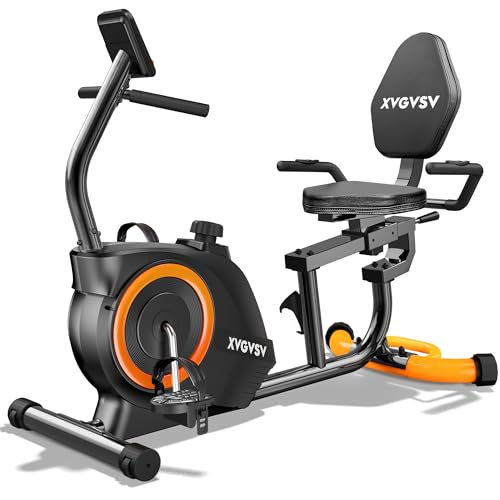

As an Amazon Associate we earn from qualifying purchases at no extra cost to you. Ratings are shown as listed on Amazon.
Best recumbent exercise bikes by situation
| Best for | Recommended model | Why it stands out | Important limitation |
|---|---|---|---|
| Most home users on a budget | Schwinn 230 | 20 resistance levels, sliding seat, straightforward console, and broad availability | 300-pound user limit and a relatively long footprint |
| Easy access and larger users | Horizon Comfort R | Low step-through frame, 350-pound capacity, and 16 resistance levels | Basic entertainment and workout feedback compared with premium bikes |
| Compact premium home gym | 3G Cardio Elite RB | Shorter overall length, 16 resistance levels, and a substantial seat and frame | Costs more than entry-level bikes and has a less elaborate console |
| Frequent, high-volume training | Sole LCR | 40 resistance levels, 400-pound capacity, and a sturdier commercial-style design | Heavy, wide, and typically priced in the upper market range |
Specifications can vary by production year and retailer configuration, so confirm the current manual before buying. The figures below are useful for comparison, not a substitute for checking the exact model number.
Head-to-head comparison
| Bike | Approx. footprint (L × W) | Resistance | User limit | Seat adjustment | Console and extras |
|---|---|---|---|---|---|
| Schwinn 230 | 64 × 27 in | 20 magnetic levels | 300 lb | Sliding rail; multiple positions | Dual screens, programs, telemetry-compatible heart-rate tracking |
| Horizon Comfort R | 66.5 × 25 in | 16 electronic levels | 350 lb | Sliding seat with a broad adjustment range | Large display, Bluetooth on some versions, speakers or device shelf depending on version |
| 3G Cardio Elite RB | 55 × 30 in | 16 magnetic levels | 350 lb | Sliding seat; reclined backrest | Time, distance, pulse, calories, watts, and preset programs |
| Sole LCR | 57 × 30 in | 40 electronic levels | 400 lb | Sliding seat with several locking positions | Large color display, workout programs, Bluetooth and device connectivity |
What matters when choosing a recumbent bike
Seat adjustability and pedal position
A seat that moves only a few inches can make an otherwise well-built bike uncomfortable. At the correct setting, your knee should retain a slight bend when the pedal is farthest away. You should not need to point your toes to reach the bottom of the rotation, nor should your knee remain sharply bent throughout the stroke.
Measure from the front of the seat back to the nearest pedal at its farthest position, then compare that range with your inseam and preferred posture. Manufacturer height ranges are only estimates because torso length and ankle flexibility also affect fit. A sliding rail is generally more useful than a reclining backrest alone: the rail changes leg extension, while the backrest changes hip and back angle.
Pedal position is another meaningful difference. A more forward pedal position supports a relaxed, chair-like posture and is often the reason people prefer a recumbent bike. However, an extremely reclined position can make it harder to produce power. If you plan to perform challenging intervals, look for a seat and crank arrangement that lets your hips stay stable rather than sinking too far behind the pedals.
Step-through access
Look for an open section between the seat and the front console, a low frame tube, and a handle that remains easy to reach while standing. A bike may be advertised as “easy access” yet still have a tall front crossbar or a narrow opening. Leave at least 24 inches of clear space beside the frame and approximately 30 inches in front of it so you can approach, turn, and exit without squeezing around furniture.
The Horizon Comfort R is particularly appealing when entry and exit are priorities. The Schwinn 230 also provides a relatively accessible layout, but its long frame requires more room around the bike than many shoppers expect.
Resistance range
Resistance-level counts are not directly comparable across brands. One company’s level 10 may not equal another company’s level 10. What the range tells you is how finely you can adjust effort.
- 8–16 levels: adequate for steady cardio, beginner training, and moderate intervals.
- 20 levels: more useful for gradual progression and household members with different fitness levels.
- 30–40 levels: valuable for frequent training, watt-focused workouts, or users who want small changes in effort.
Magnetic resistance is typically quiet and has no brake pad to replace. Electronic adjustment is convenient, but it adds control components that may eventually need service. A bike with 40 levels is not automatically better than one with 16; it is better only if you will use the extra control.
Console features
Prioritize readable numbers for time, speed, distance, resistance, heart rate, and watts. A phone shelf is useful if you intend to watch videos, while Bluetooth matters if you want to pair a heart-rate monitor or use a training app. Preset programs can provide structure, but they are not essential for a simple 30-minute routine.
Check whether the console runs from batteries, an adapter, or both. A battery-backed display can preserve basic workout data during brief interruptions, but it may not power motorized resistance indefinitely. Also check the location of the water-bottle holder and controls: on a deeply reclined bike, reaching down or forward repeatedly can be inconvenient.
Footprint, delivery, and room planning
Use the published footprint as the starting point, not the complete space requirement. Add approximately 24 inches on each side for access and 30 inches at the front or rear, depending on how the bike is entered. For example, a 64-by-27-inch bike needs a practical operating zone of roughly 112 by 75 inches if you want comfortable access from both sides. That is about 58 square feet, before accounting for a wall, desk, or other equipment.
Weight also affects ownership. A lighter bike is easier to reposition, but a heavier frame may feel more stable during hard pedaling. Before delivery, verify that the route to the room accommodates the boxed dimensions, particularly stairways and narrow doorways. Many recumbent bikes require partial assembly, and the seat rail, pedals, console wiring, and front stabilizer deserve careful installation.
Durability and ownership realities
The parts most likely to require attention are the pedals and straps, seat rollers, adjustment handle, power adapter, and console wiring. Pedal straps can stretch, and seat rollers can accumulate dust that makes adjustment rough. Wipe sweat from the frame and seat after each session, keep the rail free of grit, and inspect pedal tightness periodically. Avoid spraying cleaner directly onto the console or adjustment mechanism.
Do not use the maximum user-weight limit as a target. If two people will use the bike daily, a capacity with at least a 50-pound margin above the heavier user provides a more sensible fit. Also consider warranty coverage for labor, electronics, and the frame separately; a long frame warranty does not necessarily mean the console or resistance motor has the same coverage.
A common mistake is choosing a bike that barely fits the rider at its shortest or longest seat position. Another is placing it directly against a wall, leaving no room to step through. Test the adjustment while wearing the shoes you will use for exercise, and keep the pedal straps snug without restricting circulation.
How much should you spend?
General market pricing in 2026 is approximately $500–$900 for basic home models, $900–$1,500 for better-built midrange bikes, and $1,500–$2,500 or more for heavy-duty or premium designs. A cheaper bike can be appropriate for two or three short sessions per week. For daily use by multiple people, stronger seat hardware, a higher capacity, and a longer parts warranty can matter more than a larger program library.
For a simple value calculation, suppose a $750 bike is used four times weekly for five years: 4 × 52 × 5 equals 1,040 workouts, or about $0.72 per workout before electricity and maintenance. If a more durable $1,500 bike is used six times weekly for the same period, it produces 1,560 workouts, or about $0.96 per workout. The less expensive purchase is not necessarily the better value if its fit or durability causes it to sit unused.
Bottom line
Choose the Schwinn 230 when you want a capable, relatively affordable all-purpose bike. Choose the Horizon Comfort R when step-through access and a 350-pound limit are central requirements. Choose the 3G Cardio Elite RB when floor length is restricted but you still want a substantial machine. Choose the Sole LCR when several people will train often and you value a wide resistance range and higher capacity over price and portability.
If you have an injury, balance concern, or condition that affects exercise tolerance, use general product information only and ask a qualified health professional whether this type of equipment and posture are appropriate for you.


Write Your Review
No reviews yet. Be the first to share your experience!