

Key takeaways
- Compare the best gravity boots for inversion therapy, spinal decompression and safe hanging, with fit, padding and bar compatibility guidance.
As an Amazon Associate we earn from qualifying purchases.
Disclosure: This article contains affiliate links. If you buy through these links, we may earn a commission at no extra cost to you.
Our top pick: Teeter EZ-Up Gravity Boots. Runner-up: MuscleForge Gravity Boots with Safety Lock.
Hours of sitting, standing, and training push the discs of the spine together and leave many people finishing the day stiffer and sorer than they began it. Gravity boots reverse that pressure for a few minutes at a time. You secure padded cuffs around your ankles, hook them over a sturdy bar, and let your own body weight lengthen your spine while you hang fully inverted.
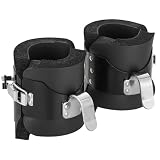
Compared with a full inversion table, the best gravity boots take up almost no space. A pair stores in a closet or gym bag and works with a power rack or well-mounted pull-up bar. That portability is their biggest appeal, and also their biggest responsibility. Boots place you in full inversion right away, with no partial angles, so the quality of the cuffs, hooks, and locking hardware matters most.
This guide compares five proven pairs, from a lightweight design with removable calf loops to heavy steel models built for larger users. Each pick was chosen for secure locking, honest published limits, and padding that protects the ankles under load.
How to Choose the Best Gravity Boots for Your Body and Bar
Begin with the bar, because no boot can make a weak support safe. Your bar or rack must be firmly anchored and able to hold your full weight with a comfortable margin while you mount, hang, and come back down. Check the diameter as well. Many boots fit bars up to about 1.25 inches across, while wider hooks accept bars up to 1.5 inches. Never hang from a loose doorway bar or any support that flexes.
Next, respect the published weight limit as a hard ceiling, not a target. Limits in this guide range from about 225 to 330 pounds, and the limit of your bar or rack may be lower than the limit of the boots. The lower figure always governs. Leave room for the boots and the extra force created as you mount and dismount.
Fit around the calf decides whether hanging feels relaxing or painful. Measure the widest part of each calf while standing. Standard Teeter boots suit calves under 16 inches around, while wider cuffs suit bigger legs. A loose cuff lets the foot slide and concentrates pressure in the wrong places, while a tight one pinches. Look for thick foam liners, contoured pads, and extra insert pads that fine-tune the fit.
Locking design is the safety core of any pair. Single-action locks, double latches, and self-locking ratchet buckles all appear below, and each works well when it closes positively and stays closed under load. Before every session, close each lock fully, tug on each boot, and confirm the hooks sit completely on the bar.
Finally, think about how you will get down. Full inversion demands enough strength to pull yourself back up, or a planned assist such as a strap or a partner. Begin with hangs of twenty to thirty seconds and build gradually. Anyone with high blood pressure, glaucoma, a heart condition, or a recent injury should speak with a clinician first.
Teeter EZ-Up Gravity Boots

Specs
- Weight limit: 300 lb, with a pair weight of about 2 lb
- Fit: standard size for calves under 16 inches in circumference, about 9 inches long
- Shell and hooks: DuPont Hytrel shell with hooks and calf loops in a 40 percent glass and nylon alloy
- Padding: soft foam liners about 5/8 inch thick around the ankle and lower calf
- Closure and compatibility: dual self-locking ratchet buckles, fits bars up to 1.25 inches across, works with select Teeter tables, racks, and bars
The Teeter EZ-Up is the lightest and most refined pair in this guide, with the most complete maker documentation behind it. Instead of a rigid metal frame, each boot uses a flexible shell that gives slightly as it wraps the ankle, backed by foam liners that spread pressure evenly. At roughly two pounds for the pair, they are easy to carry and less tiring during longer hangs than heavier steel designs.
The detail that sets this pair apart is the removable calf loop set. Each loop holds a gentle bend in the knee while you hang, reducing strain across the knees and the tops of the feet. For people whose discomfort comes from straight, locked legs, that small bend changes the whole feel of a session. Choose the Teeter pair if you value light weight and your calves measure under sixteen inches.
MuscleForge Gravity Boots with Safety Lock

Specs
- Weight limit: 330 lb, with each hook reinforced by four screws
- Padding: foam padding about 1.18 inches (3 cm) thick around the ankle
- Fit: adjustable straps for ankle circumferences from about 7.9 to 15 inches, one size design, model KF-58
- Hardware: alloy steel hooks with a double-locking metal buckle and safety lock
- Compatibility: hooks over sturdy chin-up bars and racks, includes a strap for pulling back up
The MuscleForge pair is built around its lock. A double-locking metal buckle closes over alloy steel hooks, and each hook is reinforced with four screws, giving you clear checks before you commit your weight to the bar. The maker publishes a ceiling of 330 pounds, matching the highest limit in this guide.
Comfort comes from foam about 1.18 inches thick, while adjustable straps fit ankle circumferences from about 7.9 to 15 inches, covering slim and muscular legs in one size. An included strap helps you pull back up at the end of a hang. Choose the MuscleForge pair for a wide fit range and a double lock you can verify by hand.
TONYKO Anti Gravity Inversion Boots

Specs
- Weight limit: 150 kg, about 330 lb, the highest ceiling in this guide
- Bar fit: designed for bars from about 1 to 1.5 inches in diameter
- Cuff size: inside diameter of about 3 7/8 inches, with foam padding around the ankle
- Hardware: steel hooks with a double-locking closure and a metal band around the cuff
- Use: hanging decompression and inverted core training from a bar or rack
The TONYKO pair earns its place through capacity and bar range. Its published ceiling of about 330 pounds sits above the other pairs here, and its hooks accept thicker bars, up to about 1.5 inches, opening up many racks and gym bars that narrower hooks cannot use safely. For bigger users, that combination alone may decide the purchase.
Comfort depends heavily on leg size. The cuff opening is fixed at just under four inches across, so slimmer legs can feel loose, and the practical fix is thick socks or added padding until the ankle cannot slide. Once snug, the foam lining and double lock give a secure hang for decompression and inverted core work. Consider this pair if you are a heavier user or your rack uses a thicker bar.
BORDSTRACT Anti Gravity Inversion Boots
Specs
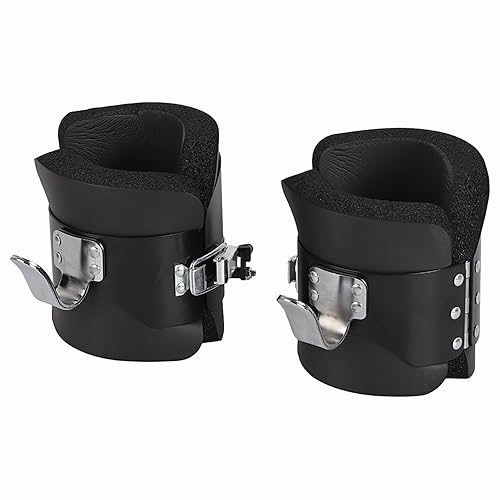
- Construction: solid steel frame and hooks made for chin-up bars and racks
- Weight limit: about 225 lb, the lowest published ceiling in this guide
- Pair weight: about 6.32 lb, with dimensions of about 13.19 x 7.87 x 7.09 inches
- Padding: padded foam sides that wrap around the ankle and lower leg
- Closure: sturdy buckles that secure each boot before you hang
The BORDSTRACT pair is the traditional steel option in this lineup. A solid steel frame, padded foam sides, and sturdy buckles give it a planted feel on the bar, and the hooks attach and detach quickly for decompression hangs and inverted core work between training.
Two limits define who should choose it. At about 6.32 pounds it is the heaviest pair here, so long passive hangs feel more tiring, and its published ceiling of about 225 pounds is well below the others, so it suits lighter users only. Pick the BORDSTRACT boots if you stay comfortably under that ceiling and prefer an all-steel build for shorter sessions.
Sutekus Anti Gravity Inversion Boots

Specs
- Weight limit: 300 lb as published on the product listing
- Padding: foam padding about 1.2 inches thick around the ankle area
- Hardware: chrome-plated steel hooks with a strap locking system
- Fit: one size design fastening around the ankle and lower calf with adjustable strapping
- Compatibility: attaches to most chin-up bars and racks with a suitable horizontal bar
The Sutekus pair is the straightforward, portable option in this lineup. Thick foam, a full 1.2 inches around the ankle, does the comfort work, while chrome-plated hooks and a strap lock keep the design simple and light enough for a gym bag. There are no brand-specific parts, which suits people who hang wherever a solid bar is available.
Simplicity asks a little more of the user. Because the published figures come from the listing rather than a detailed maker sheet, be conservative: stay under the stated limit, inspect the hooks and stitching before each use, and make sure the strap is fully tight. Pick the Sutekus boots for a light, uncomplicated pair for decompression and abdominal work.
Comparison Summary
All five pairs hang you fully inverted so your own weight can lengthen your spine, but they suit different bodies and setups. The Teeter EZ-Up is the lightest at about two pounds, fits calves under sixteen inches, accepts bars up to 1.25 inches, and adds removable calf loops. The MuscleForge pair counters with thick foam, a double-locking buckle, and straps that fit a wide range of ankle sizes.
The TONYKO pair shares the highest published ceiling, about 330 pounds, and has the widest bar range, though its fixed cuff suits larger ankles best. The BORDSTRACT pair is the all-steel heavyweight at about six pounds, with the lowest ceiling, about 225 pounds. The Sutekus pair keeps things light and simple, with the thickest stated foam at about 1.2 inches.
Match the pair to three measurements: your weight against the lowest limit in your setup, your calf size against the cuff, and your bar diameter against the hook range. When all three line up with room to spare, any of these five can deliver comfortable hangs.
Frequently Asked Questions
How long should a beginner hang in gravity boots?
Begin with twenty to thirty seconds per hang, once or twice in a session, and come down while you still feel fully in control. Add time slowly as your body adapts. Most home users settle into sessions of one to three minutes. Dizziness, pressure in the head, or pain in the ankles or knees is a signal to come down right away.
Can gravity boots be used with any pull-up bar?
No. The bar must be firmly mounted, stable, and strong enough to hold your weight plus the movement of mounting and dismounting, and its diameter must fall inside the hook range of your boots, up to about 1.25 inches for many pairs and 1.5 inches for wider designs. Loose doorway bars are not suitable.
Are gravity boots a good fit for people with larger calves?
They can be, if you choose a pair sized for your legs. Measure your calf and compare it with the cuff guidance for each model. Standard Teeter boots suit calves under sixteen inches around, while wider cuffs, such as the TONYKO design, and strap-adjustable models, such as the MuscleForge pair, give larger legs more room. A cuff that cannot close fully should never be forced.
What should I check before every hanging session?
Check that both locks close completely, that any safety lever or second latch is engaged, and that both hooks sit fully on the bar. Tug each boot firmly while your feet are still near the ground, confirm the padding has not shifted, and make sure you have a clear way back up. If any part looks worn or loose, skip the session.
Conclusion
Gravity boots remain one of the most compact ways to practise full inversion, provided you respect what they demand: a solid bar, an honest look at weight limits, and a cuff that fits your legs. For most people, the Teeter EZ-Up Gravity Boots are the easiest pair to live with, thanks to their light shell, self-locking buckles, and calf loops. Heavier users point toward the TONYKO pair, secure-lock users toward the MuscleForge pair, steel traditionalists toward the BORDSTRACT pair, and simplicity seekers toward the Sutekus pair.
Whichever of these best gravity boots you choose, build the habit slowly. Keep early hangs short, check every lock twice, and let comfort set the length of each session. A few careful minutes of hanging, repeated regularly, will do more for a tired back than one long effort.
More from Amazon
Programs that pair well with the guide above. Offers and eligibility are set by Amazon and may change.
Collect the home and kitchen items you want in one registry that guests can shop from.
Create a wedding registrySet up recurring deliveries of everyday items on eligible products. Terms and savings are set by Amazon.
Explore Subscribe & SaveFree shipping on eligible items, Prime Video and more. Eligible new members can start with a free trial.
Start a Prime free trialAudiobooks and podcasts to listen to on the go. Eligible new members can start with a free trial.
Try Audible freeAs an Amazon Associate we earn from qualifying purchases.

Write Your Review
No reviews yet. Be the first to share your experience!