

Key takeaways
- Six best inversion boots compared on hooks, intended use and fit, with firm safety guidance on bars, contraindications and short hang times.
If you have decided inversion boots are right for you and your doctor agrees, the NYXOVA gravity boots are our pick for people who mainly want core work with the option of a short hang: the listing names two hooks, ab crunches and spine decompression use. Inversion boots, also called gravity boots, are padded ankle supports with hooks that clip over a horizontal bar so you can hang head-down; unlike an inversion table, they have no angle control and no frame. That makes them a more demanding, higher-risk tool. The six pairs below are compared on what their listings state, with safety guidance up front.
Quick List
- AMGSH Gravity Boots – best for an all-round two-hook pair aimed at core exercise
- FLKQC Gravity Inversion Boots – best for a no-frills two-hook pair
- KYLIN SPORT Anti Gravity Boots – best for sit-up and crunch routines on a bar
- TONYKO Anti Gravity Boots – best for casual stress-relief hangs in a basic black design
- Sutekus Anti Gravity Boots – best for abdominal training with a bar-hook setup
- NYXOVA Gravity Inversion Boots – best for core work with decompression-style hangs
Which One Is Right for You?
| If you… | Choose |
|---|---|
| Want to mix short hangs with ab crunches and have a sturdy bar | NYXOVA Gravity Inversion Boots |
| Prefer a simple pair that states two hooks | FLKQC Gravity Inversion Boots |
| Care most about sit-up style training | KYLIN SPORT Anti Gravity Boots |
| Want a plain black pair for occasional use | TONYKO Anti Gravity Boots |
| Focus on abdominal work above all | Sutekus Anti Gravity Boots |
| Want an all-purpose option that names both hooks and gym use | AMGSH Gravity Boots |
The choice between these pairs is smaller than the choice of bar and safety plan. Every listing names few specifications, so the details that matter most, such as ankle fit, hook rating and padding thickness, need to be checked on the product page. If you have any doubt about your heart, eyes, blood pressure or spine, an adjustable inversion table is generally a gentler route than boots.
All 6 Picks in Detail
1. AMGSH Gravity Boots – Best for an all-round two-hook pair aimed at core exercise
As an Amazon Associate we earn from qualifying purchases at no extra cost to you.

The AMGSH listing describes gravity boots with two hooks for hanging upside down, positioned for core and gym fitness exercise. Two hooks mean one per boot, which is the standard layout. The pair is a sensible default for fit adults who already use a pull-up bar and understand how to enter and exit an inverted position.
- Type: ankle-support boots with two hooks
- Marketed uses: core and gym fitness exercise, hanging
- Hook rating, bar compatibility and maximum user weight: confirm on listing
- Ankle size range and closure type: confirm on listing
- Padding and strap material: confirm on listing
Fit note: your weight hangs on the hooks and ankle straps, so inspect both for cracks or fraying before every use. Do not hang from a bar you have not already loaded.
Who should look elsewhere: anyone who wants documented limits for hook strength or user weight should favor a pair whose listing publishes them.
Before a first hang, practice getting in and out with your feet near the ground. Many people start by hooking in at a low bar, letting go with the hands only briefly, and then releasing again. Never skip the exit plan: know how you will pull yourself up or lower your hands to the floor, and keep a clear space beneath you free of furniture, weights or sharp edges.
Pros:
- Two-hook design is standard and easy to understand
- Suits core exercise routines
Cons:
- No load rating visible in the name
- Hanging inverted carries real risk for many people
It is nearly identical in layout to the FLKQC, with slightly more emphasis on gym use.
2. FLKQC Gravity Inversion Boots – Best for a no-frills two-hook pair

FLKQC keeps its listing brief: gravity inversion boots with two hooks, described as anti-gravity hanging boots. There is nothing to distract you, but there is also little information. That makes the product page the place to confirm everything from foot-size range to padding. It suits buyers who have used boots before and know what they need.
- Type: gravity boots with two hooks
- Marketed use: hanging, anti-gravity exercise
- Ankle fit range: confirm on listing
- Maximum user weight and hook rating: confirm on listing
- Included accessories: confirm on listing
Fit note: choose boots that grip the ankle firmly without cutting off circulation. Slippage in the boot is a hazard, so avoid wearing them over loose socks.
Who should look elsewhere: first-time users who want written guidance and more descriptive specs may prefer a listing with a longer description.
Because the listing is thin, write down the details you confirm on the product page, including the ankle circumference range, the maximum user weight and the hook gap width. Compare the hook gap to your bar diameter in person with a tape measure. If the numbers do not match, send the pair back rather than forcing a fit.
Pros:
- Simple, familiar configuration
- Two hooks as stated
Cons:
- Sparse information
- Unknown weight limit
Against the AMGSH, the difference comes down to what the product page says, not how the pair is built.
3. KYLIN SPORT Anti Gravity Boots – Best for sit-up and crunch routines on a bar
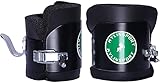
The KYLIN SPORT listing mentions abdominal crunches, sit-ups, bar hooks, therapy and a core gym exerciser, along with stress relief. It frames the product mainly as a fitness tool, and the sit-up focus means you hang and curl your torso toward your knees. It suits strong, experienced exercisers who already do hanging core work.
- Type: anti-gravity boots with bar hooks
- Marketed uses: abdominal crunches, sit-ups, core training, stress relief
- Number of hooks: confirm on listing
- Ankle size range and weight limit: confirm on listing
- Padding and strap details: confirm on listing
Fit note: inverted sit-ups raise heart rate and blood pressure more than a passive hang. Keep sets short, rest on the ground between them and never train alone.
Who should look elsewhere: anyone interested only in a gentle stretch should avoid boots and consider a table with an adjustable angle.
If you use the pair for crunches, keep your reps controlled and do not swing. Momentum loads the hooks suddenly, which is exactly when a worn strap or poorly seated hook can fail. Finish each set with a calm, planned descent to the floor rather than dropping out of the position when you are tired.
Pros:
- Aimed at core training
- Established listing in this category
Cons:
- Inverted crunches are a demanding exercise
- Specs are minimal in the name
Compared with the Sutekus, the focus is nearly the same, with a stronger therapy and stress-relief message.
4. TONYKO Anti Gravity Boots – Best for casual stress-relief hangs in a basic black design

TONYKO’s listing offers anti-gravity inversion boots in black for stress relief and fitness. The description is brief, and the stress-relief wording points toward short passive hangs rather than a workout. It suits someone who wants a simple pair and already has a bar mounted at a safe height.
- Type: anti-gravity inversion boots
- Color: black
- Marketed uses: stress relief and fitness
- Hooks, sizing and weight limit: confirm on listing
- Padding thickness: confirm on listing
Fit note: passive hangs are still strenuous on the ankles and the eyes. Begin with only a few seconds and lower yourself back down at the first sign of dizziness, headache or pressure in the face.
Who should look elsewhere: people who want exercise-specific guidance or a very detailed spec sheet will find more in other listings.
For a stress-relief session, the quiet approach is best: a few slow breaths while hanging briefly, then back to upright. Do not treat it as meditation that you hold for as long as it feels good, because the pressure in your head and eyes builds even when you feel relaxed. Set a visible timer so you do not lose track.
Pros:
- Straightforward concept
- Neutral black design
Cons:
- Limited specification detail
- Stress-relief claims should be treated cautiously
It is the plainest of the group, in contrast to the exercise-oriented KYLIN SPORT.
5. Sutekus Anti Gravity Boots – Best for abdominal training with a bar-hook setup
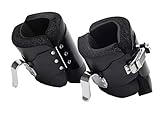
The Sutekus listing is built around ab crunches, abdominal sit-ups, bar hooks, therapy and a core gym exerciser. Like the KYLIN SPORT, it is positioned for hanging abdominal work. The language is oriented toward athletes, so it is best for people who already train on a pull-up bar and want to add an inverted variation.
- Type: anti-gravity boots with bar hooks
- Marketed uses: ab crunches, sit-ups, therapy, core work
- Hook count and rating: confirm on listing
- Size range and maximum weight: confirm on listing
- Strap and padding construction: confirm on listing
Fit note: treat the therapy wording with caution. Hanging inverted is not a proven treatment, and it is unsuitable for many conditions. The exercise application is more defensible than the medical one.
Who should look elsewhere: anyone with high blood pressure, glaucoma, heart disease, or similar issues should not use any boots without medical clearance.
Pair these boots with a solid training plan, not just a bar. A strong grip, good shoulder mobility and the ability to do controlled hanging leg raises from the ground up make the inverted version safer. If you cannot yet hold a dead hang for half a minute, build that first before trying to flip upside down.
Pros:
- Core-focused design
- Hook-and-bar setup is standard
Cons:
- No specs in the name
- Therapy claims are not backed up in the listing
It is functionally a sibling of the KYLIN SPORT.
6. NYXOVA Gravity Inversion Boots – Best for core work with decompression-style hangs

NYXOVA’s listing names two hooks, anti-gravity hanging foot supports, core strength, ab crunches, back pain relief and spine decompression. Its marketing covers both exercise and a perceived stretch for the spine, but the evidence for pain relief from hanging by the ankles is limited. As equipment it is similar to the others; the difference is the combination of core and decompression wording.
- Type: gravity boots with two hooks and foot supports
- Marketed uses: core strength, ab crunches, back pain relief, spine decompression
- Padding, size range and weight limit: confirm on listing
- Hook rating and bar compatibility: confirm on listing
- Included accessories: confirm on listing
Fit note: spinal decompression claims are not guaranteed. If you have a known disc problem or back pain, ask a clinician before hanging upside down, and consider an adjustable-angle table as a more controlled alternative.
Who should look elsewhere: shoppers whose main goal is back pain should read the safety section of this guide first.
If your main reason for buying is a sore back, treat these boots as an exercise tool first and a stretch second. Gentler options such as walking, floor-based mobility work or a table with an adjustable angle let you control the load on your spine. Discuss any plan with a clinician who knows your history, especially if you have disc problems.
Pros:
- Two hooks as stated
- Broad exercise and stretch positioning
Cons:
- Back pain claims go beyond what boots can promise
- Specs not shown in the name
It differs from the AMGSH mainly through its decompression and back-pain messaging.
Specs Compared
| Product | Hooks | Marketed focus | Color | Weight limit and sizing |
|---|---|---|---|---|
| AMGSH Gravity Boots | 2 hooks | Core and gym fitness | Confirm on listing | Confirm on listing |
| FLKQC Gravity Inversion Boots | 2 hooks | Anti-gravity hanging | Confirm on listing | Confirm on listing |
| KYLIN SPORT Anti Gravity Boots | Confirm on listing | Ab crunches, sit-ups, stress relief | Confirm on listing | Confirm on listing |
| TONYKO Anti Gravity Boots | Confirm on listing | Stress relief and fitness | Black | Confirm on listing |
| Sutekus Anti Gravity Boots | Confirm on listing | Ab crunches, sit-ups, therapy | Confirm on listing | Confirm on listing |
| NYXOVA Gravity Inversion Boots | 2 hooks | Core, back pain relief, spine decompression | Confirm on listing | Confirm on listing |
How We Chose These
We started with the six inversion boots in the current catalog and read each listing name and specification field. Because boots carry real safety risk, we favored clear hook counts, clear intended use and wording that does not overpromise medical benefits. Most listings omit weight limits, sizing and hook ratings, so we flagged those as items to confirm rather than assuming values. For safety guidance we relied on the published warnings in a major manufacturer’s gravity boot manual and on general medical references about inversion. This is a research-based comparison, not a report of personal use.
What to Look For
The bar matters as much as the boots
A manufacturer manual for gravity boots warns against using a bar thicker than about 1.25 inches (3.2 cm), because oversized bars stress the hooks and can lead to failure. It also says the bar must be mounted high enough that your head hangs clear of the floor, and that the bar and its mounts should be weighted well before you trust them. A common approach is to have helpers hang from each side while bouncing, using a combined weight well above your own, before any inverted use. Use a rated, wall- or frame-mounted bar rather than a doorway bar that can pop loose.
Ankle fit, padding and hooks
Boots should wrap the ankle snugly so the foot cannot slide out, and the closure should be secure with no loose straps. Thick padding reduces pressure on the ankle bones and calf during longer hangs. Check the hook shape and rating, and make sure the hooks have a latch or a design that prevents them from slipping off the bar. Replace the pair if you notice cracks, frayed stitching or a bent hook.
Who should not use inversion boots
Inverting raises blood pressure, slows the heart rate and increases pressure in the head and eyes. People with high blood pressure, heart disease, a history of stroke, glaucoma or other eye conditions, ear infections, hernia, osteoporosis, fractures, or who are pregnant, should avoid it unless a clinician approves. Some medications, including blood thinners, make inversion unsuitable. The manufacturer manual also advises obtaining physician approval before use. When in doubt, skip inverted hanging altogether.
Time limits and a worked example
Short sessions are safer. A reasonable beginner plan, once cleared by a clinician, is to hang for only a few seconds, return upright and rest, then slowly build to a minute or so over weeks, never to prolonged hangs. Older research suggests that blood pressure can rise to high levels after two to three minutes inverted. Example: on day one, hang for five seconds, rest a minute, repeat twice; add a few seconds each session only if there is no dizziness, headache or eye pressure. Always have a spotter nearby.
Boots versus an inversion table
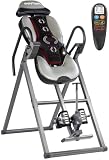
A table lets you choose an angle, such as 20 or 40 degrees, rather than going fully upside down, and you can leave the position by shifting your weight. Boots require you to enter and exit by hand and offer only a full hang, so they demand more strength and carry a bigger fall risk. For general back stretching, a table or even floor-based routines are usually more manageable.
One more consideration is where you will hang. Garage ceilings, basement beams and tree branches are common choices, but only a bar that is designed for dynamic body loads belongs in this job. Check the mounting hardware, the stud or beam it is fixed into, and the clearance for your head and arms. A padded floor mat reduces injury if you drop out of the boots, and a clear zone of several feet around you keeps a fall from turning into a collision with equipment. Never practice inverted hangs when you are tired, dehydrated or alone.
Finally, think about what happens after a hang. Coming down too quickly from an inverted position can cause lightheadedness, so lower your hands or pull yourself up slowly, rest for a minute and stand carefully. Keep your phone within reach and tell someone at home when you plan to hang. If you ever notice chest pain, severe headache, vision changes or numbness, stop and seek medical help immediately.
Questions
Are inversion boots safe?
They can be used safely by healthy, fit adults with proper equipment, a spotter and medical clearance, but they carry real risks. Falls, ankle injuries and spikes in blood pressure are among the main concerns.
Do gravity boots relieve back pain?
Evidence is limited and mixed. Some people report a temporary feeling of relief after short hangs, but hanging by the ankles is not a proven treatment, and it can worsen some conditions.
How long should I stay inverted?
Start with seconds, not minutes, and stay well under two to three minutes. Longer hangs can raise blood pressure and cause discomfort in the head and eyes.
What kind of bar do I need?
Use a sturdy, properly mounted horizontal bar no thicker than the boot manufacturer allows, commonly around 1.25 inches. Doorway bars that rely on friction are a poor choice for inversion.
Can I do sit-ups in inversion boots?
Many people do, and several of these listings promote it. It is an advanced exercise that stresses your grip, hooks and cardiovascular system, so build up slowly and use a spotter.
Should I choose boots or an inversion table?
If your goal is a controlled stretch, a table with adjustable angles is usually easier and safer. Boots suit people who already train on a bar and want a fitness tool.
Update History
- October 20, 2026 – Initial publication; product set drawn from current catalog listings.
- Check the product page for current specifications and availability before buying.
Sources
- Retailer listing titles and specification fields for all six boots
- Published safety warnings from a manufacturer’s gravity boot owner’s manual
- General medical reference material on inversion therapy risks and contraindications

Write Your Review
No reviews yet. Be the first to share your experience!