

Key takeaways
- Ball or standard round head: the most versatile option for thighs, glutes, calves, and shoulders.
- Soft or air-cushioned head: useful when a standard ball feels too intense or for areas close to joints.
- Bullet head: narrow and firm; use conservatively around small muscle areas rather than directly on bones.
- Wedge or scraper head: broad and useful for sweeping across shoulder blades or larger muscle surfaces, without pressing into the spine.
- Fork head: designed to pass around a muscle or tendon; it still should not be dragged directly over the spine or other bony structures.
- Flat head: spreads pressure across a broad area and can be a comfortable general-purpose alternative.
Best Massage Guns for Muscle Recovery
The best massage guns for everyday recovery are the Hyperice Hypervolt 2 Pro for high-force full-body work, the Therabody Theragun Mini 3rd Gen for portability, and a mid-range model such as the Ekrin Athletics B37S for balancing power, battery life, and price.
A massage gun is most useful when its specifications match how you will use it. A runner who wants brief calf and foot sessions needs portability and a comfortable grip; someone sharing a device with a household may value battery capacity and interchangeable heads; a larger user working on glutes and hamstrings may notice stall force and amplitude more than the number of speed settings. The comparison below focuses on those practical differences rather than treating every model as interchangeable.
Our top picks
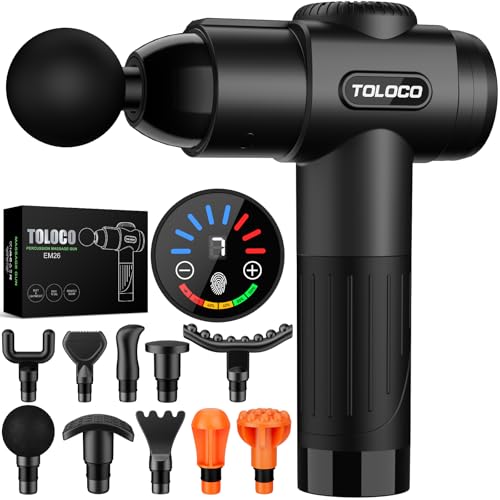
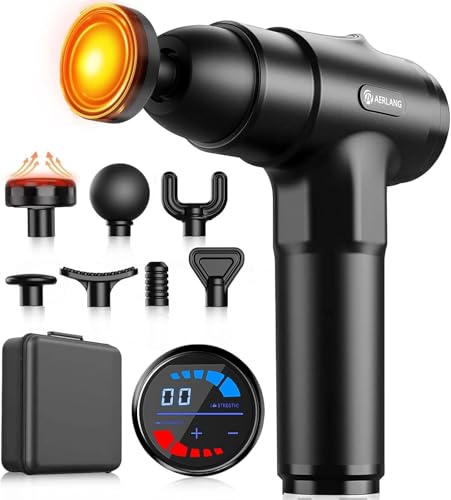


As an Amazon Associate we earn from qualifying purchases at no extra cost to you. Ratings are shown as listed on Amazon.
Quick comparison of leading massage guns
| Model | Approx. weight | Speed range | Amplitude | Battery life | Noise and portability | Typical market range |
|---|---|---|---|---|---|---|
| Hyperice Hypervolt 2 Pro | About 2.6 lb | 5 speeds, up to about 2,700 percussions/min | About 14 mm | Up to about 3 hours | Moderate; travel-friendly but substantial | About $250–$350 |
| Therabody Theragun PRO | About 2.8 lb | 5 speeds, up to about 2,400 percussions/min | About 16 mm | About 2.5 hours | Moderate; large and designed for deep sessions | About $450–$600 |
| Ekrin Athletics B37S | About 2.0 lb | 5 speeds, up to about 3,000 percussions/min | About 12 mm | Up to about 8 hours | Relatively quiet; easy to carry in a gym bag | About $150–$250 |
| Therabody Theragun Mini 3rd Gen | About 0.8 lb | 3 speeds | About 12 mm | Up to about 5 hours | Compact; some motor noise at higher speeds | About $160–$220 |
| Bob and Brad C2 | About 1.5 lb | 5 speeds, up to about 3,200 percussions/min | About 10 mm | Up to about 5 hours | Moderately portable and generally quieter than large high-force units | About $80–$130 |
Specifications can vary by revision, region, and measurement method. “Percussions per minute” describes motor speed, while amplitude describes how far the attachment travels into the body. A higher speed is not automatically a stronger or better massage: amplitude, stall force, attachment shape, and how much pressure you apply all affect the sensation.
Best overall for demanding full-body recovery: Hyperice Hypervolt 2 Pro
The Hypervolt 2 Pro is a strong all-round choice for people who regularly work on large muscle groups such as the quadriceps, glutes, hamstrings, and back. Its approximately 14 mm amplitude reaches deeper than many compact devices, while five speed levels make it possible to start gently and increase intensity gradually. The roughly three-hour battery rating is enough for many weeks of short personal sessions before recharging.
Its main compromise is size. At around 2.6 pounds, it is comfortable for short treatments but can become tiring when you are trying to reach your back or hold the device overhead. It also occupies more space than a mini model. Choose it when stall resistance and coverage matter more than carrying the smallest possible device.
Best for maximum amplitude: Therabody Theragun PRO
The Theragun PRO is aimed at users who want a substantial device with approximately 16 mm of amplitude, one of the deepest figures in this group. That extra travel can be useful for dense areas such as glutes and hamstrings, particularly when the device is used with controlled pressure rather than forced into the body. Its ergonomic multi-grip handle makes it easier to change hand positions and reach different areas.
The PRO is also one of the heaviest and most expensive options. Its roughly 2.5-hour battery life is adequate, but not exceptional relative to lighter competitors. It is a better fit for frequent home use, strength athletes, or a shared household than for someone who wants a device for occasional travel.
Best balance of price, force, and battery: Ekrin Athletics B37S
The Ekrin B37S sits between compact budget guns and large premium models. Its approximately 12 mm amplitude, five speeds, and long advertised battery life of up to eight hours make it practical for repeated weekly use. The angled handle can reduce wrist strain when treating the legs, and its lower weight is easier to manage than a professional-size unit.
Battery claims are usually based on intermittent operation at lower settings, not continuous use at maximum speed. Even so, the B37S is attractive for people who dislike frequent charging or who want one device for pre-exercise warm-up and post-exercise relaxation. It is a sensible choice when a premium model’s extra amplitude is not a priority.
Best travel option: Therabody Theragun Mini 3rd Gen
The Theragun Mini 3rd Gen is the clearest choice for portability. At about 0.8 pounds, it fits easily in a work bag, carry-on, or small gym compartment. Its approximately 12 mm amplitude is unusually substantial for a compact device, and the battery rating of up to five hours is ample for short sessions on calves, feet, shoulders, and hips.
The trade-offs are a smaller grip, only three speeds, and less leverage than a full-size massage gun. It is also not the easiest design for reaching the middle of your back. Pick it for convenience and regular short sessions, not for prolonged high-pressure treatment of the entire body.
Best lower-cost choice: Bob and Brad C2
The Bob and Brad C2 offers a useful set of features at a lower general market price: multiple speed settings, several attachment heads, a relatively light body, and a battery rated for up to about five hours. Its approximately 10 mm amplitude is less aggressive than the Theragun PRO or Hypervolt 2 Pro, which may be preferable for users who are new to percussive devices.
Budget models can vary more in motor refinement, charger quality, long-term battery performance, and replacement-part availability. The C2 makes sense when cost is the primary constraint, but confirm that the seller provides a suitable warranty and that replacement attachments or charging equipment can be obtained.
Choose by situation, not by the biggest number
| Your situation | What matters most | Better match |
|---|---|---|
| Daily home use on legs and glutes | Stall force, 12–16 mm amplitude, comfortable grip | Hypervolt 2 Pro or Theragun PRO |
| Frequent travel or a small apartment | Weight, size, USB or compact charging, adequate battery | Theragun Mini 3rd Gen |
| Several users sharing one device | Battery capacity, washable attachments, durable case | Ekrin B37S or Hypervolt 2 Pro |
| First massage gun on a limited budget | Adjustable speeds, basic attachment selection, warranty | Bob and Brad C2 |
| Hands and wrists tire easily | Lower weight and multiple grip positions | Ekrin B37S or Theragun PRO |
Understanding stall force, speed, and amplitude
Stall force is the amount of pressure a motor can tolerate before the head slows or stops. It matters most on large muscle groups, where users naturally press harder. However, a high stall-force rating does not mean you should apply maximum pressure. Excess force can make a session uncomfortable and can leave the area more irritated.
Speed range controls how quickly the attachment moves. Lower settings are generally easier for sensitive areas and a first pass; higher settings can feel more stimulating on large muscle groups. Amplitude is the depth of the attachment’s stroke. Longer amplitude may feel more intense, but it is not automatically appropriate for every body area or user.
For everyday recovery, start at the lowest comfortable speed and use light pressure for 30 to 60 seconds per muscle area. Keep the device moving rather than holding it in one spot. Avoid bones, the front of the neck, open wounds, areas of altered sensation, and recently injured or inflamed tissue.
Attachment types that are actually useful
- Ball or standard round head: the most versatile option for thighs, glutes, calves, and shoulders.
- Soft or air-cushioned head: useful when a standard ball feels too intense or for areas close to joints.
- Bullet head: narrow and firm; use conservatively around small muscle areas rather than directly on bones.
- Wedge or scraper head: broad and useful for sweeping across shoulder blades or larger muscle surfaces, without pressing into the spine.
- Fork head: designed to pass around a muscle or tendon; it still should not be dragged directly over the spine or other bony structures.
- Flat head: spreads pressure across a broad area and can be a comfortable general-purpose alternative.
Battery, noise, and ownership costs
Suppose you use a massage gun for 10 minutes, five days per week. That equals about 43 hours of use per year. A device advertised at three hours of intermittent battery life would need roughly 15 charging cycles annually, while an eight-hour model would need about five or six. The difference is not just convenience: fewer charging cycles may reduce wear on the battery over time, although battery longevity also depends on heat, storage, and charging design.
Noise is difficult to compare because manufacturers measure it at different distances and speeds. A device that sounds quiet at its lowest setting may be noticeably louder at maximum speed. If you use one while watching television or sharing a room, prioritize a lower-weight model with a refined motor rather than selecting solely by maximum percussions per minute.
The attachment heads and rechargeable battery are the parts most likely to affect ownership. Wipe attachments with a lightly damp cloth and mild soap, then dry them fully before storage. Do not submerge the motor housing. Keep vents clear, avoid dropping the device, and do not store it fully discharged for months. If the battery becomes swollen, unusually hot, or loses capacity abruptly, stop using the device and follow the manufacturer’s disposal guidance.
When a massage gun may not be appropriate
Massage guns are general wellness tools, not a substitute for diagnosis or treatment. Ask a qualified health professional before using one if you have a blood-clotting condition, take anticoagulant medication, have significant circulation or nerve problems, are recovering from surgery, or are unsure whether pain reflects an injury. Stop if you experience sharp pain, numbness, unusual swelling, or worsening symptoms. For most buyers, the best choice is the lightest device that provides sufficient force, a useful speed range, and a battery you will realistically maintain.





Write Your Review
No reviews yet. Be the first to share your experience!