

Key takeaways
- Choose the Hyperice Vyper 3 if you want strong vibration and firm pressure for frequent full-body use. Choose the Therabody Wave Roller if adjustable intensity, balanced texture, and household versatility matter most. Choose a compact three- or four-speed roller if you need a lower-cost option…
The best vibrating foam rollers depend on how much pressure you tolerate, how precisely you want to target a muscle, and whether you need a roller that can travel: the Hyperice Vyper 3 is the strongest all-round choice, the Therabody Wave Roller is the most balanced premium option, and a compact vibrating roller is better for smaller budgets and limited storage.
Our top picks


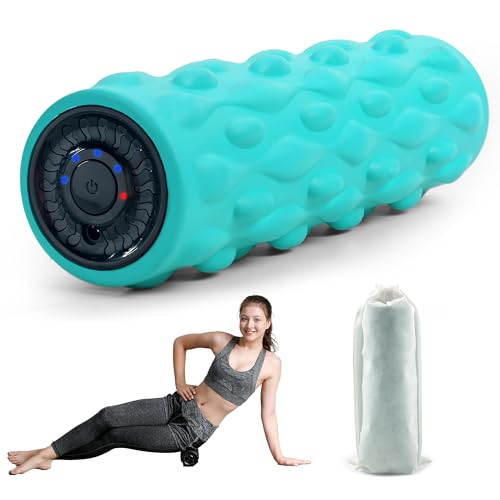
As an Amazon Associate we earn from qualifying purchases at no extra cost to you. Ratings are shown as listed on Amazon.
Best vibrating foam rollers at a glance
| Best for | Recommended type | Typical vibration | Foam and surface | Typical size | Typical battery life |
|---|---|---|---|---|---|
| Strong, frequent recovery sessions | Hyperice Vyper 3 | 3 intensity levels, high-output motor | Firm, grooved exterior | About 13 x 5.3 inches | About 2 hours |
| Balanced pressure and versatility | Therabody Wave Roller | 5 vibration settings | Medium-firm, ridged surface | About 12 x 5 inches | About 180 minutes |
| Budget-conscious home use | Entry-level vibrating roller | 3 to 5 settings | Medium-density foam, shallow ridges | About 12 x 5 inches | About 60 to 120 minutes |
| Travel and small apartments | Compact vibrating roller | 2 to 4 settings | Firm foam, smooth or lightly textured | About 11 x 4 inches | About 60 to 90 minutes |
Specifications vary by production revision and region, so check the current manufacturer listing before purchasing. Battery figures are commonly quoted as maximum runtime and can be lower at the highest setting.
Our picks by situation
Hyperice Vyper 3: best for powerful, full-body sessions
The Vyper 3 is the better choice when vibration intensity matters more than a soft, forgiving feel. Its firm grooved body creates noticeable pressure over the calves, quadriceps, hamstrings, glutes, and upper back. The larger diameter also increases leverage, which can make a slow pass feel more substantial than the same movement on a small roller.
Choose it if you train several times per week, prefer deep pressure, or want a roller that can cover large muscle groups efficiently. The trade-offs are price, weight, and a more assertive feel. Beginners may find the strongest setting excessive, particularly over tender areas.
Therabody Wave Roller: best overall balance
The Therabody Wave Roller offers five vibration settings, allowing more adjustment than many three-speed models. Its ridged exterior provides changing contact pressure without being as aggressively knobby as a massage ball or highly textured roller. That makes it a versatile option for alternating between gentle warm-up work and slower post-training passes.
It is a strong fit for households with different users, people who want fine control over intensity, and anyone who values longer quoted battery life. Its approximately five-inch diameter offers a useful middle ground: stable enough for the back and legs, but not so large that it becomes difficult to position.
Compact vibrating roller: best for portability and value
A compact roller with a 10- to 12-inch length and a four-inch diameter is easier to pack in a gym bag and store in a small room. These models usually have fewer speed settings and smaller motors, but that is not automatically a disadvantage. A lower-output device can be easier to control around the calves, shoulders, or other areas where a full-size roller feels unwieldy.
Prioritize a USB-C charging port, a removable or washable cover if available, and a stated battery capacity or runtime. Avoid choosing solely by the number of vibration modes: a stable motor, firm housing, and useful low setting matter more than decorative mode names.
What to compare before buying
Vibration intensity and speed settings
Intensity describes how much mechanical output reaches the roller surface; speed settings describe the available operating levels. A roller with five settings is not necessarily stronger than one with three. For most users, the useful range is a comfortable low setting, a moderate setting for large muscle groups, and a high setting for brief targeted work.
Look for a motor that does not noticeably slow when you apply body weight. Excessive rattling, stalling, or a hot housing after a short session can indicate poor construction. High intensity is not a substitute for good positioning: moving slowly over a moderate setting is often easier to control than holding a very powerful roller in one place.
Foam firmness and surface texture
Firm foam transfers more pressure and usually keeps its shape longer, but it can be unforgiving for new users. Medium-firm foam is the safer general-purpose choice if several people will share the roller. Soft foam feels comfortable initially but may compress permanently, especially under repeated use by heavier users.
Texture changes pressure distribution. Shallow ridges provide mild variation, larger grooves concentrate pressure along narrower bands, and pronounced knobs create more localized contact. A smooth or lightly textured surface is generally easier to control on sensitive areas, while a deeply textured surface suits users who already know how much pressure they can tolerate.
Diameter and coverage
A five- to six-inch roller offers more stability for the spine, hips, and legs. A four-inch model is easier to angle and carry, but it places more pressure on a smaller contact area. For a simple sizing rule, choose the largest diameter you can comfortably control: approximately five inches for general full-body use, or four inches if portability and precise positioning are priorities.
Battery and charging
Battery life is best evaluated in sessions rather than advertised hours. Suppose a roller provides 120 minutes of quoted runtime and you use it for 12 minutes per session. The theoretical maximum is:
120 minutes divided by 12 minutes per session = 10 sessions.
Allowing for high-speed use, battery aging, and time spent charging, planning on roughly seven to eight practical sessions is more realistic. If you use the roller daily, a 60-minute model may require charging every four or five days, while a 180-minute model may last two weeks or more at similar session lengths.
Portability
Check more than length. A roller can fit inside a suitcase yet be too heavy for comfortable travel. Compact models commonly weigh about 2 to 3 pounds; larger premium rollers may approach 4 pounds or more. A USB charging connection is convenient, but proprietary chargers can be easier to lose, so consider replacement availability before buying.
Decision matrix
| Your situation | Best specification to prioritize | Most suitable choice |
|---|---|---|
| New to foam rolling | Medium-firm foam, smooth or shallow texture, low setting | Balanced roller such as the Therabody Wave Roller |
| Frequent strength or endurance training | Strong motor, firm body, at least 2 hours of quoted runtime | Hyperice Vyper 3 or another high-output roller |
| Small budget | Reliable low and medium settings, USB charging, replaceable warranty coverage | Basic three-speed vibrating roller |
| Small living space or regular travel | 11 to 12-inch length, approximately four-inch diameter, under 3 pounds | Compact vibrating roller |
| Shared household use | Several intensity levels and a wipe-clean exterior | Medium-firm roller with four or five settings |
How to use a vibrating foam roller more effectively
- Charge the roller and begin on its lowest setting. This lets you judge pressure without committing to the strongest vibration.
- Support your weight with your hands or the opposite leg. More support means less pressure; shifting weight gradually increases it.
- Move at roughly one inch per second over broad muscle areas. Avoid repeatedly rolling directly over joints, the front of the neck, or the lower back.
- Pause briefly beside, rather than directly on, a particularly tender spot. Stop if you experience sharp pain, numbness, tingling, dizziness, or unusual symptoms.
- Limit each broad muscle area to a short pass rather than repeatedly attacking the same point. A complete session can often be kept to 8 to 15 minutes.
Vibration does not make aggressive pressure necessary. If a lower setting allows smoother movement and relaxed breathing, it is usually the more controllable choice.
Durability, cleaning, and ownership costs
The exterior foam or rubberized coating usually shows wear before the motor fails. Look for flattening along the contact surface, cracks near charging ports, loose end caps, and increasing noise. Store the roller away from direct heat and do not leave it in a hot car, where foam, adhesives, and battery components can deteriorate faster.
Wipe the surface with a lightly damp cloth after use and follow the manufacturer’s cleaning instructions. Do not immerse a powered roller or spray liquid into its charging port. Sweat, grit, and pet hair can collect in grooves, so a soft brush is useful for textured surfaces.
A more expensive roller can make financial sense if it lasts longer. For example, a $160 roller used three times weekly for two years provides approximately 312 sessions, or about $0.51 per use before electricity and replacement costs. A $70 roller used once weekly for the same period provides about 104 sessions, or about $0.67 per use. Frequency and durability matter as much as the initial price.
Final verdict
Choose the Hyperice Vyper 3 if you want strong vibration and firm pressure for frequent full-body use. Choose the Therabody Wave Roller if adjustable intensity, balanced texture, and household versatility matter most. Choose a compact three- or four-speed roller if you need a lower-cost option that is easy to carry and store. Whichever model you select, prioritize controllable low-speed performance, suitable foam firmness, credible battery information, and a warranty over the highest mode count.
Vibrating rollers are general fitness and recovery tools, not substitutes for diagnosis or treatment. If pain is persistent, worsening, associated with injury, or accompanied by neurological symptoms, consult a qualified health professional before using one.




Write Your Review
No reviews yet. Be the first to share your experience!