

Key takeaways
- Best Broadheads for Accurate Hunting The best broadheads for accurate hunting are usually compact fixed-blade heads for maximum tuning stability, while mechanical heads are the better choice when you want a larger wound channel from a well-tuned bow and primarily…
Best Broadheads for Accurate Hunting
The best broadheads for accurate hunting are usually compact fixed-blade heads for maximum tuning stability, while mechanical heads are the better choice when you want a larger wound channel from a well-tuned bow and primarily hunt medium-sized game.
Accuracy does not come from blade count alone. Broadhead diameter, ferrule alignment, total weight, blade strength, sharpening requirements, and the head’s effect on arrow flight all matter. The right choice also depends on your bow’s draw weight, arrow setup, shooting distance, and game regulations.
Our top picks



As an Amazon Associate we earn from qualifying purchases at no extra cost to you. Ratings are shown as listed on Amazon.
Fixed vs. Mechanical Broadheads: The Important Differences
| Characteristic | Fixed-blade broadhead | Mechanical broadhead |
|---|---|---|
| Typical cutting diameter | 7/8 to 1 1/4 inches | 1 1/2 to 2 1/2 inches when deployed |
| Common hunting weights | 100 or 125 grains | 100 or 125 grains |
| Penetration | Usually strongest for a given bow setup | Can be slightly lower because of blade deployment and wider cutting path |
| Flight tuning | May require careful spine, center-shot, and rest adjustment | Often flies more like a field point before impact |
| Blade maintenance | Sharpen or replace blades; inspect the ferrule | Replace or inspect blades, deployment bands, clips, and pivots |
| Best general use | Whitetail, elk, hogs, and higher-impact setups | Whitetail and similar-sized game when legal and adequately powered |
These are typical design ranges rather than universal specifications. Always confirm the exact weight, cutting diameter, blade material, and legal status of a particular model before buying.
When Fixed-Blade Broadheads Are the Better Choice
A fixed broadhead has blades that remain exposed from launch through impact. Because there is no deployment mechanism, energy is not used to open the blades, and there are fewer parts to fail. This makes fixed heads attractive for heavy-boned game, lower-poundage bows, and hunters who prioritize penetration over maximum entrance-hole diameter.
Compact fixed heads generally create less aerodynamic disturbance than large fixed heads. A two- or three-blade design with a ferrule around 7/8 to 1 inch wide can be easier to tune than a broad, multi-blade head. The trade-off is that exposed blades can reveal poor arrow flight. If a fixed broadhead groups several inches away from field points, the cause may be nock alignment, arrow spine, cam timing, rest position, or an imperfectly aligned insert rather than the broadhead itself.
Popular fixed-head designs include the Magnus Stinger, Slick Trick-style four-blade heads, and simple cut-on-contact two-blade heads. Choose a model with replaceable blades if you want lower long-term ownership cost. A one-piece or permanently sharpened head can be durable, but damage may require replacing the entire head.
Fixed blades and penetration
Penetration depends on more than the broadhead. Arrow mass, impact velocity, blade angle, ferrule shape, and shot placement all contribute. A narrow 100-grain fixed head on a properly spined arrow will often penetrate more reliably than a 2-inch mechanical head from the same bow, particularly on quartering shots or larger animals.
For elk, moose, large hogs, or any legal species with substantial shoulder and rib structure, many hunters choose a strong fixed head and an arrow with sufficient total mass. Verify minimum draw-weight, broadhead, and blade requirements in your hunting area.
When Mechanical Broadheads Make More Sense
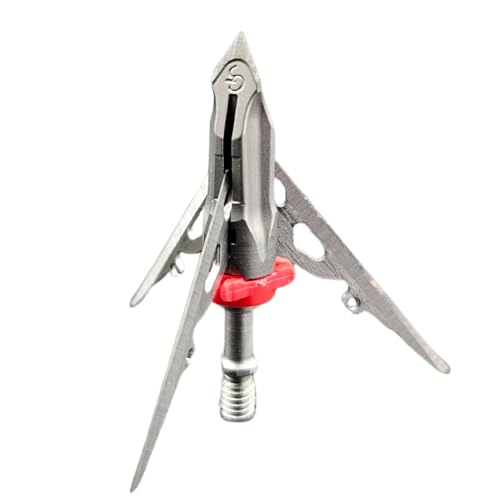
Mechanical broadheads keep their blades closed during flight and open on impact. Their smaller flight profile can make them easier to group with field points, especially for a compound-bow setup that is already tuned. Once deployed, the blades can produce a cutting diameter of roughly 1 1/2 to 2 1/2 inches, depending on the model.
This large entry wound can make blood-trail visibility better, but a larger cut is not a substitute for an ethical angle and accurate shot placement. Mechanical heads are most suitable for adequately powered bows and medium-sized game such as whitetail deer, provided local rules allow them.
Deployment reliability is the key ownership issue. Before hunting, inspect the retention bands, blade pivots, screws, and locking features. A damaged band or bent blade can affect opening. Practice only with the manufacturer’s designated practice head when required; repeatedly shooting hunting blades into targets can dull or bend them.
Rage is a well-known mechanical-broadhead brand, and many of its designs use replaceable blades and a deployment system that must be checked before each hunt. The exact cutting diameter and blade configuration vary by model, so compare the published specifications rather than assuming all mechanical heads perform alike.
Blade Diameter, Material, and Sharpening Needs
Diameter
A smaller diameter, such as 7/8 to 1 inch, normally creates less resistance and places less demand on arrow momentum. A larger diameter, such as 1 1/2 to 2 inches, can create a more substantial wound channel but may reduce penetration and increase the consequences of marginal energy or poor blade deployment.
Material
Most replaceable broadhead blades use stainless steel or hardened high-carbon steel. Stainless steel resists corrosion and is convenient in wet conditions; hardened steel can offer excellent edge retention but still needs drying and protective storage. Ferrules may be stainless steel, aluminum, or other lightweight alloys. Aluminum reduces weight but can deform if it strikes bone, rock, or a hard target frame.
Sharpening
Replaceable blades are usually the simplest option for consistent maintenance. A sharpening stone, guided sharpener, or purpose-built broadhead sharpener can restore a fixed blade, but the bevel must remain even on both sides. Do not sharpen while holding the head loosely in your hand. Use a secure tool, wear cut-resistant gloves, and protect the edge during transport.
A practical check is to inspect the edge under bright light. A shiny flat spot, rolled edge, burr, or nick indicates that the blade needs replacement or sharpening. Avoid testing sharpness with a finger.
Decision Matrix: Which Broadhead Fits Your Situation?
| Your situation | Recommended direction | Reason |
|---|---|---|
| New archer with a properly tuned compound bow | Compact fixed head or reliable mechanical | Start with a forgiving design and confirm broadhead-to-field-point grouping |
| Limited budget and frequent practice | Replaceable-blade fixed head | Blades can be replaced without discarding the ferrule |
| High-poundage bow, whitetail hunting, preference for large entry wounds | Mechanical around 1 3/4 to 2 inches | Large deployed diameter with a compact in-flight profile |
| Elk, large hogs, or heavy-boned game | Narrow, strong fixed head | Fewer moving parts and generally better penetration potential |
| Broadhead groups differently from field points | Do not switch designs first; tune the bow | Flight problems often originate in arrow spine, rest alignment, or timing |
| Wet or humid hunting conditions | Corrosion-resistant stainless design | Reduces maintenance demands, though drying is still necessary |
How to Tune and Inspect Broadheads Before Hunting
- Match the weight. Use the same point weight for practice and hunting arrows. A change from 100 to 125 grains changes front-of-center balance and may alter tune.
- Confirm arrow condition. Reject arrows with cracks, damaged nocks, loose inserts, or visibly bent shafts.
- Check ferrule alignment. Screw the head onto the insert and spin the arrow. Significant wobble suggests a seating, insert, ferrule, or shaft problem.
- Shoot at a safe distance. Compare broadhead groups with field-point groups at 20, 30, and 40 yards if your skill and range allow. Start close so a tuning error is not magnified.
- Correct the bow before blaming the head. Check center shot, rest position, nocking point, cam timing, and arrow spine with a qualified technician if needed.
- Inspect immediately before the hunt. Fixed blades should be sharp and secure. Mechanical heads should have intact retention components and blades that move as designed.
For example, if a 100-grain broadhead groups 3 inches left of field points at 30 yards, that is not a reason to compensate by aiming 3 inches right. A 3-inch difference at 30 yards can become a much larger error at longer range or under field conditions. Tune the equipment and confirm the result at several distances.
Ownership Costs and Common Mistakes
General market prices often range from about $25 to $60 for a multi-pack of fixed or mechanical broadheads, with replacement blades commonly costing less than a new set of complete heads. The lowest purchase price is not always the lowest cost per hunt: a durable ferrule with inexpensive replacement blades can be more economical for frequent hunters.
The parts most likely to wear are cutting edges, mechanical retention bands, pivot points, and ferrule threads. Store heads dry in a protective case, remove dirt after use, and do not leave blood or moisture on steel blades. Never shoot hunting broadheads into a standard practice target unless it is specifically rated for them.
For most hunters seeking the best broadheads for accurate hunting, start with a compact replaceable-blade fixed head if penetration, durability, and broad species suitability are priorities. Choose a mechanical head when your bow is well tuned, your target game is appropriate, local regulations permit it, and the larger deployed diameter is worth the added inspection and deployment requirements.

Write Your Review
No reviews yet. Be the first to share your experience!