

Key takeaways
- Compound bows: favor molded supports or adjustable straps around the riser and limbs, with a recessed area for cams.
- Recurve bows: use separators so limbs and riser do not rub against one another.
- Crossbows: require rail support and dedicated clearance beneath the scope.
- Arrows: use a rigid arrow tube or a protected arrow compartment rather than leaving shafts loose beside the bow.
The best bow cases depend on your bow style and travel conditions: choose a fitted hard case for air travel and maximum protection, a padded soft case for vehicle trips and storage, and a hybrid case when you want moderate protection without the weight of a full hard shell.
Our top picks


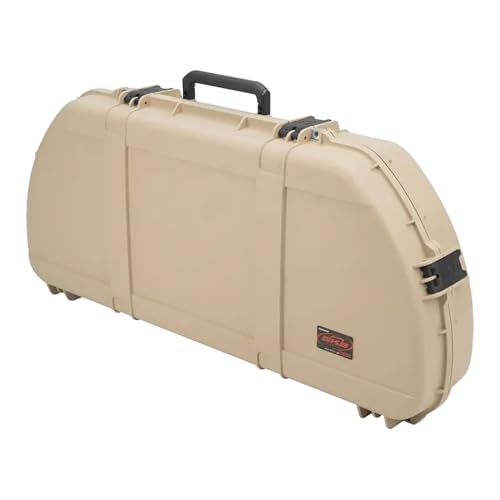
As an Amazon Associate we earn from qualifying purchases at no extra cost to you. Ratings are shown as listed on Amazon.
Quick picks by situation
| Situation | Best case type | What to prioritize | Typical market range |
|---|---|---|---|
| Frequent airline travel | Heavy-duty hard case | Lockable latches, wheels, crush resistance, tie-down points | $180–$450 |
| Weekly range or hunting trips by car | Structured soft case | Dense padding, adjustable straps, accessory pockets | $60–$180 |
| Compact recurve bow | Recurve-specific soft or slim hard case | Correct limb length, string clearance, arrow tube space | $35–$160 |
| Compound bow with sight and stabilizer attached | Deep compound hard case | Interior height, customizable foam, accessory clearance | $130–$350 |
| Crossbow transport | Crossbow-specific hard case | Rail support, scope clearance, cocking-device storage | $100–$300 |
| Occasional use and limited storage space | Foldable padded soft case | Low weight, collapsible construction, reinforced handles | $30–$100 |
Hard versus soft bow cases
Hard cases: the safer choice for impacts and air travel
A hard bow case uses molded plastic, reinforced polymer, or a composite shell to resist crushing, punctures, and concentrated impacts. It is the better choice when the bow will be checked on an airplane, placed beneath heavy camping equipment, or transported frequently in a crowded vehicle. Models from established case manufacturers such as SKB, Plano, and Pelican illustrate the main advantages of this category: rigid shells, replaceable or adjustable interior foam in some models, and hardware designed for repeated handling.
The trade-off is weight and bulk. A full-size hard case commonly weighs about 12–25 pounds before the bow and accessories are added. It may also be too deep for a compact closet or difficult to carry across a large venue. Wheels help, but small wheels can struggle on gravel, stairs, and uneven parking lots.
Soft cases: lighter, easier, but less protective
A soft case is usually made from polyester or nylon over foam padding. It is convenient for range visits, hunting-camp travel by car, and home storage. A typical soft case weighs 2–8 pounds, folds more easily, and often offers more exterior pockets than a rigid case.
However, soft fabric does not prevent a bow from being crushed. Padding also compresses over time, especially where a sight, cam, or stabilizer repeatedly presses against the same area. A soft case should not be treated as equivalent to a hard case for baggage handling or for transport under heavy cargo.
Bow compatibility comes before brand
Measure the bow in its actual travel configuration rather than relying only on the manufacturer’s advertised case length. For a compound bow, record the axle-to-axle length, total height with the sight installed, cam width, stabilizer length, and the space needed around cables and rests. If you remove the stabilizer or sight for transport, measure that configuration separately.
For a recurve bow, measure the longest limb and the riser, then allow room for limb pockets or separators. A take-down recurve can fit a much shorter case than a one-piece recurve. Traditional longbows need a case long enough to avoid bending the bow or forcing the string into an awkward position.
Crossbows need different interior geometry. Check clearance for the scope, crank or rope-cocking device, stirrup, limbs, and rail. A general compound-bow case may technically close around a crossbow while placing damaging pressure on the scope or limbs.
A practical fit calculation
Suppose a compound bow measures 36 inches from end to end in its travel setup, including the installed sight, and the case manufacturer lists 2 inches of interior padding on each end. The case should provide at least 40 inches of usable internal length: 36 inches for the bow plus 4 inches of end clearance. If the stated “case length” is the outside measurement, it may not meet that requirement. Always compare your measurements with the internal dimensions.
Interior padding and organization
Padding is useful only when it holds the bow securely. Look for closed-cell foam, dense layered padding, or adjustable blocks that prevent movement without compressing cams, limbs, or sight housings. A case with thick padding but no tie-downs can allow the bow to slide into the walls during transport.
- Compound bows: favor molded supports or adjustable straps around the riser and limbs, with a recessed area for cams.
- Recurve bows: use separators so limbs and riser do not rub against one another.
- Crossbows: require rail support and dedicated clearance beneath the scope.
- Arrows: use a rigid arrow tube or a protected arrow compartment rather than leaving shafts loose beside the bow.
Check whether the interior has enough height for your largest accessory. A case may fit the bow itself but fail to close after adding a quiver, stabilizer, or scope. Removable accessory trays are valuable because they let you customize the layout and make cleaning easier.
Arrow storage: convenience versus protection
Soft cases often provide a zippered arrow sleeve that is convenient but offers limited protection from bending. For carbon or aluminum arrows, a rigid tube or hard-sided compartment is preferable, particularly when the case will be stacked or checked for travel. Confirm the compartment’s usable length: many full-length arrows measure 28–32 inches, while broadhead protectors can add extra space.
Do not store broadheads loose in a fabric pocket. Use a secure broadhead case, keep points covered, and make sure sharp accessories cannot contact the bowstring, cables, or case lining.
Weather protection and locks
No fabric case is automatically waterproof. Water resistance comes from coated material, covered zippers, storm flaps, and sealed seams. These features help during a walk from a vehicle to a range, but they may not protect a bow during prolonged rain. A rain cover can add useful protection to a soft case, especially when the case has exposed exterior pockets.
Hard cases generally provide better water and dust resistance when they use a continuous gasket and robust latches. Look for a pressure-equalization valve if the case may experience altitude changes. For air travel or public transport, choose lockable latches that accept travel-compliant locks where applicable. A small padlock may discourage casual opening, but it does not make a case theft-proof.
Travel durability: what actually wears out
The first failures are often not the shell. On soft cases, expect wear around zippers, shoulder-strap anchors, bottom corners, and the fabric beneath the cams. On hard cases, wheels, hinges, latch hardware, and foam retention are common trouble points. A case with replaceable wheels or hardware can cost more initially but remain useful longer.
Estimate value by usage rather than purchase price. A $240 hard case used for 40 airline trips costs about $6 per trip before maintenance. A $90 soft case used for 100 local range visits costs $0.90 per visit, but replacing it after one crushing incident changes the calculation. The cheaper option is not necessarily economical when the consequences of damage are high.
Features worth paying for
- Adjustable interior: useful when you change sights, stabilizers, or quivers.
- Reinforced corners and base: important for cases placed on concrete or vehicle floors.
- Two carrying options: backpack straps help with soft cases; wheels and a telescoping handle help with heavy hard cases.
- Replaceable hardware: extends service life when wheels, latches, or straps fail.
- Dedicated accessory storage: prevents loose tools and releases from striking the bow.
- Moisture control: allows ventilation or drying after a wet trip instead of trapping condensation.
Common buying and packing mistakes
The most common mistake is choosing by external length alone. Internal width, depth, and clearance around accessories matter just as much. Another is overpacking the accessory compartment until the lid presses on the bow. Close the empty case gently and check that no zipper, latch, or foam block contacts a cam or sight.
Before each trip, inspect the string, cables, limbs, cams, and sight for contact marks. Secure arrows separately, remove loose batteries from electronic sights or rangefinders, and dry the case before storing it. Do not leave a damp bow sealed in a closed case overnight.
Final recommendation
Choose a hard case when the bow is checked, transported frequently, or exposed to crushing and bad weather. Choose a padded soft case for routine vehicle travel when low weight and easy storage matter more than maximum impact protection. For the best balance, select a structured hybrid or reinforced soft case with dense padding, adjustable retention, a rigid arrow compartment, and weather-resistant zippers.
The best bow cases are not the largest or most heavily padded. They are the cases whose internal dimensions match the bow, whose restraints prevent movement, and whose construction suits the actual journey.




Write Your Review
No reviews yet. Be the first to share your experience!