

Key takeaways
- Anchors: The frame should be secured according to the installation instructions, especially on compact or lightweight sets. Anchors should not leave protruding hardware at ground level.
- Protective surfacing: Grass and bare soil are not reliable impact protection. Plan for an appropriate depth of engineered wood fiber, rubber mulch, rubber tiles, or another surface recommended for the fall height.
- Guardrails and barriers: Elevated platforms need openings that prevent a child from easily falling through. Avoid improvised netting or modifications that create entrapment spaces.
- Covered hardware: Bolts, hooks, and fasteners should be recessed, capped, or otherwise protected from clothing snags and sharp contact.
- Flexible swing seats: Belt-style seats are generally more forgiving for younger users than rigid seats. Chains or ropes should be coated or designed to reduce finger pinch points.
- Non-slip access: Steps, climbing walls, and ladders need secure footholds and should remain usable when damp.
- Age-appropriate layout: A tall deck, monkey bars, or a fast slide may be unsuitable for toddlers even when the overall structure is marketed for a broad age range.
The best swing sets are the ones that fit your available fall zone, support every intended user with room to spare, and include age-appropriate safety features—not simply the set with the most slides and accessories.
Our top picks
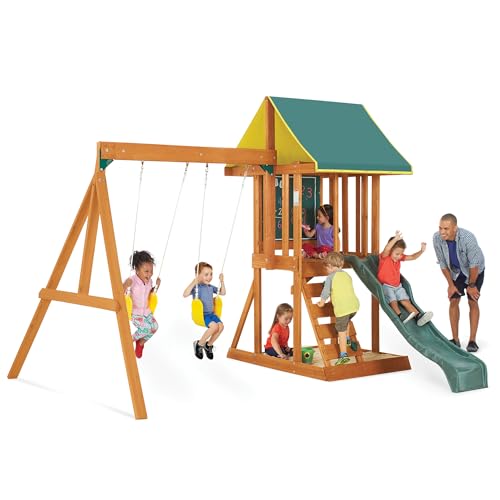
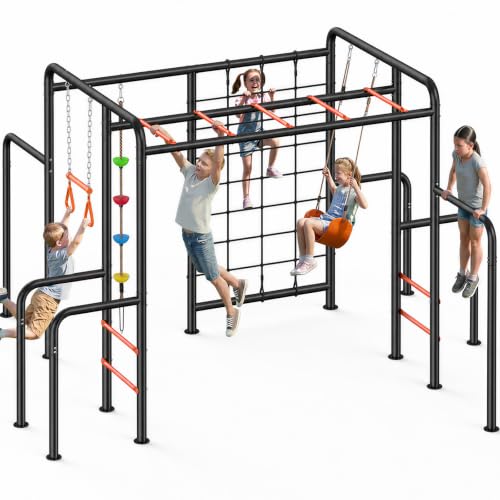


As an Amazon Associate we earn from qualifying purchases at no extra cost to you. Ratings are shown as listed on Amazon.
Quick picks by backyard and buying priority
| Situation | Best swing-set type | Typical footprint | Typical budget range | Why it fits |
|---|---|---|---|---|
| Small yard or younger children | Compact metal or wood set with two swings and a low platform | 8–12 ft wide by 8–10 ft deep | $250–$700 | Uses less space and is easier to supervise |
| Two or three children using it often | Mid-size wooden playset with three swing positions | 12–18 ft wide by 12–16 ft deep | $700–$1,800 | Balances capacity, play variety, and backyard footprint |
| Older children and frequent group play | Heavy-duty wood or steel set with a larger deck and climbing features | 16–24 ft wide by 14–20 ft deep | $1,500–$4,000+ | Provides higher capacity and more durable play components |
| Minimal maintenance | Powder-coated steel frame with molded seats | 8–16 ft wide by 8–14 ft deep | $300–$1,200 | Does not require staining, although hardware still needs inspection |
How to choose the best swing sets for your yard
1. Measure the entire safety zone, not just the frame
A swing set’s listed dimensions describe the structure, but children need clear space around it. Start with the manufacturer’s footprint, then add a safety area extending at least 6 feet beyond the play structure. The swing arc usually requires more room in front and behind the seats: a practical planning allowance is about twice the height of the swing beam in each direction.
For example, a set that measures 12 feet wide by 10 feet deep may need an overall play area of approximately 24 feet wide by 22 feet deep once side clearance and swing movement are included. Check the specific instructions before buying, particularly if the set includes a slide, climbing wall, or trapeze bar.
Keep the zone away from fences, sheds, tree trunks, retaining walls, pools, driveways, and other hard obstacles. Look upward as well: low branches and overhead utility lines can turn an apparently spacious yard into an unsuitable location.
2. Match weight limits to real household use
Look for separate limits for each swing, the platform, slides, climbing features, and the entire structure. Do not treat the advertised maximum as a comfortable everyday target. A useful planning rule is to keep routine loads below roughly 75% of the stated limit, leaving room for movement and uneven use.
Calculate the likely load rather than counting children. A swing occupied by a 60-pound child has a very different demand from one used by a 120-pound adult. If two children may share a platform, add their weights and allow for toys or a supervising adult only when the manufacturer expressly permits adult access.
Weight limits also change with age and component condition. A seat, rope, bolt, or wooden beam that has weathered for several years should not be assumed to perform like a new one.
Materials: wood, steel, or plastic?
| Material | Strengths | Trade-offs | Typical maintenance | Expected planning life |
|---|---|---|---|---|
| Pressure-treated or naturally durable wood | Stable appearance, quieter play, easy to integrate into a yard | Can crack, warp, fade, or develop rough areas | Inspect and clean twice yearly; stain or seal as specified | About 8–15 years with good care |
| Powder-coated steel | Strong frame, slim posts, low structural maintenance | Can become hot in direct sun; scratches may rust | Inspect coating, welds, fasteners, and rust spots | About 8–15 years, depending on coating and climate |
| Molded plastic | Low weight, smooth surfaces, generally simple cleaning | May fade or become brittle in intense sunlight and cold | Wash with mild soap; inspect for cracks and UV damage | About 5–10 years for major components |
These are planning ranges rather than guarantees. Coastal air, standing water, strong sunlight, freeze-thaw cycles, and poor drainage can shorten the life of any material. For wood, rounded edges and properly finished surfaces matter more than a particular stain color. For steel, look for capped tube ends, corrosion-resistant fasteners, and a coating without exposed sharp edges.
Safety features worth paying for
- Anchors: The frame should be secured according to the installation instructions, especially on compact or lightweight sets. Anchors should not leave protruding hardware at ground level.
- Protective surfacing: Grass and bare soil are not reliable impact protection. Plan for an appropriate depth of engineered wood fiber, rubber mulch, rubber tiles, or another surface recommended for the fall height.
- Guardrails and barriers: Elevated platforms need openings that prevent a child from easily falling through. Avoid improvised netting or modifications that create entrapment spaces.
- Covered hardware: Bolts, hooks, and fasteners should be recessed, capped, or otherwise protected from clothing snags and sharp contact.
- Flexible swing seats: Belt-style seats are generally more forgiving for younger users than rigid seats. Chains or ropes should be coated or designed to reduce finger pinch points.
- Non-slip access: Steps, climbing walls, and ladders need secure footholds and should remain usable when damp.
- Age-appropriate layout: A tall deck, monkey bars, or a fast slide may be unsuitable for toddlers even when the overall structure is marketed for a broad age range.
Follow the applicable manufacturer instructions and local safety guidance. Adult supervision remains important, but supervision does not replace proper surfacing, anchoring, or routine inspection.
Assembly time: budget more than the box suggests
Assembly is often the largest ownership surprise. A compact metal set may take two adults about 3–6 hours. A mid-size wooden playset commonly takes 8–16 hours, while a large multi-feature structure can require 16–30 hours spread over a weekend or more. Uneven ground, missing tools, sorting hundreds of fasteners, and weather can add substantial time.
A lower-risk assembly sequence
- Prepare the site first. Level the area, remove roots and stones, and decide where the protective surface and anchors will go.
- Inventory every part. Separate fasteners by size and compare them with the parts list before beginning.
- Build on level ground. Assemble major frames on a flat surface so twisting is not built into the structure.
- Leave fasteners slightly loose at first. Align the frame, confirm square corners, and then tighten in the sequence given by the instructions.
- Anchor before use. Do not let children climb on a completed-looking frame until every required anchor and protective cap is installed.
- Recheck after the first few uses. Wood can compress around bolts, and initial movement may reveal loose hardware.
Hiring assembly help can be sensible for a large wooden set, a sloped yard, or a family without two adults available for lifting. The cost is often lower than correcting a twisted frame or an incorrectly installed anchor.
Durability and maintenance realities
The parts that usually wear first are swing seats, ropes or chains, plastic handholds, slide surfaces, wooden steps, and exposed fasteners. Inspect high-use components monthly during the play season and perform a more complete inspection at least twice a year.
- Replace seats, ropes, chains, or connectors at the first sign of fraying, cracking, severe rust, or deformation.
- Sand and refinish rough wooden areas rather than allowing children to continue using them.
- Wash plastic and metal surfaces with mild soap; avoid harsh chemicals that may degrade coatings.
- Keep drainage clear so posts do not stand in wet soil.
- Retighten hardware only as instructed; over-tightening can crush wood or damage plastic components.
- Remove standing water, fallen branches, and slippery buildup from platforms and slides.
A common mistake is adding accessories without checking compatibility. Extra swings, a heavier glider, a rope ladder, or a homemade canopy can alter balance, clearance, and weight distribution. Use only approved accessories and stay within the structure’s stated capacity.
Best swing sets by buying priority
Best for a tight budget
Choose a compact two-swing metal set or a basic low wooden set, then reserve part of the budget for anchoring and protective surfacing. A cheaper structure installed over hard ground is not a safer purchase than a simpler structure with an adequate fall zone.
Best for growing children
Select a modular set with adjustable or replaceable swings, a platform with a moderate deck height, and a weight limit that leaves capacity for the next several years. Avoid paying for toddler-only features if the children are already approaching the upper age or height range.
Best for frequent family use
Prioritize a reinforced frame, three or more play positions, accessible replacement parts, and a generous platform. A larger set costs more and occupies more yard, but distributing use across several activities reduces crowding and may slow wear on any single component.
Best for low maintenance
A powder-coated steel frame with molded components is usually the simplest choice for families who do not want periodic wood sealing. Check the set for heat exposure, rust protection, and a replacement-parts policy before buying.
Final buying checklist
- Measure the yard, then map the complete fall and swing-clearance zone.
- Compare individual component limits, not only the total weight rating.
- Choose materials suited to your climate and maintenance habits.
- Confirm age range, platform height, and accessory compatibility.
- Budget for anchors, protective surfacing, delivery, tools, and possible assembly help.
- Check that replacement seats, ropes, caps, and hardware can be obtained.
- Plan a monthly visual inspection and a twice-yearly detailed maintenance check.
The right choice among the best swing sets is the one that leaves enough clearance, capacity, and maintenance margin for how your family will actually use it. A modest, well-anchored set with suitable surfacing is a better fit than a feature-packed structure that crowds the yard or exceeds the adults’ ability to assemble and maintain it.

Write Your Review
No reviews yet. Be the first to share your experience!