

Key takeaways
- The best exercise bikes for seniors are usually stable recumbent or semi-recumbent models with a low step-through frame, a supportive seat, simple resistance controls, and a display that can be read without leaning forward. For most older adults, a recumbent…
The best exercise bikes for seniors are usually stable recumbent or semi-recumbent models with a low step-through frame, a supportive seat, simple resistance controls, and a display that can be read without leaning forward.
For most older adults, a recumbent bike is the safest starting point because the wide base, backrest, and low seat position reduce the need to balance while mounting and riding. A compact upright bike can be a better choice when floor space is limited or when the rider is already comfortable stepping over a conventional frame.
Our top picks


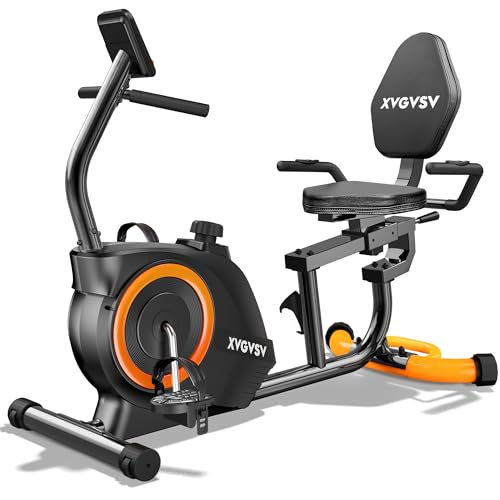

As an Amazon Associate we earn from qualifying purchases at no extra cost to you. Ratings are shown as listed on Amazon.
Best exercise bikes for seniors by situation
| Rider’s situation | Best bike type | Specifications to prioritize | Typical 2026 market range |
|---|---|---|---|
| Needs maximum stability or has balance concerns | Full-size recumbent | Wide base, backrest, 300–400 lb capacity, 8–16 resistance levels | $250–$900 |
| Wants easy access but has limited space | Compact semi-recumbent | Low step-through, 18–24 in. seat height, transport wheels, 250–350 lb capacity | $180–$600 |
| Already exercises and wants a more upright position | Upright magnetic bike | Adjustable handlebars, stable front and rear feet, 30–40 cm seat adjustment range | $200–$800 |
| Has very little room | Folding upright bike | Folded depth under 20 in., locking frame, wide stabilizer feet | $120–$400 |
| Wants gentle seated movement rather than intense workouts | Mini pedal exerciser | Weighted base, adjustable strap, nonslip feet, less than 20 lb | $40–$150 |
What to look for before choosing
1. Step-through access and a clear mounting path
A step-through frame has a low or absent top tube, so the rider does not need to swing a leg high over the frame. This matters more than a long list of preset workouts if getting on and off is difficult.
Look for at least 7–10 inches of unobstructed space between the floor and the lowest frame member, a seat that does not sit too far behind the pedals, and handlebars that can be reached without twisting. A recumbent bike should allow the rider to sit first and then place the feet on the pedals. If the bike has a center support bar, check whether it creates a trip hazard when approaching from the side.
2. Seat support and adjustability
A broad padded seat is not automatically comfortable. The more useful features are a firm backrest, a seat that locks securely, and enough fore-and-aft adjustment to keep the knee slightly bent when the pedal is farthest away. On a recumbent, the backrest should support the torso without forcing the shoulders forward.
As a practical fit check, sit in the intended riding position with the heel on the pedal. At the furthest pedal position, the knee should be nearly straight. With the ball of the foot on the pedal, it should remain comfortably bent rather than locked. If the seat cannot achieve this position, the bike is the wrong size even if its maximum user weight is high enough.
3. Smooth, low-impact resistance
Magnetic resistance is usually preferable for a senior-friendly bike because it changes gradually and does not require a friction pad pressing heavily against the flywheel. Eight resistance levels are enough for many casual riders; 12–16 levels provide finer adjustments for two people sharing a bike.
Do not select a bike solely because it offers a very high resistance setting. The useful question is whether level one feels easy to start and whether the transition between levels is smooth. A large, easy-to-turn resistance knob can be more practical than a small console button, particularly for riders with limited hand dexterity.
4. Balance, frame stability, and footprint
A heavy flywheel does not guarantee a stable bike. Stability comes from the entire frame, wide stabilizer bars, leveling feet, and a low center of gravity. For a full-size recumbent, allow roughly 65–75 inches of length and 25–30 inches of width. A compact bike may fit within 50–60 inches by 20–24 inches, but its shorter wheelbase can feel less planted.
Leave at least 24 inches of clear space on the easiest mounting side and about 12 inches behind the seat. If the rider uses a cane or walker, more room may be needed. Measure the usable floor area, not merely the place where the bike will stand; a bike that blocks a doorway or leaves no safe approach is not a good bargain.
5. Display readability and controls
The display should show time, speed, resistance, and distance in large, high-contrast characters. A backlit screen is useful in a room with uneven lighting. Test whether the console can be read from the normal seated position without leaning forward.
Simple controls are often better than a touch screen. Look for raised buttons or a prominent resistance dial, a clearly labeled start button, and a display that does not require a phone, subscription, or wireless connection for basic cycling. A tablet holder is convenient, but it should not cover the workout metrics.
Useful models and categories to compare
The Schwinn 230 Recumbent Bike is a recognizable full-size option with a low-entry layout, supported seat, and electronic resistance. Its larger footprint makes it more suitable for a permanent exercise area than a small apartment. Availability and exact console specifications can vary by production run.
The Sunny Health & Fitness SF-RB4616 is a compact recumbent-style option commonly considered when price and floor space are important. Before buying, confirm the current seat adjustment range and maximum user weight, since retailers may list different revisions.
The Marcy ME-709 is a budget-oriented recumbent design with a straightforward console and relatively simple operation. It can suit occasional use, but buyers should pay particular attention to seat fit, frame stability, and warranty coverage rather than assuming that a lower price means equivalent long-term durability.
For a conventional upright choice, consider models from established fitness brands such as Schwinn, Nautilus, or Sunny Health & Fitness. Choose the specific model only after checking its lowest seat height, handlebar reach, stabilizer width, and whether the display remains readable from an upright posture.
Decision matrix: which features deserve your money?
| Priority | Spend more on | Do not overpay for |
|---|---|---|
| Easy mounting | Low step-through frame, side handles, secure seat locking | Dozens of workout programs |
| Back comfort | Adjustable recline and ventilated, supportive backrest | Very heavy flywheel |
| Small room | Short footprint, transport wheels, accessible power cord | Large media screen |
| Frequent household use | Rigid frame, replaceable pedals, longer warranty | Decorative accessories |
| Simple operation | Large display and physical controls | App connectivity and online classes |
Setup steps that improve safety and comfort
- Position the bike on a hard, level surface. Avoid thick carpet, which can make the frame rock and interfere with leveling feet.
- Place the easiest approach side toward open space. Keep cords away from the walking path and use a rubber mat only if it does not create a raised edge.
- Set the seat before the first ride. With the pedal farthest forward, the knee should not be jammed against the handlebar; with the pedal farthest away, the leg should retain a small bend.
- Start at the lowest resistance. Pedal slowly for several minutes and increase resistance only if the motion remains smooth and controlled.
- Confirm the emergency plan. Know where the stop button is, keep a phone within reach if appropriate, and avoid riding when the bike is unstable or the rider feels unwell.
Ownership, maintenance, and common mistakes
The parts most likely to need attention are pedals, pedal straps, seat adjustment hardware, drive belts, and the plastic end caps on stabilizer feet. Wipe perspiration from the seat, handlebars, and frame after each use. Dust the flywheel housing and console with a dry or slightly damp cloth; do not spray cleaner directly into the display.
Check the pedals and visible bolts monthly, especially during the first few weeks when hardware can settle. A squeak may come from a loose pedal rather than a failing drive system. Do not use household oil on a sealed magnetic-resistance mechanism unless the manufacturer specifically permits it. Replace worn pedal straps promptly, and stop using the bike if the frame rocks, the seat slips, or the pedals bind.
For occasional use three times weekly, a $300 bike used for two years costs about $0.96 per session before electricity and maintenance: $300 divided by 3 sessions per week, 52 weeks, and 2 years. A more expensive model can be the better value if its easier access and better seat make regular use more likely.
Final buying recommendation
Choose a full-size recumbent when stability, back support, and easy mounting are the main concerns. Choose a compact semi-recumbent when space is limited but a low step-through remains essential. Choose an upright model only when the rider can safely mount it, maintain balance, and reach the controls without leaning or twisting.
Before purchase, verify the current dimensions, maximum user weight, seat range, warranty, and return policy for the exact model. If pain, dizziness, balance problems, or a medical condition affects exercise, ask a qualified healthcare professional or physical therapist for individualized guidance before beginning a routine.


Write Your Review
No reviews yet. Be the first to share your experience!